 ‧ Agnes Kazaryan ‧
March 14, 2026
‧ Agnes Kazaryan ‧
March 14, 2026  808 ‧
808 ‧
 0
0
More than half of all U.S. business activity now happens online – and that share keeps growing. If you have been sitting on an idea or wondering whether it is too late to start, the honest answer is: it is not. But the gap between a side hustle that earns $200 a month and a real business that replaces a full-time income is wider than most guides will admit.
The online business opportunities that actually work in 2026 are not secret – but choosing the right one for your situation makes all the difference.
This article gives you a straight breakdown of the most viable models available right now. You will find realistic earning ranges, honest effort levels, and a clear framework for picking the right starting point based on where you are today.
Quick answer: The best online business opportunities in 2026 include dropshipping, freelancing, digital products, affiliate marketing, and content creation. Earning potential ranges from $200–$500/month for beginners to $5,000–$15,000+/month for full-time operators who treat it like a real business.
What are online business opportunities?
An online business opportunity is any model that lets you generate income primarily through the internet – whether that means selling physical or digital products, offering services, building an audience, or creating systems that earn while you sleep.
What makes 2026 meaningfully different from even five years ago is accessibility. You no longer need a warehouse, a team, or years of experience to get started. The tools are there. The platforms are there. What you need is a clear model, the right platform, and consistent effort.
The global ecommerce market alone is expected to approach $7 trillion by the end of 2026. Social commerce is growing fast, AI tools have lowered the barrier to entry for almost every online model, and more consumers than ever prefer buying online.
That creates real, tangible opportunity for first-time entrepreneurs – but it also means the market is more competitive than it used to be. Picking the right opportunity matters more than it did five years ago.
The best online business opportunities share a few traits: low overhead, scalability, and the ability to operate from anywhere. Ecommerce, freelancing, and content-based models all fit that description – but they differ sharply in how quickly you can earn, how much effort they require upfront, and how far they can realistically scale. Understanding those differences is the starting point for making a smart choice.
How much can you realistically earn from an online business?
Most online business income figures you see quoted online are either top-performer ceiling numbers or cherry-picked case studies. The realistic range for someone starting out today – with no prior audience, no existing client base, and part-time hours – is $200–$800/month in the first 60–90 days.
That is not discouraging. That is just where most real businesses begin. Here is a straightforward comparison of the main online business models by effort and earning potential:
Ecommerce and dropshipping offer the widest earning ceiling of any beginner-accessible model. Freelancing and digital products work well for people with an existing skill set. Content creation and affiliate marketing take the longest to build but can become genuinely passive income over time.
One note on the upper figures: The high end of every range above reflects full-time operators who have been running their businesses for 12–18 months or more. In your first 60–90 days, treat $300–$800/month as a realistic benchmark – and build from there with consistent effort.
The other thing worth noting is scalability. Freelancing income is directly tied to your hours. Ecommerce, digital products, and affiliate marketing can all scale without proportionally increasing your workload – which is why so many experienced online entrepreneurs eventually move toward product or content-based businesses, even if they start with services.
Product-based online business models
Dropshipping
Dropshipping is one of the most popular online business opportunities for a reason. You sell products through your own online store, but a supplier handles storage and shipping on your behalf. You never touch the inventory. When a customer places an order, it goes directly to the supplier, who ships it to them. Your job is to find winning products, build a store worth buying from, and bring in customers.
This model works particularly well in 2026 because ecommerce platforms have become significantly easier to set up, product sourcing tools are more powerful than ever, and social commerce on platforms like TikTok Shop and Instagram has opened new discovery channels for independent stores. AI product research tools have also made identifying trending niches faster than it has ever been.
Earning potential: $500–$5,000/month within the first 3–6 months with consistent marketing effort and a well-chosen niche.
Why this works in 2026: The global ecommerce market continues to grow, and the barrier to entry has never been lower – a beginner can launch a fully operational store without holding a single product.
Print-on-demand
Print-on-demand (POD) follows a similar no-inventory logic as dropshipping – but instead of reselling existing products, you put your own designs on t-shirts, mugs, phone cases, and similar items. A POD supplier prints and ships each order only when it is placed, so there is no upfront stock to buy and no risk of unsold inventory sitting in a warehouse.
This works well for people with a design eye or a strong niche community. Margins are tighter than dropshipping, which slows scaling, but the startup cost is minimal and you retain full creative control. Platforms like Printful and Printify are the two most widely used fulfillment partners in 2026.
Earning potential: $200–$2,000/month for a focused niche store with consistent new designs added regularly.
Selling digital products
Digital products – templates, ebooks, courses, presets, spreadsheets, printables – are among the highest-margin items you can sell online. You create them once and sell them an unlimited number of times with no manufacturing cost. That is about as close to passive income as most online business models get.
The challenge is audience. Digital products tend to sell best when you already have some kind of following or when your content ranks well in search. If you are starting from zero, expect 3–6 months of consistent marketing work before the income becomes meaningful.
Earning potential: $300–$5,000/month once a product library is established and traffic is consistent.
Service-based online business models
Freelancing
Freelancing remains one of the fastest ways to earn money online – especially if you already have a marketable skill. Writing, graphic design, web development, video editing, SEO, social media management, and virtual assistance are all in consistent demand in 2026. Platforms like Upwork, Fiverr, and Toptal give you access to clients without needing to build your own audience first.
The downside is that freelancing income is linear. You earn when you work. There is no product selling for you while you sleep, and raising your rates takes time and a track record. That said, for someone who needs income in the next 30 days rather than the next 6 months, freelancing is hard to beat as a starting point.
Earning potential: $1,000–$5,000/month for established freelancers. Beginners can realistically reach $500–$1,500/month within 60–90 days with a focused pitch strategy on one or two platforms.
Productized services
A productized service is a freelance skill packaged into a defined, repeatable offer – “I will write 4 SEO blog posts per month for $800” rather than hourly billing. This model has grown in popularity because it makes selling easier, sets clear expectations for clients, and gives you something closer to predictable recurring revenue each month.
It works especially well for content writers, designers, and developers who want to move beyond project-by-project uncertainty without giving up service work entirely. Many productized service businesses eventually bring on subcontractors and operate more like small agencies.
Earning potential: $2,000–$8,000/month once you have 4–8 retainer clients in place. The ceiling grows as you bring in support.
Content and audience-based online business models
Affiliate marketing
Affiliate marketing means earning a commission by promoting other companies’ products. When someone clicks your link and buys, you earn a percentage of the sale. The income can become genuinely passive once a piece of content ranks consistently in search – but building to that point typically takes 6–12 months of consistent publishing and SEO work.
The most reliable affiliate marketers pick a specific niche, build a content hub around it (usually a blog or YouTube channel), and focus on ranking for purchase-intent keywords. Sites like Reddit and Trustpilot are useful for understanding what real buyers actually say about the products you might promote – and that kind of authentic research gives your content a credibility edge over generic reviews.
Earning potential: $100–$500/month in the first 6 months, scaling to $2,000–$6,000/month or more for established sites with consistent traffic.
Content creation and monetized channels
Building a YouTube channel, newsletter, podcast, or social media presence can generate income through ad revenue, sponsorships, memberships, and product sales. The challenge is that monetization thresholds take time – YouTube requires 1,000 subscribers and 4,000 watch hours before you can even apply for the Partner Program.
That said, content creation in 2026 benefits from a real structural advantage: audiences increasingly trust individual creators over brands. A focused niche creator with 10,000 engaged followers can often out-earn a generic channel with 100,000 because their audience is more targeted and their recommendations carry more weight.
Earning potential: $50–$500/month in year one. Well-established channels in profitable niches can earn $3,000–$10,000+/month through combined revenue streams including ads, sponsorships, and their own products.
Pro Tip: Do not chase multiple income streams at once. Pick one online business model, run it seriously for 90 days, and optimize based on what you learn before adding anything else.
Legal and ethical considerations for online businesses
Starting an online business is relatively straightforward in 2026 – but staying on the right side of platform policies, tax law, and consumer protection rules matters more than most beginner guides acknowledge. Getting this wrong early can mean account bans, fines, or having to rebuild from scratch on a different platform.
What to avoid absolutely
Fake reviews are one of the biggest risks. Whether you are selling on Amazon, running a dropshipping store, or building an affiliate site, fabricated social proof violates platform terms of service and – in many markets – consumer protection law. Amazon has pursued legal action against review manipulation operations, and Google can penalize sites that use manipulative tactics to inflate credibility.
Misleading income claims are another area to treat carefully. Telling potential customers or followers they can “earn $1,000 in a week” without qualification is not just ethically questionable – it can attract FTC scrutiny in the U.S. and equivalent regulators elsewhere. Always qualify income figures with realistic conditions and timeframes.
Key principle: Build your online business on claims you can substantiate and a product experience you would be happy to receive yourself.
What to do instead
Register your business properly. Most countries make this straightforward and affordable – a sole trader registration or LLC formation protects you personally and allows you to open a proper business bank account. For dropshipping and ecommerce specifically, check whether you need to collect sales tax in the markets you sell into. U.S. rules around nexus have evolved significantly in recent years and vary by state.
Disclose affiliate relationships clearly. The FTC requires that any material connection between you and a brand you promote is clearly disclosed to your audience. A simple note at the top of a review post is all it takes – and it builds trust with readers rather than undermining it.
How to choose the right online business opportunity for you
There is no single best online business opportunity – there is only the best one for your specific situation. Your available time, existing skills, startup budget, and income timeline should all factor into the decision. Here is a practical breakdown by reader profile to help you find your starting point.
Complete beginner
If you have no existing audience, no specialized skill, and limited startup capital, dropshipping is the most accessible path to your first real ecommerce income. You do not need to create a product, hold inventory, or have any prior business experience. The learning curve is real, but the model is transparent – your results depend directly on product selection and traffic, both of which are learnable. Expect 60–90 days before your store earns consistently, and treat that time as education, not failure.
Intermediate / part-time builder
If you already have a skill set – writing, design, marketing, development – freelancing or productized services are the fastest path to income in the next 30 days. In parallel, consider building a dropshipping store or an affiliate content site on the side. These take longer to pay off but create scalable income that is not tied to your hours, which is ultimately where you want to be.
Advanced / full-time goal
If your goal is to replace a full-time income within 12 months, ecommerce is the most realistic path for most people. A serious dropshipping operation – with a focused niche, a tested product range, and consistent paid or organic traffic – can reach $3,000–$8,000/month within that window. The key difference between a hobbyist and a full-time operator is treating every decision like a business owner, not a side hustler.
Whichever model you choose, the underlying formula is the same: pick one opportunity, commit to it for at least 90 days, measure what is working, and double down. The biggest mistake new online entrepreneurs make is switching models every few weeks when early results are slow. Slow early results are normal. Consistent effort is what separates the people who break through from the ones who do not.
AliDropship: Your complete all-in-one solution for starting dropshipping in 2026
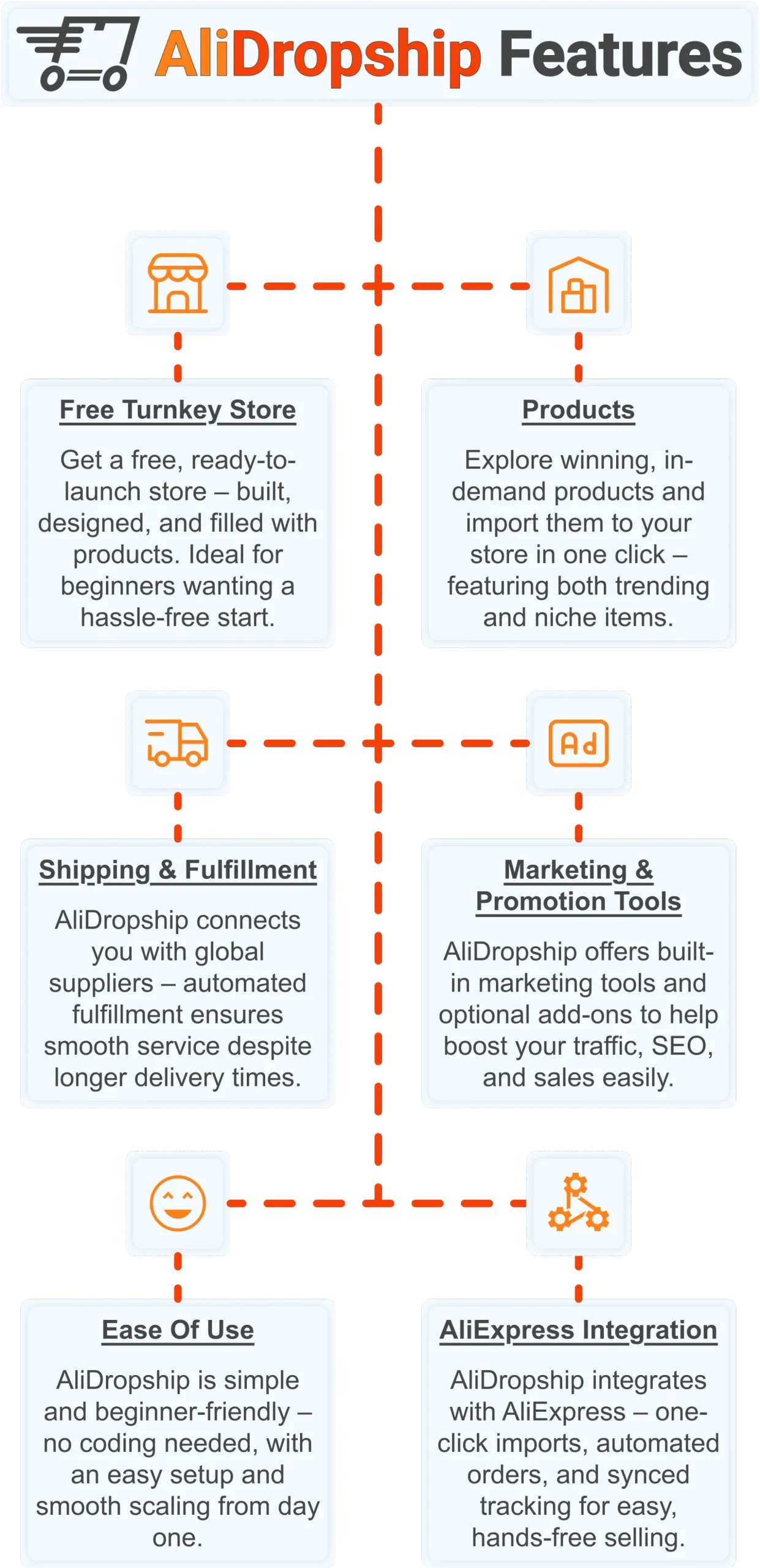
If you want the simplest possible way to start dropshipping – especially if you’re brand new – AliDropship remains one of the most beginner-friendly tools available in 2026. It brings together store creation, product imports, automation, and marketing into a single streamlined system designed to help you launch quickly and grow confidently.
Free turnkey store ️
Get a free turnkey store – built, designed, and filled with products. Ideal for beginners wanting a hassle-free start, the store comes fully optimized to attract customers right away, saving you time on setup. Plus, it includes professional design elements to give your business a polished, trustworthy look from day one. This ready-made foundation makes it easy to move seamlessly into product selection.
Products
Once your store is set up, you can explore winning, in-demand products and import them in one click – featuring both trending and niche items. This wide selection lets you cater to diverse customer interests and test what works best. Regular updates ensure you always have fresh products, keeping your store competitive and relevant. With great products in place, smooth shipping becomes the next essential step.
Shipping & fulfillment
AliDropship connects you with global suppliers, and automated fulfillment ensures seamless order processing despite international delivery times. Customers receive real-time tracking updates, which builds confidence and trust in your store. Once shipping is handled reliably, you can focus on promoting your store and attracting traffic.
Marketing & promotion tools
To maximize sales, AliDropship offers built-in marketing tools and optional add-ons that help boost traffic, SEO, and conversions. From email campaigns and discounts to social media integration, these tools empower you to reach and retain customers without needing prior marketing experience. With promotion strategies in place, managing your business becomes simpler and more efficient.
Ease of use
AliDropship is beginner-friendly – no coding needed, with an intuitive dashboard that guides you through every step. Easy setup and smooth scaling let you expand your store without stress. As your business grows, adding new features, products, and marketing campaigns remains hassle-free, giving you more time to focus on sales.
AliExpress integration
Finally, AliDropship integrates seamlessly with AliExpress, enabling one-click imports, automated orders, and synced tracking. Your inventory stays up-to-date with the latest products and prices, while automated order processing frees you from manual tasks. Combined with the turnkey setup, reliable shipping, and built-in marketing tools, this integration ensures your dropshipping business is fully equipped for growth and success.
Frequently Asked Questions
What are the best online business opportunities to start in 2026?
The strongest online business opportunities in 2026 include dropshipping, freelancing, digital products, affiliate marketing, and content creation. Dropshipping and ecommerce offer the widest earning ceiling of any beginner accessible model, with potential ranging from 500 to 15000 dollars or more per month. Freelancing suits people who already have a marketable skill and can realistically reach 500 to 1500 dollars within 60 to 90 days. The right opportunity depends on your available time, existing skills, and how quickly you need income.
How much money can you realistically make from an online business opportunity?
Someone starting from zero, with no existing audience or client base, can realistically expect 200 to 800 dollars per month within the first 60 to 90 days. Full time operators who have run their businesses for 12 to 18 months or more can reach the higher end of most ranges, often 5000 to 15000 dollars per month. Dropshipping tends to produce the widest ceiling, while content creation and affiliate marketing take the longest to build. Treating the first 3 months as a learning period rather than expecting immediate income leads to more realistic planning.
Is dropshipping still a good online business opportunity in 2026?
Dropshipping remains one of the most accessible online business opportunities because it requires no inventory and lets a supplier handle storage and shipping. Earning potential sits at 500 to 5000 dollars per month within the first 3 to 6 months for stores with consistent marketing and a well-chosen niche. Social commerce platforms like TikTok Shop have opened additional discovery channels that did not exist a few years ago. A serious operation with a focused niche can reach 3000 to 8000 dollars per month within about 12 months.
How does freelancing compare to other online business opportunities?
Freelancing is one of the fastest online business opportunities for generating income because it does not require building an audience first. Established freelancers can earn 1000 to 5000 dollars per month, while beginners can reach 500 to 1500 dollars within 60 to 90 days using a focused pitch strategy on one or two platforms. The tradeoff is that freelancing income is linear, meaning you earn only when you work. Productized services can push earnings to 2000 to 8000 dollars per month once 4 to 8 retainer clients are in place.
What online business opportunity has the lowest startup cost?
Print on demand and digital products carry some of the lowest startup costs among online business opportunities since there is no need to purchase inventory upfront. Print on demand stores can earn 200 to 2000 dollars per month once a niche is established, with suppliers printing and shipping only after an order is placed. Digital products such as templates and courses can be created once and sold an unlimited number of times, with earning potential of 300 to 5000 dollars per month once a library is built. Affiliate marketing also requires minimal capital but typically needs 6 to 12 months of consistent publishing before income becomes meaningful.
Of all the online business opportunities available in 2026, dropshipping with a ready-made store is the most accessible way to start earning without inventory, capital, or prior experience. Get your free turnkey store and a $100 voucher to start selling today.
 Previous post
