 ‧ Agnes Kazaryan ‧
March 14, 2026
‧ Agnes Kazaryan ‧
March 14, 2026  979 ‧
979 ‧
 0
0
The global recommerce market is worth $257 billion in 2026 and growing at nearly 10% year over year. That one number tells you something important: a reseller business is not a side hustle trend. It is a legitimate, scalable model that millions of people are quietly using to generate real income online.
Whether you are flipping thrift finds on eBay, running a white-label software operation, or building a branded dropshipping store from scratch, reselling gives you a low-barrier entry point into ecommerce that does not require you to manufacture a single thing.
But here is where most guides fall short. They lump every reseller business idea into one bucket, skip the honest earning figures, and never explain which model actually fits your situation.
This guide fixes that. You will get a clear breakdown of what a reseller business is, what the different models look like in practice, how much you can realistically earn at each stage, and what to watch out for before you invest time or money.
Quick answer: A reseller business is any model where you acquire products or services from a supplier and sell them to end customers at a markup. You do not need to create the product. Your job is to find buyers, deliver value through service or branding, and keep the margin in between.
What is a reseller business?
A reseller business is any operation where you purchase goods or services from a manufacturer, wholesaler, or platform and sell them on to a different buyer – typically at a higher price. The core mechanics are simple: find a product that has demand, source it at a price low enough to leave room for profit, and connect it with the people who want it. The reseller earns the difference.
What makes the model attractive in 2026 is how many different forms it takes. An online reseller might buy branded sneakers at retail and flip them on StockX. A software reseller might white-label a SaaS tool and sell it under their own brand.
A dropshipping store owner is technically a reseller too – they list products from overseas suppliers, collect payment from customers, and the supplier handles shipping. The product never touches the reseller’s hands.
The reseller business model is distinct from affiliate marketing (where you earn a commission, not a margin) and from manufacturing (where you produce the product yourself). It sits squarely in the middle: you own the customer relationship, you control the pricing, and you bear the commercial risk – which is also why the potential upside is much higher.
In 2026, the model is more accessible than ever. Platforms like eBay, Amazon, Poshmark, and AliExpress have removed most of the traditional barriers. You no longer need a physical store, a large upfront investment, or a warehouse. An internet connection, a supplier relationship, and a clear niche are enough to get started.
How much can you realistically earn from a reseller business?
The honest answer is: it depends entirely on the model you choose, the hours you put in, and how quickly you build systems that remove you from repetitive tasks. Most guides either overstate the ceiling or skip the nuance entirely. Here is a realistic breakdown based on current market data.
Part-time resellers across all models typically earn $500–$3,000 per month, while full-time operators with established systems report $4,000–$10,000 and above. The gap between those two figures is almost entirely explained by systems, not hours.
One note on ceiling figures: Six-figure reseller businesses exist, but they are the result of 2–4 years of consistent operation, reinvested profits, and tight process control – not a lucky product pick. Most people starting out should target $500–$1,500 per month in the first 90 days as a realistic, achievable milestone.
Full-time effort in a reseller business means treating it like a real job: consistent sourcing, active marketing, regular listing updates, and customer service. People who treat it casually and expect passive income in month one are the ones who quit early. The ones who build systems first, automate what they can, and choose a niche with genuine demand are the ones still running the business two years later.
Types of reseller business models worth considering in 2026
Not all reseller business ideas are created equal. Some require significant upfront capital; others let you start with almost nothing. Some involve physical logistics; others are entirely digital. Below is a breakdown of the main models, what each involves in practice, and where the real earning opportunity sits in 2026.
Physical product reselling
Thrift store flipping
This is where most people start. You source undervalued items from thrift stores, garage sales, estate auctions, or charity shops and resell them on platforms like eBay, Mercari, or Facebook Marketplace at a profit. The model requires no upfront infrastructure – just sourcing knowledge, a smartphone, and an account on a resale platform.
The critical skill here is product knowledge. Resellers who specialise in a narrow category – vintage electronics, branded sportswear, collectible toys, mid-century furniture – consistently outperform generalists. They know what to look for, what condition issues are acceptable, and what price the market will bear.
Active eBay and Mercari sellers in focused niches commonly earn $400–$1,500 per month on a part-time basis.
Earning potential: $400–$2,500/month part-time; $4,000–$7,000/month full-time with volume and niche focus.
Wholesale product resale
Rather than sourcing one item at a time, wholesale resellers buy in bulk from manufacturers or distributors and sell at retail margins across platforms like Amazon, eBay, or their own online store. The model has stronger margins per unit than thrift flipping but requires more upfront capital – typically $1,000–$5,000 to build initial inventory worth listing.
The advantage here is predictability. Once you have a reliable supplier and a platform listing that converts, you can scale volume consistently. The risk is inventory: if a product stops selling or gets undercut by a lower-cost competitor, you are holding stock.
That is why successful wholesale resellers keep their product catalogue narrow, test with small orders first, and avoid seasonal items until they understand the cycle.
Why this works in 2026: Supply chain normalisation post-2023 means smaller buyers can now access wholesale pricing that was previously reserved for larger retailers.
Branded goods and sneaker resale
A specialist sub-niche of physical reselling, this model focuses on limited-edition or high-demand branded goods – primarily sneakers, streetwear, and collectibles. Resellers use platforms like StockX, GOAT, and Depop, with margins that frequently exceed 30–80% on high-demand releases.
The barrier here is access. You need to win raffles, maintain relationships with retailers, and move quickly on restocks. The ceiling is real – top sneaker resellers report $2,000–$5,000 per month in profit – but so is the competition. This model rewards inside knowledge and fast execution above everything else.
Earning potential: $500–$5,000/month depending on access, release timing, and capital available to buy at retail.
Online reseller business models (no inventory)
Dropshipping
Dropshipping is arguably the most accessible reseller business model available in 2026. You build an online store, list products sourced from suppliers (typically AliExpress or a domestic wholesaler), and when a customer places an order, the supplier ships directly to them. You never touch the product. Your job is to run the storefront, manage marketing, and handle customer service.
The model works because you take on zero inventory risk. Margins are thinner than wholesale – typically 15–40% per sale – but the operational simplicity and low starting cost make it the go-to option for people building their first online reseller business.
Platforms like AliDropship exist specifically to automate this process, connecting your store to suppliers, syncing inventory, and handling order processing without manual input.
Why this works in 2026: Domestic fulfilment options have significantly improved delivery times, removing the biggest historical complaint about dropshipping – slow shipping.
White-label and software resale
In this model you license a product – usually software, a SaaS tool, or a digital service – from a provider and resell it under your own branding at a higher price. Web hosting resellers, AI tool resellers, and marketing platform resellers all operate this way. The appeal is recurring revenue: once a client subscribes, they tend to stay subscribed, meaning your income compounds over time.
AI reseller programs in particular have become a significant opportunity in 2026. Platforms offer 20–40% recurring commissions, and some pay up to 55% in the first year. The barrier is client acquisition – you need to consistently find businesses that need the underlying tool and cannot or will not source it directly.
Earning potential: $1,000–$8,000/month with a client base of 50–150 accounts; scales linearly as you add clients.
Digital product resale
Some resellers focus exclusively on digital goods – ebooks, templates, printables, online courses, and stock assets. You acquire a licence to resell these products (or source PLR – private label rights – content), package them, and sell through platforms like Etsy, Gumroad, or your own site. Margins are extremely high because there is no cost of goods after the initial purchase.
The challenge is differentiation. Digital product markets are saturated in popular niches. Resellers who succeed here typically add genuine value through bundling, better presentation, or niche-specific targeting that competitors have not addressed.
Earning potential: $200–$3,000/month; highly variable and dependent on traffic and niche selection.
Reseller hosting and service-based models
Web hosting resale
You purchase bulk server resources from a hosting provider and subdivide them into individual hosting plans that you sell to clients under your own brand. This model is popular with web designers and digital agencies who want to add a recurring revenue stream to project-based income.
A solo freelancer managing 20–30 hosting clients can add $300–$600 per month in near-passive income. Agencies scaling to 100+ clients report hosting revenue contributing $2,000–$5,000 monthly.
Important note: The hosting resale market rewards reliability over price. Competing on cost against major providers is a losing strategy – compete on personalised support and bundled maintenance instead.
Print-on-demand resale
Print-on-demand sits at the intersection of reselling and custom products. You upload designs to a platform like Printful or Printify, which manufactures and ships items on your behalf when orders come in. Technically you are reselling the print service and adding design value on top. Margins are modest – typically $5–$15 per item – but the model requires zero inventory and zero upfront production cost.
Earning potential: $300–$2,500/month; scales with design quality, niche targeting, and volume of active listings.
How to start a reseller business: practical steps
Regardless of which model you choose, the starting framework is largely the same. The difference between resellers who gain momentum in the first 60–90 days and those who stall is almost always execution discipline, not idea quality.
Step 1 – Choose your model and niche first
The biggest mistake new resellers make is jumping straight to a product before deciding on a model. Your model determines your capital requirement, your logistics, your platform choice, and your margin structure. Nail that decision first. Then – within your chosen model – go narrow.
A reseller who focuses on vintage denim outperforms a general clothing reseller. A dropshipping store built around home gym equipment for small apartments outperforms a general fitness store. Specificity is your competitive advantage when you are starting out.
Step 2 – Validate demand before you source
Use sold listings on eBay or Amazon Best Seller Rank data to check that real people are buying the type of product you plan to resell. For digital and software models, check search volume using Google Keyword Planner or a tool like Ahrefs. The signal you are looking for is consistent, steady demand – not viral spikes that have already peaked.
Step 3 – Set up your reseller business infrastructure
For physical reselling, this means your selling accounts, shipping supplies, and a basic inventory tracking system (even a simple spreadsheet works). For online resellers running dropshipping stores, this means a proper ecommerce platform with supplier integration – not just a free marketplace account.
Marketplace accounts give you limited control over branding, pricing, and the customer relationship. Your own store changes that completely.
Step 4 – Price for margin, not for traffic
Underpricing is the most common early mistake. Most new resellers race to the bottom, assuming low prices drive volume. They do – but at margins too thin to sustain the business. Calculate your true cost per sale (product cost, platform fees, shipping, time), then price to leave at least 25–40% margin. If you cannot get that margin, the product or supplier is wrong, not the price.
Step 5 – Build systems and reinvest early profits
Every dollar of early profit that goes back into inventory depth, better product photos, or a faster listing workflow multiplies your output. Resellers who reinvest for the first 90 days consistently out-earn those who withdraw early. Set a personal rule: reinvest 70% of profit for the first three months, then reassess your income level and scale-up potential.
Pro tip: Cross-list on at least two platforms from day one. The same item listed on both eBay and Facebook Marketplace sells 40–60% faster than on a single platform, according to data shared by multi-platform resellers on Reddit.
Legal and ethical considerations for resellers
Running a reseller business is entirely legitimate, but there are specific legal and ethical lines you need to stay on the right side of – especially as your volume grows and the IRS or your local tax authority starts paying attention.
Tax obligations you cannot ignore
In the US, reselling income is taxable. Platforms including eBay, Poshmark, and Mercari are required to issue a 1099-K for any seller generating over $600 in annual sales on their platform. That means the IRS already has a record of your sales before you file.
The 1099-K reports gross revenue, not profit – so tracking your cost of goods (what you paid to source each item) is essential to avoid overpaying. Self-employment tax runs at 15.3% on net earnings, which surprises many first-year resellers who only budgeted for income tax.
Key principle: Keep digital records of every purchase and sale from day one – a simple spreadsheet or a purpose-built app is enough, and it will save you significant money at tax time.
What to avoid absolutely
Reselling counterfeit goods is a serious legal risk, regardless of where you sourced them. Knowingly listing fakes on any platform violates both platform terms and federal law in the US. The same applies to reselling items that infringe trademarks – including unofficial “inspired by” branded merchandise.
Grey-market goods (authentic items imported through unauthorised channels) exist in a legal grey zone that has resulted in account bans and legal action for resellers on Amazon and eBay.
Fake reviews – buying or trading positive feedback to inflate your seller score – violate platform terms universally and have resulted in permanent bans and, in some jurisdictions, consumer protection fines. Your reputation as a reseller is a long-term asset. Protect it.
What to do instead
Source from legitimate suppliers, keep receipts, and price your items to reflect their honest condition. If you are running a dropshipping business, vet your suppliers carefully – check that they do not ship counterfeit goods and that your product descriptions accurately represent what customers receive.
Transparency builds repeat business. In a recommerce market growing at nearly 10% per year, there is more than enough legitimate opportunity that no reseller needs to cut ethical corners.
How to choose your reseller business model by profile
There is no single best reseller business model. The right choice depends on your starting capital, time availability, risk tolerance, and long-term goals. Here is a clear breakdown by reader profile to help you make the right call.
Complete beginner – low capital, learning the basics
Start with thrift store flipping or dropshipping. Both models let you begin with under $200 and build product knowledge quickly. Thrift flipping gives you hands-on experience with sourcing, pricing, and customer communication.
Dropshipping removes the logistics entirely and lets you focus on the commercial side – finding what sells and building a store that converts. If you choose dropshipping, use a platform that handles supplier connections and order automation so your learning curve stays manageable.
Recommended target: $300–$800/month within 60–90 days.
Intermediate – some capital, part-time operation
At this stage you have enough disposable income ($500–$2,000) to test wholesale resale alongside a dropshipping store. Running both in parallel lets you compare margins and figure out which suits your workflow.
You can also start cross-listing systematically across two or three platforms, which meaningfully increases sell-through rate without adding much operational overhead. Most people at this stage should target $1,500–$3,000/month within six months of focused effort.
Advanced – full-time goal, building a scalable business
If your goal is a full-time online reseller business, the model that scales most cleanly is a branded dropshipping or white-label operation with your own domain, its own SEO presence, and a customer email list. These assets compound over time in a way that a marketplace account never does.
Full-time resellers who own their platform consistently outperform those who rent attention from third-party marketplaces. Expect 6–12 months to reach $4,000–$7,000/month, assuming consistent product testing, reinvestment, and a focused niche.
Frequently asked questions
What is a reseller business and how does it work?
A reseller business is any operation where a person purchases goods or services from a manufacturer, wholesaler, or platform and sells them to a different buyer at a markup. The global recommerce market is worth 257 billion dollars in 2026 and is growing at nearly 10 percent year over year. A dropshipping store owner is technically a reseller too, since they list products from suppliers and the supplier handles shipping. The model differs from affiliate marketing because a reseller earns a margin rather than a commission and controls the customer relationship.
How much can you realistically earn from a reseller business?
Part-time resellers across all models typically earn 500 to 3000 dollars per month, while full-time operators with established systems report 4000 to 10000 dollars or more. Thrift flipping on platforms like eBay or Mercari commonly earns 400 to 1500 dollars per month for active part-time sellers. White-label and software resale can generate 1000 to 8000 dollars monthly with a client base of 50 to 150 accounts. Most people starting out should target 500 to 1500 dollars per month within the first 90 days.
Which reseller business models require no inventory?
Dropshipping requires no inventory since suppliers ship products directly to customers, though margins run only 15 to 40 percent per sale. White-label and software resale involves licensing a product like a SaaS tool and reselling it under a personal brand, with AI reseller programs paying 20 to 40 percent recurring commissions. Digital product resale covers items like ebooks and templates, with earning potential of 200 to 3000 dollars per month. Print-on-demand resale carries modest margins of 5 to 15 dollars per item but requires zero upfront production cost.
What tax obligations apply to a reseller business?
Platforms including eBay, Poshmark, and Mercari are required to issue a 1099-K for any seller generating over 600 dollars in annual sales. The 1099-K reports gross revenue rather than profit, so tracking the cost of goods for each item sold is essential. Self-employment tax runs at 15.3 percent on net earnings, a figure that surprises many first-year resellers. Keeping digital records of every purchase and sale from day one helps avoid overpaying at tax time.
What legal risks should resellers avoid?
Reselling counterfeit goods is a serious legal risk regardless of where the items were sourced, and it violates both platform terms and federal law in the US. Grey-market goods, meaning authentic items imported through unauthorized channels, exist in a legal grey zone that has led to account bans on Amazon and eBay. Fake reviews used to inflate a seller score violate platform terms universally and can result in permanent bans. Sourcing from legitimate suppliers and accurately representing product condition protects a reseller reputation long term.
AliDropship: Your complete all-in-one solution for starting dropshipping in 2026
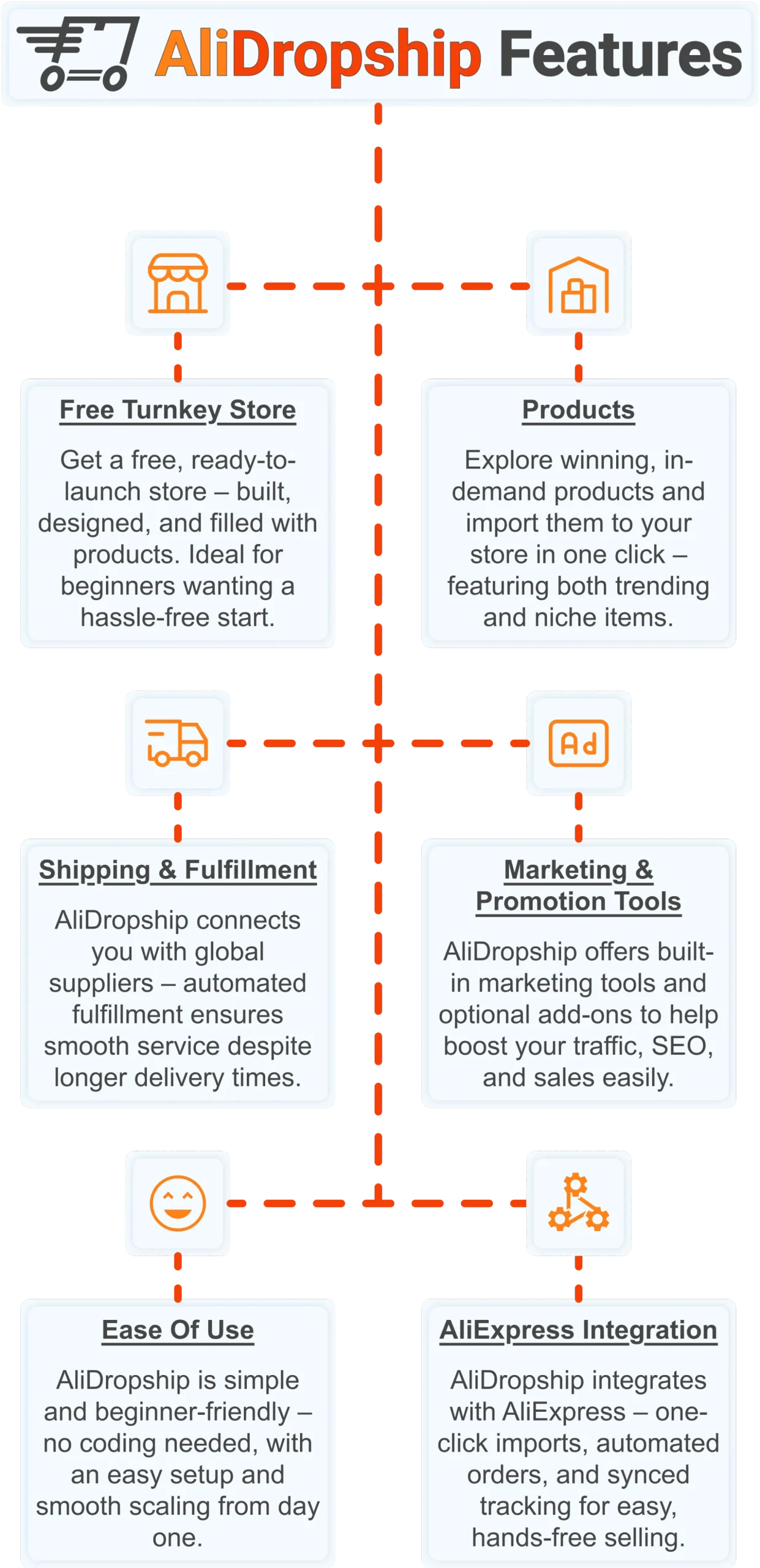
If you want the simplest possible way to start dropshipping – especially if you’re brand new – AliDropship remains one of the most beginner-friendly tools available in 2026. It brings together store creation, product imports, automation, and marketing into a single streamlined system designed to help you launch quickly and grow confidently.
Free turnkey store ️
Get a free turnkey store – built, designed, and filled with products. Ideal for beginners wanting a hassle-free start, the store comes fully optimized to attract customers right away, saving you time on setup. Plus, it includes professional design elements to give your business a polished, trustworthy look from day one. This ready-made foundation makes it easy to move seamlessly into product selection.
Products
Once your store is set up, you can explore winning, in-demand products and import them in one click – featuring both trending and niche items. This wide selection lets you cater to diverse customer interests and test what works best. Regular updates ensure you always have fresh products, keeping your store competitive and relevant. With great products in place, smooth shipping becomes the next essential step.
Shipping & fulfillment
AliDropship connects you with global suppliers, and automated fulfillment ensures seamless order processing despite international delivery times. Customers receive real-time tracking updates, which builds confidence and trust in your store. Once shipping is handled reliably, you can focus on promoting your store and attracting traffic.
Marketing & promotion tools
To maximize sales, AliDropship offers built-in marketing tools and optional add-ons that help boost traffic, SEO, and conversions. From email campaigns and discounts to social media integration, these tools empower you to reach and retain customers without needing prior marketing experience. With promotion strategies in place, managing your business becomes simpler and more efficient.
Ease of use
AliDropship is beginner-friendly – no coding needed, with an intuitive dashboard that guides you through every step. Easy setup and smooth scaling let you expand your store without stress. As your business grows, adding new features, products, and marketing campaigns remains hassle-free, giving you more time to focus on sales.
AliExpress integration
Finally, AliDropship integrates seamlessly with AliExpress, enabling one-click imports, automated orders, and synced tracking. Your inventory stays up-to-date with the latest products and prices, while automated order processing frees you from manual tasks. Combined with the turnkey setup, reliable shipping, and built-in marketing tools, this integration ensures your dropshipping business is fully equipped for growth and success.
A reseller business built on dropshipping gives you the margins, the branding control, and the scalability that marketplace flipping never will. Get your free AliDropship store and start building a real online reseller business today.
 Previous post
