 ‧ Agnes Kazaryan ‧
August 04, 2026
‧ Agnes Kazaryan ‧
August 04, 2026  295 ‧
295 ‧
 0
0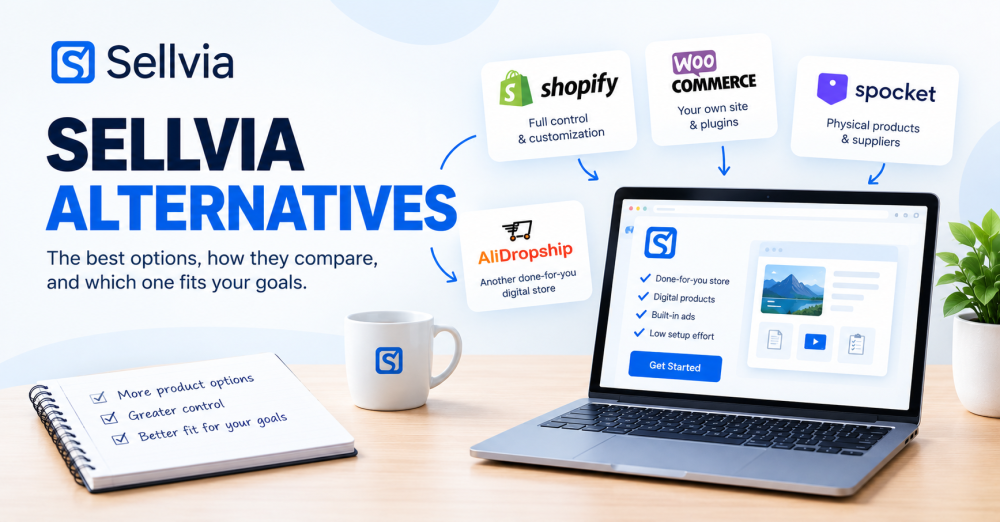
Quick Answer: The main Sellvia alternatives fall into three groups – other done-for-you digital stores like AliDropship, self-built platforms like Shopify and WooCommerce, and supplier-sourced physical product setups like Shopify paired with Spocket – and the right pick depends on whether you want a different done-for-you catalog, full control over your own site, or physical products instead of digital ones.
Sellvia is not the only way to start an online store, and it is not automatically the right fit for everyone – some sellers want more control over their storefront, a bigger product catalog to pull from, or a platform they can move to a different host down the road. This article walks through the realistic alternatives worth considering, what each one is actually built for, and how to think about which one matches your own goals.
None of the platforms below are inherently better across every use case – the differences come down to how much setup you want to do yourself, whether you want digital or physical products, and how much you value having someone else manage the technical side.
What are Sellvia alternatives, and when do you need one?
A Sellvia alternative is any platform that lets you launch and run an online store without Sellvia’s specific done-for-you setup – whether that means building your own site from scratch, installing a store plugin on a website you already control, or pulling products from a wider marketplace than Sellvia’s own catalog. People look for alternatives when they want a bigger product selection, want to own their own domain and hosting outright, or already have a website and just need a way to add a store to it.
How much can you realistically earn with a Sellvia alternative?
These figures are illustrative ranges tied to effort level, not typical or guaranteed results across any platform – actual earnings depend on your product choices, ad budget, and how much time you put into running the store.
Important note: It is possible to see a sale within your first week on any of these platforms. It is not accurate to say most sellers do on any of them, since none publish data on what a typical store owner earns.
Shopify
Shopify is the most widely recognized ecommerce platform, letting you build a fully custom store with your own design, apps, and payment setup. It gives you the most flexibility of any option on this list, since you control the storefront design and can add almost any app to extend it.
Where Shopify fits
Shopify works best for sellers who want long-term control over their brand and are comfortable handling more of the setup themselves – choosing a theme, connecting a supplier app, and configuring payment and shipping settings. It is a stronger fit if you already know roughly what you want your store to look like, rather than wanting one built for you.
What it takes to get started
Shopify’s base plan runs at a similar monthly cost to many done-for-you platforms, but the store itself starts empty – you add products through a separate supplier app, install your own theme, and handle marketing setup yourself. That extra flexibility comes with a steeper learning curve for someone who has never run a store before.
AliDropship
AliDropship is a separate done-for-you online business platform under the same parent company as Sellvia, giving you a pre-built store loaded with its own catalog of digital products – guides, courses, checklists, and a growing line of AI-powered toolkits that generate a personalized plan or guide for the buyer on the spot. The core setup mirrors Sellvia closely: a ready-made store, one-click ads, a 14-day free trial with a $40 ad coupon, and a $39/month plan afterward.
Where AliDropship fits
AliDropship suits sellers who specifically want to compare a different done-for-you catalog and brand against Sellvia’s, rather than sellers looking for a fundamentally different way of running a store. Its AI toolkits line is the clearest point of difference, since it generates a result tailored to each buyer instead of a static download.
What it takes to get started
Setup works the same way as Sellvia – sign up, choose which products to feature from AliDropship’s own catalog, and turn on the built-in ad system. There is no separate hosting, plugin installation, or product sourcing involved, since the whole store arrives pre-built.
WooCommerce
WooCommerce is a free, open-source store plugin for WordPress, giving you a store builder rather than a curated product catalog or fulfillment system. It pairs with separate supplier plugins if you want to add dropshipping-style product sourcing on top of it.
Where WooCommerce fits
WooCommerce works well for sellers who already have a WordPress site or want the lowest possible starting cost, since the core plugin itself is free. It requires more assembly than a done-for-you platform, since you are choosing your own theme, payment processor, and product source separately rather than getting them bundled together.
Spocket
Spocket is a supplier app that connects to Shopify, WooCommerce, and similar store builders, giving you access to a catalog of suppliers – many based in the US and Europe – with generally faster shipping times than overseas suppliers. It is a sourcing tool rather than a full store platform on its own.
Where Spocket fits
Spocket fits sellers who already have a store platform set up and specifically want faster-shipping physical products to sell through it. Some independent reviews note billing clarity and support responsiveness as recurring concerns, so read current user reviews directly before committing to a plan.
SaleHoo and directory-style tools
SaleHoo and similar directory tools give you a vetted list of suppliers to source from yourself, rather than a store or a fulfillment system. These fit sellers who want to build their own supplier relationships and are comfortable handling sourcing, negotiation, and logistics directly rather than through an automated system.
Legal and ethical considerations
Key principle: Whichever alternative you choose, be accurate with customers about expected shipping times and what a product actually is, since misleading claims create refund disputes and payment processor flags regardless of which platform you use.
What to avoid: presenting any platform’s typical results, shipping speed, or profit margins as guaranteed. What to do instead: test a small ad budget first on any new platform, track your actual numbers, and scale only once you have real data from your own store rather than relying on someone else’s results.
Final thoughts: Which Sellvia alternative fits you?
There is no single best alternative – the right one depends on how much setup you want to handle yourself and what kind of products you want to sell.
- Complete beginner: A done-for-you platform like Sellvia still removes the most setup steps; if you specifically want more control from day one, Shopify’s guided setup is the more beginner-friendly of the self-built options.
- Intermediate or part-time seller: If you want to stay in the same done-for-you model but try a different catalog, AliDropship’s own digital product line is worth comparing directly against Sellvia’s; if you specifically want to own your own site, WooCommerce paired with a supplier app is the better fit, at the cost of more setup and ongoing maintenance.
- Advanced or full-time goal: Combining a store builder like Shopify with a supplier app like Spocket, or running a self-hosted WooCommerce store, gives the most long-term flexibility for a seller who wants to scale a store on infrastructure they fully control.
Sellvia: Your complete all-in-one solution for starting an online business in 2026
If you want the simplest possible way to start an online business – especially if you’re brand new – Sellvia remains one of the most beginner-friendly platforms available in 2026. It gives you a fully built online store pre-loaded with digital products you can sell right away, plus one-click ads to help bring in buyers, so there is no design, coding, or product sourcing required to get started.
Prebuilt store, ready to sell
Sign up and your store arrives already built and pre-loaded with digital products you can sell immediately – no design, coding, or product sourcing required on your end. You choose which products to feature from the Sellvia catalog rather than creating your own. The store works from your phone or computer, so there is no separate software to install. With the store itself handled, running ads is the next step.
One-click ads built in
Instead of learning Facebook or Google Ads yourself, Sellvia’s built-in advertising system handles targeting, creatives, and optimization for you. You choose a daily budget of $10 to $50, and your store can start selling the same day you turn on ads. A $40 ad credit is included free during your trial, so you can test the system before spending your own money. Turning ads on gets your store in front of buyers – how much you sell from there still depends on your products and how you run things.
Digital products, no logistics headaches
Every product in the Sellvia catalog is digital – guides, courses, checklists, and similar tools created by Sellvia, not by you. There is no inventory, no shipping, and no warehouse involved, since each purchase is delivered to the buyer instantly. You keep 50 to 70% of each sale as your share, before ad spend, your monthly plan, and order fees. This removes the operational side that slows down most physical-product businesses.
Built for zero experience, zero tech skills
Every part of Sellvia is designed for someone who has never done this before – the dashboard works from a phone, the language stays simple, and a personal growth manager is available to answer questions as you go. There is no coding, design, or marketing background required to get your store live. This is one of the clearest differences between Sellvia and store-builder platforms like Shopify or Wix, which expect you to build, source, and market on your own. Once your store and ads are running, understanding the real costs is worth doing upfront.
A low monthly plan, costs shown upfront
Sellvia’s monthly plan costs $39, or about $1.30 a day, after a 14-day free trial that includes a $40 ad credit. During the trial the store itself is free to use; order fees only apply once a sale actually happens. After the trial ends, the $39 monthly plan continues automatically – you can cancel anytime before then with no charge. Beyond the base plan, ad spend, product packs, and other upgrades are separate costs worth budgeting for as you grow.
Backed by real recognition
Sellvia is a member of the Forbes Communications Council and the Entrepreneur Leadership Network, and it ranked 1,818th on the 2022 Inc. 5000 list of fastest-growing private companies. The platform has also picked up industry awards from TITAN, Hermes Creative Awards, MarCom, and dotCOMM. More than 1,500,000 stores have launched on Sellvia, and store owners have earned $1.5B+ in total. These are the kinds of independent, checkable signals worth looking for before trusting any online business platform.
If the setup and maintenance of the alternatives above feel like more than you want to take on right now, the done-for-you route is still on the table. Start your free Sellvia trial and compare it for yourself.
Free for 14 days with a $40 ad credit. $39/month after the trial. Cancel anytime before then – no charge.
 Previous post
