 ‧ Agnes Kazaryan ‧
March 14, 2026
‧ Agnes Kazaryan ‧
March 14, 2026  887 ‧
887 ‧
 0
0
Shopify vs Amazon – if you’ve been Googling ways to sell online in 2026, you’ve almost certainly landed on that question. Both platforms are real, both have created genuine success stories, and both get recommended constantly. But most comparisons skip the part that matters most for someone just getting started: the gap between what these platforms promise and what they actually deliver in your first year.
Quick answer: Shopify gives you full brand control and a flexible store builder, but you have to drive every visitor yourself. Amazon gives you access to hundreds of millions of active shoppers, but charges heavy fees and owns your customer data. Dropshipping with AliDropship gives you a fully built store, zero inventory risk, and a realistic path to income without needing to pick either expensive option.
This guide covers the real differences between Shopify vs Amazon – fees, learning curve, earning potential, and who each platform actually suits. Then it explains why a third path quietly outperforms both for most beginners in 2026.
Before the head-to-head, it helps to understand what these platforms were actually built to do. Shopify is a store builder. Amazon is a marketplace. They solve different problems – and that distinction matters more than most side-by-side comparisons ever acknowledge.
What is the Shopify vs Amazon debate really about?
At its core, the Shopify vs Amazon debate is about control vs convenience. Shopify hands you a blank canvas – you build, brand, and market everything yourself from scratch. Amazon hands you a pre-built audience already in buy mode, but sets the rules, takes a significant cut of every sale, and owns the relationship with your customer.
Neither platform is inherently better. They are different tools for different stages of a business. The problem is that most people asking this question are in the earliest days of thinking about selling online – and for that group, neither option is as beginner-friendly as the marketing materials suggest.
Shopify requires real marketing skills, a working ad budget, or an existing audience. Without traffic, even the most polished Shopify store earns zero. Amazon, on the other hand, has a steep learning curve around listing optimisation, pay-per-click ads, and constant competition from other sellers – including Amazon itself stocking competing products under its own private label.
Important note: This is not a knock on either platform. Both work. But the gap between “it works” and “it works for me as a complete beginner” is wide – and that gap is exactly where alternatives like dropshipping become worth examining seriously.
How much can you realistically earn?
Earnings on both platforms vary enormously depending on your product category, marketing investment, and consistency. The table below gives a realistic overview for someone working part-time on each model in their first 6–12 months.
These figures reflect realistic outcomes for part-time operators – not headline success stories. Most Shopify sellers without prior marketing experience see slow traction in year one. Amazon FBA can deliver solid results but requires meaningful upfront capital before a single sale is made.
One note on these figures: Reaching the higher end of any range typically takes 6–9 months of consistent effort, product testing, and traffic-building. No platform delivers passive income from day one.
Dropshipping sits in a compelling middle ground. Startup costs are near zero – especially with AliDropship’s free turnkey store – and the earning ceiling is real for sellers who find a winning niche and build consistent traffic over time.
Shopify: What it offers and where it falls short
Shopify is one of the most polished ecommerce platforms ever built. It gives you a professional store with customisable themes, a wide app ecosystem, and full control over your brand identity. If you already have an audience – on social media, YouTube, or through existing customers – Shopify is an excellent choice for monetising that audience with your own products.
What Shopify does well
Shopify’s core strength is flexibility. You can sell physical products, digital downloads, subscriptions, or services from a single dashboard. Payment processing, shipping integrations, and abandoned cart recovery are all built in. The app store contains thousands of add-ons covering everything from upsells and loyalty programmes to advanced SEO and email marketing automation.
For dropshipping specifically, Shopify works well when paired with apps like DSers or AutoDS. You can import products from AliExpress suppliers, set your own prices, and run a mostly hands-off fulfilment model. But you still need to build the store yourself, manage app integrations, and – critically – drive your own traffic from day one.
Where Shopify falls short for beginners
The biggest hidden cost of Shopify is not the monthly subscription – it is the advertising budget required to get any traffic at all. Shopify does not come with a built-in audience. You are starting at zero. Most beginners discover this after signing up, paying for a plan, and watching their store sit idle for months while they try to figure out Facebook Ads or TikTok marketing.
Add app costs, transaction fees if you use a third-party payment gateway, and the inevitable failed ad experiments – and Shopify’s real cost of entry is significantly higher than its $39/month base price suggests.
Earning potential: $500–$5,000/month with an established audience or ad spend; $0–$300/month for most complete beginners in the first 90 days.
Amazon: the marketplace giant and its real drawbacks
Amazon is the largest ecommerce marketplace in the world, with over 300 million active customer accounts globally. Selling on Amazon means instant access to shoppers who are already in buy mode – and that is a genuine advantage no independent store can match from a standing start.
Amazon FBA (Fulfilled by Amazon) takes it a step further. You ship inventory to Amazon’s warehouses and they handle packing, shipping, and customer service on your behalf. It sounds frictionless – and at scale, it largely is.
What Amazon does well
Amazon’s biggest advantage is trust. Shoppers trust Amazon at a level that independent stores take years to build. Conversion rates on Amazon listings are consistently higher than on most new independent stores because buyers already feel safe handing over their payment details. For sellers with unique or branded products, Amazon’s organic search volume can drive real revenue without a single paid ad.
Amazon also handles logistics at a scale no small business can replicate. Prime shipping, returns management, and customer support are all part of the FBA package – meaning once your product is in the warehouse, a significant portion of the operational workload disappears.
Where Amazon falls short for beginners
Amazon FBA has a high cost of entry that surprises most first-time sellers. You need to source physical inventory upfront – typically $2,000–$5,000 minimum for a viable first product run – before you make a single sale. Factor in Amazon’s referral fees (typically 8–15% per sale depending on category), FBA fulfilment fees, monthly storage fees, and pay-per-click advertising to boost visibility – and margins compress quickly.
More critically, Amazon owns the customer. You cannot email your buyers directly, build a retargeting list, or re-market to people who purchased. Every sale you make belongs to Amazon’s ecosystem. And if Amazon decides to stock a competing version of your product under its own private label, your listing visibility can drop overnight with no recourse.
Earning potential: $1,000–$10,000/month for experienced FBA sellers with a proven product and optimised listing; unpredictable and often below break-even for first-time sellers in the first 3–6 months.
Shopify vs Amazon fees: The real cost breakdown
Fees are one of the most searched angles in the Shopify vs Amazon debate – and for good reason. They are where real differences in profitability show up day to day. Here is what each platform actually costs once you move beyond the headline subscription price.
The headline numbers look similar – both platforms charge around $39–$40/month to get started. But the true costs diverge sharply once you factor in advertising, fulfilment, and inventory. Shopify becomes expensive through ad spend; Amazon becomes expensive through per-sale referral fees, storage costs, and upfront inventory risk.
Dropshipping sidesteps most of these costs entirely. No inventory means no storage fees. No upfront product orders means no capital at risk. And with AliDropship’s free turnkey store, even the subscription cost disappears from the equation – making it the most cost-efficient starting point of the three models.
Shopify vs Amazon for beginners: Which is easier to start?
The honest answer is that neither platform is as beginner-friendly as their marketing suggests. Both have real learning curves, and both carry financial consequences for the mistakes beginners inevitably make during the early phase.
Shopify’s interface is clean and intuitive enough to get a basic store live in a day. But going live is not the same as generating revenue. The skills required to drive organic traffic through SEO, or paid traffic through Meta and TikTok ads, take months – sometimes a full year – to develop to a profitable level. Many beginners spend more on apps and failed ad campaigns in their first 90 days than they earn back in sales.
Amazon’s Seller Central dashboard is considerably more complex. New sellers need to navigate listing optimisation, keyword research for Amazon’s internal search algorithm, inventory management at FBA warehouses, and a policy rulebook that can result in account suspension if violated – sometimes without much warning. The capital required to get started also means the stakes of early mistakes are financially meaningful.
Where dropshipping wins for beginners
Dropshipping removes the two biggest barriers to getting started: inventory risk and store setup time. With AliDropship, you receive a fully built store – professionally designed, stocked with products, and ready to promote from day one. There is no blank-canvas problem to solve and no inventory capital to raise before your first sale.
Your job from day one is to learn how to drive traffic and make sales – in the context of an already-live, already-stocked store. That is a fundamentally faster path to your first sale than either Shopify or Amazon FBA can offer a complete beginner.
Why dropshipping beats both for getting started in 2026
The Shopify vs Amazon comparison assumes you have to pick one of two expensive options. But the dropshipping model – especially with a platform like AliDropship – is a third path that removes nearly every barrier the other two introduce for first-time sellers.
Here is what dropshipping gives you that neither Shopify nor Amazon can match for a complete beginner:
- No inventory upfront – you only purchase a product after a customer has already paid for it. No capital at risk, no warehouse costs to manage.
- A ready-built store – AliDropship builds and delivers a fully functional store, so you start with something real instead of a blank template and hours of setup work.
- Full brand ownership – unlike Amazon, you own your customer list, your domain, and your brand identity from day one. No marketplace can undercut you or remove your store.
- Scalable income – once you find a winning product and a traffic channel that converts, dropshipping scales without the inventory bottlenecks that limit FBA sellers who have to reorder stock constantly.
The most realistic path to $30–$80/day in ecommerce income for a beginner in 2026 is not a $5,000 FBA product launch, and it is not a blank Shopify store waiting for ad dollars to kick in. It is a product-stocked, professionally built dropshipping store with low overhead and real room to grow.
Why this works in 2026: Global ecommerce continues to expand, with total online sales projected well past $6 trillion in the coming years. Dropshipping captures this growth without the capital requirements of traditional retail – making it one of the most accessible models for first-time sellers entering the market today.
For complete beginners
If you have zero marketing experience, zero audience, and limited startup capital, neither Shopify nor Amazon is the recommended starting point. The capital and skill requirements are real enough to cause most beginners to quit before seeing meaningful results. Dropshipping with AliDropship is the cleaner entry point – a live store, real products, and built-in tools, without having to figure out everything from scratch.
For intermediate sellers
If you already have some traffic – a social media following, a blog, or an email list – Shopify becomes a much stronger option. You can build a brand-owned store and drive that existing audience directly to it. Dropshipping still works well here as a fulfilment model, removing inventory risk while you test and scale product lines.
For advanced or full-time sellers
Experienced sellers with capital and a validated product have a genuine case for Amazon FBA. The fulfilment infrastructure and built-in audience justify the fees at scale. But even at this level, many successful Amazon sellers maintain a parallel independent store – precisely because they want to own their customer relationships and not be entirely dependent on a single marketplace.
AliDropship: Your complete all-in-one solution for starting dropshipping in 2026
If you want the simplest possible way to start dropshipping – especially if you’re brand new – AliDropship remains one of the most beginner-friendly tools available in 2026. It brings together store creation, product imports, automation, and marketing into a single streamlined system designed to help you launch quickly and grow confidently.
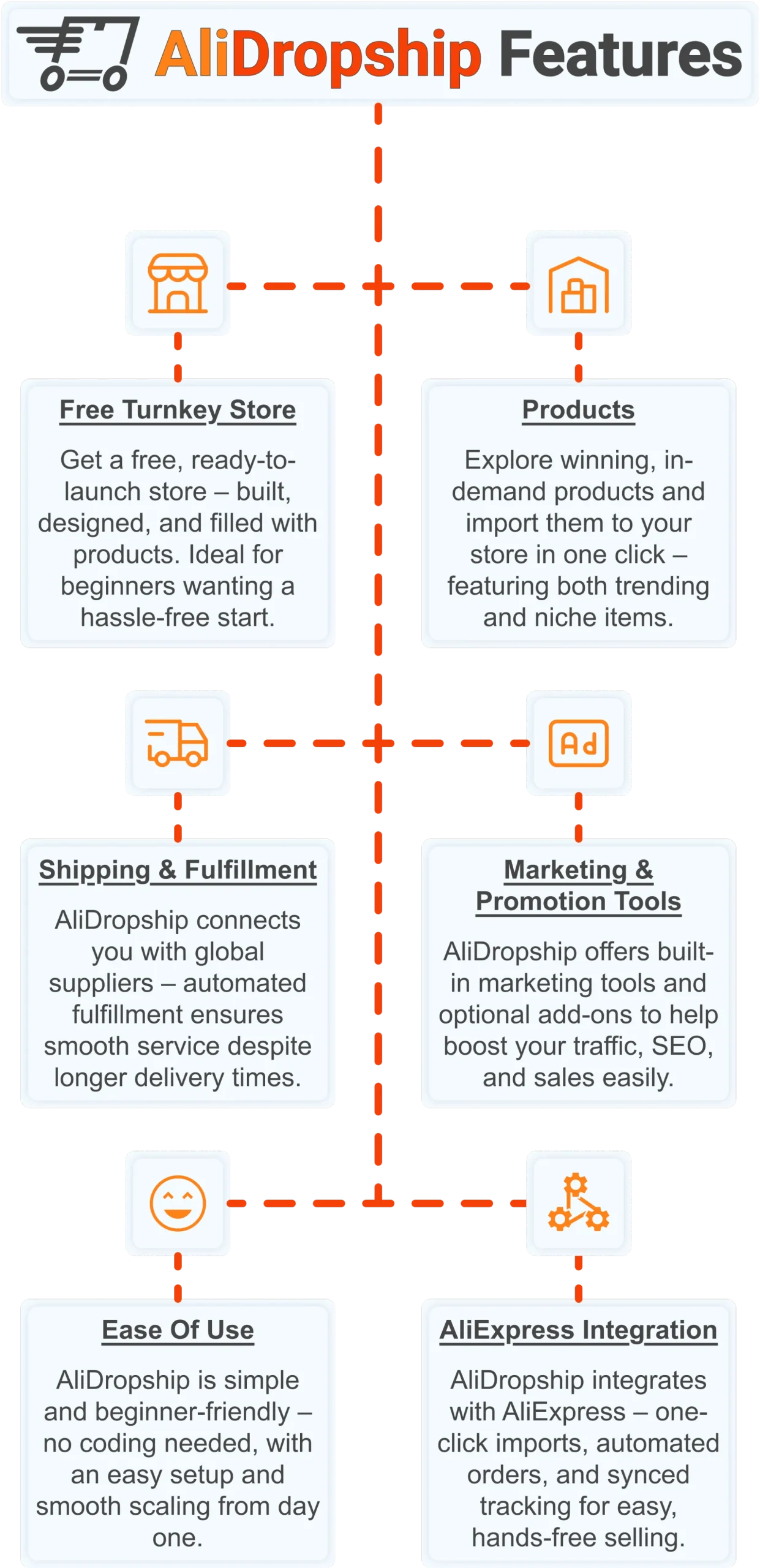
Free turnkey store ️
Get a free turnkey store – built, designed, and filled with products. Ideal for beginners wanting a hassle-free start, the store comes fully optimised to attract customers right away, saving you time on setup. Plus, it includes professional design elements to give your business a polished, trustworthy look from day one. This ready-made foundation makes it easy to move seamlessly into product selection.
Products
Once your store is set up, you can explore winning, in-demand products and import them in one click – featuring both trending and niche items. This wide selection lets you cater to diverse customer interests and test what works best. Regular updates ensure you always have fresh products, keeping your store competitive and relevant. With great products in place, smooth shipping becomes the next essential step.
Shipping & fulfillment
AliDropship connects you with global suppliers, and automated fulfillment ensures seamless order processing despite international delivery times. Customers receive real-time tracking updates, which builds confidence and trust in your store. Once shipping is handled reliably, you can focus on promoting your store and attracting traffic.
Marketing & promotion tools
To maximize sales, AliDropship offers built-in marketing tools and optional add-ons that help boost traffic, SEO, and conversions. From email campaigns and discounts to social media integration, these tools empower you to reach and retain customers without needing prior marketing experience. With promotion strategies in place, managing your business becomes simpler and more efficient.
Ease of use
AliDropship is beginner-friendly – no coding needed, with an intuitive dashboard that guides you through every step. Easy setup and smooth scaling let you expand your store without stress. As your business grows, adding new features, products, and marketing campaigns remains hassle-free, giving you more time to focus on sales.
AliExpress integration
Finally, AliDropship integrates seamlessly with AliExpress, enabling one-click imports, automated orders, and synced tracking. Your inventory stays up-to-date with the latest products and prices, while automated order processing frees you from manual tasks. Combined with the turnkey setup, reliable shipping, and built-in marketing tools, this integration ensures your dropshipping business is fully equipped for growth and success.
Frequently Asked Questions
What is the main difference between Shopify and Amazon?
Shopify is a store builder that gives you full brand control, while Amazon is a marketplace that gives you access to over 300 million active customer accounts already in buy mode. On Shopify, you must drive every visitor yourself since the platform has no built in audience. On Amazon, you gain instant shopper trust and higher conversion rates but must pay heavy fees and Amazon owns the customer relationship rather than you. Both platforms charge around 39 to 40 dollars per month to get started, but their true costs diverge sharply once advertising, fulfillment, and inventory are factored in.
How much does it cost to start selling on Shopify versus Amazon?
Shopify requires roughly 300 to 1000 dollars or more in startup costs, mostly covering ad spend and subscription fees, since the platform includes no built in audience. Amazon FBA requires a much larger investment of 2000 to 5000 dollars or more to source physical inventory before a single sale is made. Amazon also charges referral fees of 8 to 15 percent per sale depending on category, plus FBA fulfillment fees and monthly storage costs. Dropshipping through a platform like AliDropship sidesteps most of these costs, since no inventory purchase is required until after a customer has already paid.
How much can you realistically earn on Shopify compared to Amazon?
Shopify sellers without an established audience typically earn 0 to 500 dollars per month in their first year, since most beginners spend heavily on ads before finding traction. Amazon FBA sellers can earn 500 to 3000 dollars monthly with a strong listing, though results before 6 to 9 months of consistent effort are unpredictable and often below break even for first time sellers. Experienced Amazon FBA sellers with a proven, optimized product listing can reach 1000 to 10000 dollars per month. Dropshipping through AliDropship typically produces 300 to 2000 dollars per month with consistent effort, at a fraction of the startup cost of either alternative.
Which is easier for a complete beginner, Shopify or Amazon?
Neither platform is as beginner friendly as marketing materials suggest, since both carry real learning curves and financial risk for early mistakes. Shopify’s interface allows a basic store to go live in a day, but developing the SEO or paid ad skills needed to generate real traffic can take up to a full year. Amazon Seller Central is considerably more complex, requiring listing optimization, keyword research, FBA inventory management, and navigation of a policy rulebook that can trigger account suspension. Dropshipping removes the two biggest early barriers, inventory risk and store setup time, since a platform like AliDropship delivers an already built and stocked store from day one.
Does Shopify or Amazon give you more ownership of your customer data?
Shopify gives you full ownership of your customer list, your domain, and your brand identity from day one, since no marketplace sits between you and the buyer. Amazon owns the customer relationship entirely, meaning sellers cannot email buyers directly, build a retargeting list, or remarket to previous purchasers. If Amazon decides to stock a competing version of a product under its own private label, a seller listing visibility can drop overnight with no recourse. Many experienced Amazon FBA sellers maintain a parallel independent store specifically to own their customer relationships and avoid total dependence on a single marketplace.
While the Shopify vs Amazon debate rolls on, dropshipping with AliDropship offers a clearer, lower-risk entry point for anyone starting an ecommerce business in 2026. Get your free turnkey store today and start building income without inventory costs or platform fees.
 Previous post
