 ‧ Agnes Kazaryan ‧
March 23, 2026
‧ Agnes Kazaryan ‧
March 23, 2026  534 ‧
534 ‧
 0
0
Most small business owners already know they need to market better. The problem is not motivation – it is knowing where to start, and not spreading effort so thin that nothing actually works. The good news is that you do not need a big budget or a marketing degree. You need the right mix of proven tactics applied consistently, and a clear picture of what each one can realistically deliver.
Quick answer: The most effective small business marketing ideas in 2026 include local SEO, short-form video, email marketing, referral programs, and social media engagement – most of which cost nothing to start and can produce measurable results within 30–90 days.
This guide covers 17 strategies grouped by channel, with honest estimates of effort and revenue impact for each. Start with two or three from different categories rather than trying to do everything at once.
What is small business marketing?
Small business marketing is the process of connecting your product or service with the people most likely to buy it – using channels, messaging, and timing that fit your actual budget and audience. Unlike enterprise marketing, small business marketing almost always means doing more with less: a smaller team, a tighter budget, and a heavier reliance on organic reach, community, and word of mouth.
In 2026, that challenge has gotten both harder and easier at the same time. Consumer attention is fragmented across more platforms than ever, and the bar for earning trust has risen significantly. But the tools available to independent business owners – free social media, AI-assisted content creation, zero-cost email platforms – are more powerful than they have ever been. The gap between a well-marketed small business and a poorly marketed one is almost entirely down to strategy, not spend.
Whether you run a local service business, an online shop, or a side hustle you are trying to scale into something serious, the ideas below apply directly to your situation.
How much can small business marketing realistically earn you?
Marketing is not a direct income method – it is a multiplier on whatever you are already selling. Before diving into tactics, it is worth setting realistic expectations. The returns depend on your product margins, your market size, and how consistently you execute over time.
These ranges reflect realistic outcomes across different industries. A local bakery and a B2B service firm will see different numbers, but the relative effort-to-return ranking holds up across most small business categories. Most owners who execute two or three of these consistently see meaningful growth within 60–90 days.
One note on the upper figures: The high end of each range assumes a well-optimised offer, an existing audience, and sustained execution over 3–6 months. Do not plan your finances around best-case outcomes.
Online presence and SEO
1. Optimise your Google Business Profile
If you serve local customers and you have not claimed and fully optimised your Google Business Profile, this is the single highest-ROI task you can do this week. A complete profile – with photos, updated hours, service categories, Q&A responses, and regular posts – significantly improves your visibility in local search results and on Google Maps. According to Google, businesses with complete profiles receive roughly 7x more clicks than incomplete ones.
Claim your listing at business.google.com, verify ownership, fill in every field, upload at least 10 photos, and ask your five most loyal customers to leave an honest review. Then post a short update once a week – a seasonal offer, a new product, or a behind-the-scenes moment. It takes 20 minutes and costs nothing.
Earning potential: Local SEO improvements typically drive $500–$3,000/month in added enquiry or walk-in revenue within 60–90 days for most service businesses.
2. Start a blog targeting long-tail keywords
Content marketing compounds in a way that paid ads cannot. A well-written blog post targeting a specific question your ideal customer is already searching for can drive free, qualified traffic for years. The key is targeting long-tail keywords – specific phrases like “how to choose a wedding photographer in Austin” rather than broad terms like “photographer”.
Use free tools like Google Search Console, Ubersuggest, or AnswerThePublic to find what your audience is searching for. Aim for one solid post per week at 800–1,500 words. Within 6–12 months of consistent publishing, organic search can become your top traffic source.
Why this works in 2026: AI-generated content has flooded search results with generic articles. Original, experience-driven content from a real business owner now stands out more than ever – especially if you write from genuine first-hand expertise.
3. Build dedicated location pages if you serve multiple areas
If your business operates across several towns or cities, create a dedicated landing page for each location. Each page should include locally relevant content – not a copy-paste of the same text with a different city name. Mention local context, area-specific services, or community references that signal genuine local relevance to both search engines and real visitors.
Important: Thin location pages with near-identical content can hurt your rankings. Each page needs at least 400 words of genuinely distinct content to be worth creating.
Social media marketing
4. Post short-form video consistently
TikTok, Instagram Reels, and YouTube Shorts are the highest-organic-reach formats available to small businesses right now. Unlike static posts, short videos can reach hundreds of thousands of new viewers without any ad spend – especially in the first 24–48 hours after posting. You do not need professional equipment. A phone, decent lighting, and a clear point consistently outperform overproduced content on these platforms.
Start with one video per weekday. Show your product being made, answer a common customer question, share a quick niche tip, or document a day in the life of your business. These platforms reward authenticity over polish – your real personality is the asset, not a production budget.
Earning potential: Businesses with 5,000–50,000 followers on short-form platforms report $300–$5,000/month in directly attributed sales, with niche creators in specific product categories frequently earning more.
5. Use Stories for daily low-effort engagement
Instagram and Facebook Stories disappear after 24 hours, which makes them lower-stakes than permanent posts and ideal for frequent, casual touchpoints with your audience. Polls, question boxes, countdown timers for sales, and quick product demos all perform well in this format. Stories keep your brand top-of-mind between purchase cycles and tend to drive direct messages from warm prospects who are close to buying.
Aim for 3–5 Story frames per day. This sounds like a lot, but a 15-second clip, a quick poll about a new product, and a reshared customer post takes under five minutes to put together.
6. Build a niche community group on Facebook or LinkedIn
Owning a community is more valuable long-term than renting attention through a feed algorithm. A niche Facebook group or LinkedIn group positions you as the authority in your space, gives you a direct channel to your most engaged customers, and generates organic content – questions, discussions, testimonials – that keeps the group active without constant effort on your part.
Why this works in 2026: Organic reach for business pages has declined sharply, but group content still gets strong distribution. A group of 500 genuinely engaged members can outperform a page with 10,000 passive followers when it comes to actual sales conversations.
Email and direct communication
7. Build your email list from day one
Email marketing consistently delivers the highest ROI of any digital channel – typically $36–$42 for every dollar spent, based on benchmarks published by Litmus and Campaign Monitor. Unlike social media, your email list is an asset you own. Algorithm changes, platform shutdowns, and account bans cannot take it from you.
Start collecting emails immediately – via a website pop-up, a lead magnet like a free checklist or discount code, or simply asking at point of sale. Mailchimp and MailerLite both have free tiers supporting up to 500–1,000 subscribers, which is more than enough to get started. Send at least one email per week. Newsletters, product updates, how-to content, and exclusive offers all work well.
Earning potential: A list of 1,000 subscribers with a 2% conversion rate and a $50 average order value generates $1,000 per promotional send. That math scales quickly as your list grows.
8. Set up automated email sequences
A welcome sequence, an abandoned cart sequence, and a post-purchase follow-up sequence together can add 15–25% to your email revenue without any ongoing manual effort after the initial setup. Most email platforms include automation builders with pre-built templates. A welcome sequence of 3–5 emails over the first two weeks after someone subscribes consistently outperforms one-off broadcast emails across every metric – open rate, click rate, and conversion.
9. Use SMS for time-sensitive promotions
SMS open rates run around 98% compared to 20–25% for email, and most messages are read within three minutes of delivery. For flash sales, limited-stock alerts, or same-day appointment reminders, SMS is unmatched. Platforms like Klaviyo, Postscript, and SimpleTexting integrate with most ecommerce platforms and offer accessible pay-as-you-go pricing for small businesses.
Important note: Always obtain explicit opt-in consent before adding anyone to your SMS list. Unsolicited texts are illegal in most jurisdictions under CAN-SPAM, GDPR, and CASL legislation, and will damage your brand quickly.
Referrals, partnerships, and community
10. Launch a referral program
Word of mouth is the oldest and most trusted form of marketing – and a structured referral program turns it into a repeatable, measurable system. Offer an existing customer a discount, credit, or small gift for every new customer they refer. The new customer gets a first-time discount too. Both parties win, and you acquire a customer at a fraction of the cost of paid advertising.
Tools like ReferralCandy, Friendbuy, or a simple coupon code setup in WooCommerce or Shopify make this easy to build in an afternoon. The best referral programs are simple enough to explain in one sentence.
Earning potential: Businesses with active referral programs report 10–30% higher customer acquisition rates at 40–60% lower cost per acquisition than paid channels.
11. Partner with complementary local businesses
Cross-promotion with a business that shares your customer base but does not compete with you is one of the most consistently underused small business marketing ideas available. A florist and a wedding photographer. A personal trainer and a nutritionist. A children’s clothing boutique and a toy shop. These combinations create natural referral flows that cost nothing beyond the relationship itself.
Formalise the arrangement: agree on what you will promote for each other, how often, and through which channels. Even a simple Instagram shoutout swap or a co-hosted local event can expose each business to hundreds of new qualified prospects at zero cost.
12. Get featured in local press and relevant directories
Local newspapers, neighbourhood blogs, community Facebook groups, and niche online directories still drive meaningful traffic and trust signals for small businesses. Reach out to local journalists with a genuine story angle – a community impact story, a business milestone, or a unique product – rather than a generic press release. For directories, focus on Yelp, Tripadvisor where relevant, Houzz, Angi, and any industry-specific listings for your niche.
Pro Tip: When pitching local media, lead with the community benefit of your story, not the product features. Journalists are looking for stories, not advertisements.
Paid and performance marketing
13. Run targeted Facebook and Instagram ads
Meta’s advertising platform remains one of the most powerful tools available to small businesses, particularly for consumer products and local services. The ability to target by location, age, interests, behaviours, and lookalike audiences means even a $5–$20 per day budget can reach a precisely defined audience. Test multiple creative formats – single image, carousel, short video – with small budgets before scaling what works.
Start with retargeting before cold audiences: show ads to people who have already visited your website or engaged with your social profile. These audiences convert at 3–5x the rate of cold traffic and cost less per click. It is the highest-ROI entry point for paid social for most small businesses.
Earning potential: Well-optimised Meta campaigns for ecommerce or local services typically achieve 3–8x return on ad spend once creative and targeting are dialled in, which usually takes 4–8 weeks of testing.
14. Use Google Ads for high-intent search traffic
Google Ads places your business in front of people who are actively searching for exactly what you sell. Unlike social ads that interrupt users mid-scroll, search ads reach people at the exact moment of buying intent. For service businesses in particular, Google Search campaigns often outperform all other paid channels when set up correctly.
Start with exact-match and phrase-match keywords, set a clear negative keyword list, and use call extensions if phone enquiries matter to your business.
Important: Google Ads can waste budget quickly without proper campaign structure. If you are new to it, start with a $300–$500 test budget and use the Smart Campaign option or work with a certified partner before scaling.
Content and thought leadership
15. Start a YouTube channel for your niche
YouTube is the second-largest search engine in the world, and video content has a long shelf life that most other formats do not. A tutorial, product review, or how-to video uploaded today can still be discovered and driving traffic three years from now. For small businesses, YouTube works particularly well for demonstrating expertise – home improvement contractors, beauty professionals, fitness trainers, and B2B consultants all build significant audiences and inbound leads this way.
Aim for one video per week at 5–12 minutes. Keyword-optimise your titles, descriptions, and tags. Use chapters to improve watch time. It typically takes 6–12 months to see meaningful organic growth, but the compounding returns make it one of the best long-term investments in this entire list.
16. Collect and showcase customer reviews systematically
Reviews are one of the most powerful conversion tools a small business has – and most businesses are completely passive about collecting them. A systematic approach means asking every satisfied customer for a review, making it easy with a direct link to your Google or Trusted profile, and responding professionally to every review received. Research from BrightLocal consistently shows that over 90% of consumers read reviews before visiting a local business, and that most read at least 10 reviews before trusting a new one.
Why this works in 2026: AI-generated fake reviews are increasingly common and increasingly easy to spot. Authentic, detailed reviews from verified customers carry more weight than ever with both consumers and search algorithms.
17. Repurpose one piece of content across multiple channels
Creating content from scratch for every platform is exhausting and unsustainable for a small team. Instead, build around a single core piece of content per week and repurpose it across formats. A 10-minute YouTube video becomes a short clip for TikTok and Reels, a written summary for your blog, a carousel post for LinkedIn, and three talking points for your email newsletter. One effort, five outputs.
This approach keeps you consistent across platforms without burning out – and consistency, more than any single viral moment, is what actually builds an audience and drives sales over time.
Legal and ethical considerations for small business marketing
Most small business marketing tactics are straightforward – but a few grey areas can damage your reputation or expose you to real legal risk if you are not paying attention.
What to avoid absolutely
Fake reviews are the most common ethical violation small businesses engage in, often without fully understanding the consequences. Writing your own reviews on secondary accounts, paying for reviews, or offering incentives in exchange for positive feedback all violate Google’s Terms of Service, Yelp’s guidelines, and in many jurisdictions consumer protection law. The FTC has issued significant fines to businesses caught doing this, and the reputational damage lasts far longer than any short-term ranking boost.
Misleading advertising – including before-and-after photos that do not reflect typical results, unqualified income claims, or “limited time” offers that never actually expire – is illegal in most markets and corrodes the trust that marketing is supposed to build.
Spam, whether by email or SMS, is both illegal under CAN-SPAM, GDPR, and CASL legislation and deeply counterproductive. Purchased email lists produce near-zero conversions, damage your sender reputation, and can get your domain blacklisted.
Key principle: Every marketing claim you make should be backed by evidence, and every communication should go only to people who have explicitly asked to receive it.
What to do instead
Build your review strategy around making it genuinely easy for happy customers to share their experience – no incentives needed, just a well-timed ask and a direct link. Keep all promotional claims specific and qualified with timeframes and conditions. Build your list through genuine opt-ins and treat every subscriber as someone who trusted you with their inbox. Transparent, honest marketing takes slightly longer to build momentum, but it compounds into a brand reputation that paid tactics cannot buy.
How to choose the right marketing approach for your situation
Not every small business marketing idea in this guide will be equally relevant to where you are right now. Here is a straightforward way to prioritise based on your current stage.
Complete beginner
If you are just starting out, focus on two things first: your Google Business Profile and your email list. Both are free, both have a high ROI relative to effort, and both build assets you own permanently. Add one short-form video per day once those two are in place. Do not spend money on paid ads until you have validated your offer organically – you need to know what message converts before you pay to amplify it.
Intermediate / part-time
If you have been in business for 6–12 months and have some customers already, your priority is referrals and content. Set up a referral program this week. Start publishing one blog post and one YouTube video per week. Begin testing Facebook retargeting ads with a $10/day budget. Your goal at this stage is to turn satisfied customers into a growth engine and start building organic traffic that compounds over time.
Advanced / full-time goal
If you are treating your business as a full-time income goal, invest in a content repurposing system, paid search, a structured email automation stack, and community building across two or three platforms. At this level, the compounding effect of multiple channels working together – SEO feeding email, email feeding paid retargeting, video building brand trust – is where the real revenue step-changes come from. Budget 10–15% of revenue back into marketing, test continuously, and cut what does not perform within 90 days.
AliDropship: Your complete all-in-one solution for starting dropshipping in 2026
If you want the simplest possible way to start dropshipping – especially if you’re brand new – AliDropship remains one of the most beginner-friendly tools available in 2026. It brings together store creation, product imports, automation, and marketing into a single streamlined system designed to help you launch quickly and grow confidently.
Free turnkey store ️
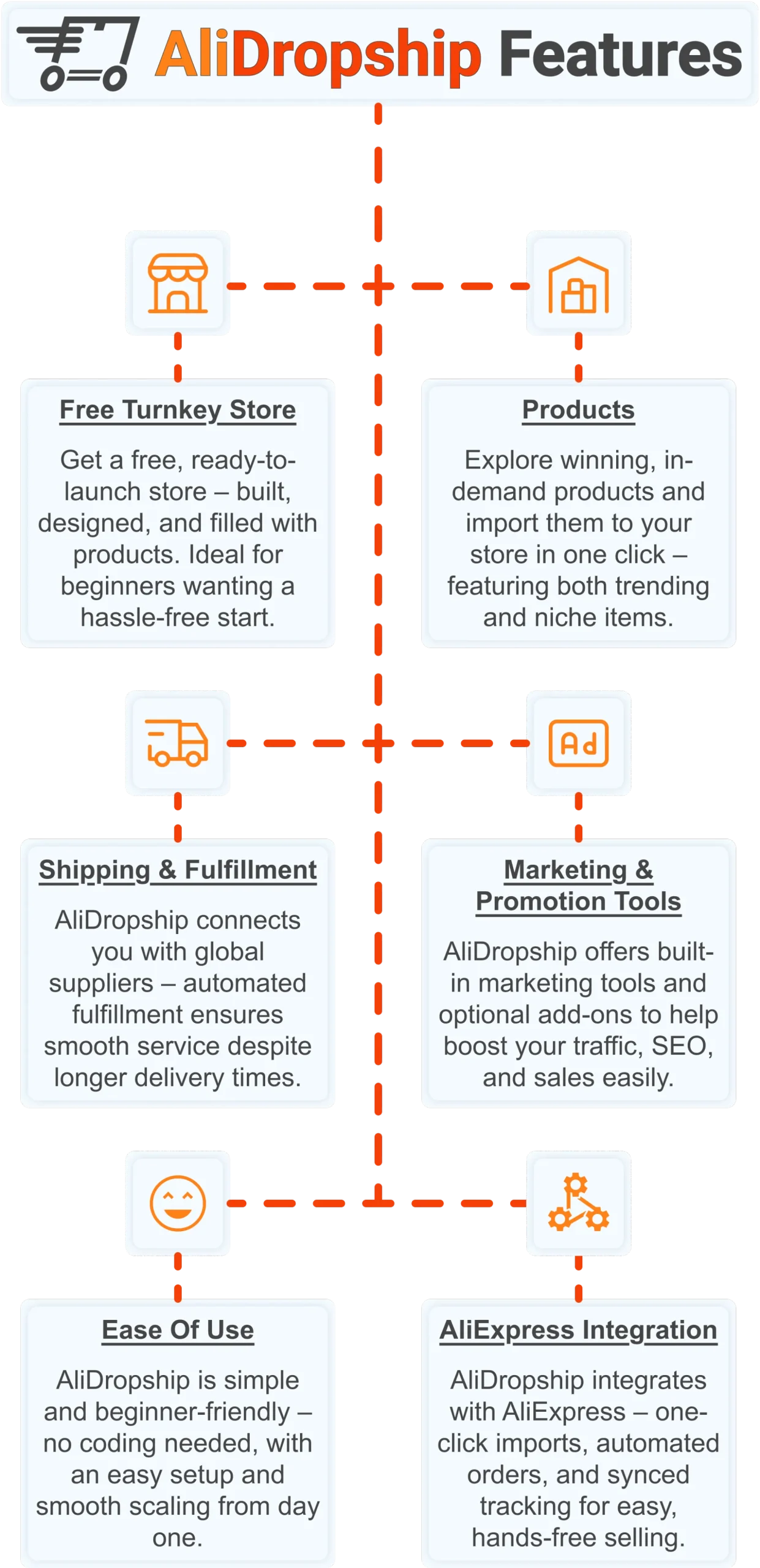
Get a free turnkey store – built, designed, and filled with products. Ideal for beginners wanting a hassle-free start, the store comes fully optimized to attract customers right away, saving you time on setup. Plus, it includes professional design elements to give your business a polished, trustworthy look from day one. This ready-made foundation makes it easy to move seamlessly into product selection.
Products
Once your store is set up, you can explore winning, in-demand products and import them in one click – featuring both trending and niche items. This wide selection lets you cater to diverse customer interests and test what works best. Regular updates ensure you always have fresh products, keeping your store competitive and relevant. With great products in place, smooth shipping becomes the next essential step.
Shipping & fulfillment
AliDropship connects you with global suppliers, and automated fulfillment ensures seamless order processing despite international delivery times. Customers receive real-time tracking updates, which builds confidence and trust in your store. Once shipping is handled reliably, you can focus on promoting your store and attracting traffic.
Marketing & promotion tools
To maximize sales, AliDropship offers built-in marketing tools and optional add-ons that help boost traffic, SEO, and conversions. From email campaigns and discounts to social media integration, these tools empower you to reach and retain customers without needing prior marketing experience. With promotion strategies in place, managing your business becomes simpler and more efficient.
Ease of use
AliDropship is beginner-friendly – no coding needed, with an intuitive dashboard that guides you through every step. Easy setup and smooth scaling let you expand your store without stress. As your business grows, adding new features, products, and marketing campaigns remains hassle-free, giving you more time to focus on sales.
AliExpress integration
Finally, AliDropship integrates seamlessly with AliExpress, enabling one-click imports, automated orders, and synced tracking. Your inventory stays up-to-date with the latest products and prices, while automated order processing frees you from manual tasks. Combined with the turnkey setup, reliable shipping, and built-in marketing tools, this integration ensures your dropshipping business is fully equipped for growth and success.
Every small business marketing idea in this guide works best when you have a great product and a store built to convert. Get your free turnkey ecommerce store and start putting these strategies to work today.
Frequently asked questions
What are the most effective small business marketing ideas for 2026?
The most effective small business marketing ideas include local SEO, short-form video, email marketing, referral programs, and social media engagement. Most of these tactics cost nothing to start and can produce measurable results within 30 to 90 days. Local SEO improvements typically drive 500 to 3000 dollars per month in added revenue within 60 to 90 days for service businesses. Email marketing delivers a strong return, generating between 36 and 42 dollars for every dollar spent based on industry benchmarks.
How much can small business marketing realistically increase revenue?
Revenue impact varies by method, with local SEO adding 500 to 5000 dollars per month and short-form video reaching 300 to 8000 dollars per month at scale. Referral programs typically produce a 10 to 30 percent revenue lift once set up. Paid social ads can achieve 3 to 8 times return on ad spend when properly optimized. Most business owners who execute two or three tactics consistently see meaningful growth within 60 to 90 days.
Why is a Google Business Profile important for small business marketing?
A complete Google Business Profile is one of the highest return tasks a local business can complete, since businesses with complete profiles receive roughly 7 times more clicks than incomplete ones. Setting it up takes about 20 minutes and costs nothing, requiring at least 10 uploaded photos and updated service categories. Local SEO improvements tied to a strong profile typically drive 500 to 3000 dollars per month in added revenue within 60 to 90 days. Posting a weekly update, such as a seasonal offer or new product, helps maintain visibility in local search results.
How effective is email marketing compared to other small business marketing channels?
Email marketing delivers the highest return on investment of any digital channel, typically generating 36 to 42 dollars for every dollar spent according to Litmus and Campaign Monitor benchmarks. A list of 1000 subscribers with a 2 percent conversion rate and a 50 dollar average order value can generate 1000 dollars per promotional send. Automated sequences, including welcome and abandoned cart emails, can add 15 to 25 percent to email revenue without ongoing manual effort. Free platforms like Mailchimp and MailerLite support up to 500 to 1000 subscribers at no cost.
What marketing mistakes should small businesses avoid?
Fake reviews are the most common ethical violation, including writing reviews on secondary accounts or offering incentives for positive feedback, which violates Google and Yelp guidelines. Misleading advertising, such as unqualified income claims or before-and-after photos that do not reflect typical results, is illegal in most markets. Spam by email or SMS is illegal under CAN-SPAM, GDPR, and CASL legislation and can get a business domain blacklisted. Purchased email lists produce near-zero conversions and damage sender reputation significantly.
 Previous post
