 ‧ Agnes Kazaryan ‧
March 07, 2026
‧ Agnes Kazaryan ‧
March 07, 2026  1086 ‧
 0
0
If you want to run a leaner, faster, more profitable online store, the best AI apps are no longer optional – they are the shortcut. In 2026, sellers who use AI tools for product research, content creation, customer service, and advertising are consistently outpacing those who do not. The gap is only widening.
Quick answer: The best AI apps for ecommerce automate content creation, customer support, product research, advertising, and store management. Tools like ChatGPT, Tidio, Canva AI, Jasper, and Surfer SEO are widely used by online sellers to save time, increase conversions, and scale stores faster – most with free plans to get started.
In this guide, we rank and review the best AI tools available right now – covering mobile apps, browser-based platforms, and AI solutions built specifically for ecommerce and dropshipping. Most work globally, but examples and use cases are especially relevant for sellers targeting the US market.
What are AI apps – and why do they matter for ecommerce in 2026?
AI apps are software tools powered by machine learning, natural language processing, or computer vision that can perform tasks a human would normally handle manually. In an ecommerce context, that means writing product descriptions, answering customer queries, generating ad visuals, optimizing listings for search, and spotting trending products – all without you being in the room.
For online sellers in 2026, this matters because margins are tighter, competition is stiffer, and customer expectations are higher than ever. A one-person store competing against funded brands needs every efficiency advantage it can get. The best AI tools for ecommerce level that playing field in a real and measurable way.
Here is a quick look at why more sellers are making AI apps a core part of their workflow:
The data is consistent: AI tools for ecommerce are not a gimmick. They translate directly into saved hours, better conversions, and faster decision-making. The question is not whether to use them – it is which ones to start with.
How AI is reshaping ecommerce operations right now
AI is not some distant future concept for big retailers. In 2026, it is already embedded in the day-to-day operations of stores of every size – and the technologies driving it are more accessible than ever.
The main types of AI powering ecommerce tools today
Machine learning (ML) analyzes customer behavior and trend data to improve product recommendations and predict future demand. It is the engine behind most personalization features you see on major platforms.
Natural language processing (NLP) is what powers chatbots like Tidio and writing assistants like ChatGPT. It allows software to understand and generate human language – useful for product copy, email responses, and customer queries.
Predictive analytics helps forecast demand, set dynamic pricing, and manage inventory based on live market data. For dropshippers, this means fewer stockouts and smarter product selection.
Computer vision enables visual search and AI product photography tools. Customers can search with an image; sellers can generate studio-quality product photos without a camera.
What this looks like for a typical ecommerce seller
In practical terms, these technologies mean your store can offer personalized shopping experiences, handle customer support around the clock, generate ad copy in seconds, and flag suspicious transactions automatically – all while you focus on growth.
Big names like Amazon and Alibaba have relied on this infrastructure for years. In 2026, the same capabilities are available to independent sellers through affordable – often free – apps and platforms.
How to integrate the best AI apps into your ecommerce workflow
The most common mistake when adopting AI tools is trying to automate everything at once. A smarter approach is to start with one clear problem, pick the right tool, and expand from there.
Start with a clear goal
Before downloading anything, ask yourself what is actually slowing your store down. Are product descriptions taking too long to write? Are customer queries piling up? Are your ads not converting? Each problem maps to a specific category of AI tool – and knowing your priority helps you avoid tool overload.
Pick tools that work with your platform
Most of the best AI tools for ecommerce integrate directly with Shopify, WooCommerce, Wix, or BigCommerce. Check for native integrations or API support before committing to a paid plan. If a tool does not connect cleanly to your stack, it creates more work, not less.
Automate what drains your time most
Common high-value targets include: AI chatbots for 24/7 customer support, automated order updates and inventory tracking, AI-assisted content creation for listings and emails, and AI-powered ad generation and A/B testing. The less manual effort on your plate, the more mental space you have to focus on strategy.
Test and refine weekly
AI apps improve the more data they have to work with. Set aside time each week to review analytics, adjust chatbot flows based on real conversations, and test new AI-generated creatives. Stores that treat AI as a set-and-forget solution tend to plateau. Those that keep iterating keep improving.
The best AI apps for iPhone users and mobile selling
A growing number of ecommerce sellers run significant parts of their business from a phone. The apps below are optimized for iPhone and cover everything from on-the-go content creation to mobile customer support and product photography.
Japer AI – Writer AI and chatbot app
⭐⭐⭐⭐⭐ 4.8/5 on App Store
Japer AI is a mobile-first writing assistant built for quick content tasks – emails, product captions, blog ideas, and ad copy – all from your phone. In 2026 it connects directly with Shopify and WooCommerce accounts, and supports multi-language output for sellers targeting international markets.
Key features: AI chatbot for real-time conversations, writing templates for ecommerce, multilingual support, one-tap caption and description generation.
Pricing: Free basic plan; Premium from $9.99/month or $39.99/year.
Best for: Sellers who need a lightweight mobile AI writing tool for daily content tasks.
Tidio
⭐⭐⭐⭐⭐ 4.8/5 on App Store
Tidio is one of the best free AI apps for iPhone and Android, combining live chat, AI chatbot, and CRM tools in a single mobile-friendly interface. In 2026 it includes automated sales funnels, AI-driven FAQ suggestions, and predictive customer behavior insights – so your store keeps converting even when you step away from the screen.
Key features: AI chatbot for FAQs, order tracking, and real-time support; multi-channel inbox (Messenger, Instagram, email); lead generation and CRM tools; customizable chat widget.
Pricing: Free basic plan; paid suites from $29/month.
Best for: Ecommerce stores that want to improve customer response times without hiring support staff.
Canva AI (Magic Write)
⭐⭐⭐⭐⭐ 4.8/5 on App Store
Canva AI pairs a full design platform with an AI text generator – making it one of the most versatile best AI tools for ecommerce sellers who need both visuals and copy in one place. In 2026 it supports AI-assisted video captions, ad graphics for Instagram and TikTok, and animated product banners built from templates.
Key features: AI text generator inside a drag-and-drop design editor; templates for store banners, social posts, and ad graphics; collaborative editing; export for web, print, and video.
Pricing: Free version with limited AI uses; paid plans from $14.99/month.
Best for: Creating product visuals, social media posts, and store banners quickly without a design background.
ChatGPT app
⭐⭐⭐⭐⭐ 4.9/5 on App Store
ChatGPT remains one of the most flexible best AI apps for ecommerce in 2026. Use it to brainstorm product ideas, write and refine product titles or descriptions, draft customer email responses, or map out a content calendar. It functions as a creative and strategic assistant available around the clock – with no technical setup required.
Key features: Conversational AI for writing, brainstorming, strategy, and customer support drafts; real-time responses; works across product descriptions, blog posts, ad copy, and scripts.
Pricing: Free version (GPT-3.5); ChatGPT Plus with GPT-4 at $19.99/month.
Best for: Sellers who want a general-purpose AI assistant for content, strategy, and customer communication.
Grammarly: AI writing keyboard
⭐⭐⭐⭐⭐ 4.7/5 on App Store
Grammarly sits quietly in the background and makes everything you type sharper – product listings, customer replies, email campaigns, social captions. In 2026 it adds AI tone suggestions specifically calibrated for ecommerce marketing, plus automatic style adjustments based on your brand voice settings.
Key features: Real-time grammar, spelling, and tone checks; sentence rewrites for clarity and persuasion; works inside any app on your phone; personal dictionary and multilingual support.
Pricing: Free version with basic suggestions; paid plans from $29.99/month.
Best for: Polishing product descriptions and customer-facing communication without a professional copywriter.
Manychat
⭐⭐⭐⭐⭐ 4.7/5 on App Store
Manychat lets you automate customer conversations on Instagram, Facebook Messenger, and WhatsApp – guiding buyers through product questions, order tracking, and even abandoned cart recovery while you focus elsewhere. In 2026 it extends to Instagram Shops and WhatsApp Commerce, making it one of the best AI tools for social selling specifically.
Key features: Drag-and-drop chat flow builder; automation for lead generation, FAQ handling, and upsells; integrations with Shopify, Zapier, and email tools; audience segmentation.
Pricing: Free plan for up to 1,000 contacts; Pro from $15/month, scaling with audience size.
Best for: Automating customer support and sales through social media DMs.
DoMyShoot – product photo studio
⭐⭐⭐⭐☆ 4.4/5 on App Store
DoMyShoot is one of the best free AI apps for sellers who need professional product photos but do not have the budget for a studio shoot. It guides you through the photography process, removes backgrounds, generates lifestyle scenes, and exports listing-ready images for Amazon, Shopify, Walmart, and more. In 2026 it adds AI scene suggestions based on trending product categories and improved batch editing tools.
Key features: AI background removal and white-background conversion; lifestyle scene generator; batch editing and resizing; built-in listing generator for major marketplaces; step-by-step photoshoot guide.
Pricing: Free; Pro-Touch editing services from $9.99.
Best for: Small business owners who need marketplace-ready product images without hiring a photographer.
Best web-based AI tools for ecommerce and online sales
Not every great AI tool comes in an app. The platforms below run in your browser and cover the full range of ecommerce needs – from SEO-optimized content and video production to paid advertising and AI-powered customer support. These are some of the best AI tools for ecommerce sellers who manage their stores primarily from a desktop or laptop.
Jasper AI
⭐⭐⭐⭐☆ 3.8/5 on Trustpilot
Jasper remains one of the most capable web-based AI writing tools for ecommerce in 2026. It handles product descriptions, email sequences, landing pages, ad copy, and long-form blog content – and integrates directly with Surfer SEO for search-optimized output. In 2026 it adds automated ad copy testing and multi-channel campaign drafting, making it a strong pick for sellers scaling their content production.
Key features: AI copywriting across formats (ads, emails, product pages, blog posts); brand voice consistency tools; Surfer SEO integration; team collaboration features.
Pricing: Free trial available; plans from $49/month.
Best for: Store owners who need high-quality written content produced quickly and consistently.
Surfer SEO
⭐⭐⭐⭐⭐ 4.8/5 on G2
If you want your product pages and blog content to rank on Google, Surfer SEO is one of the best AI tools for that specific job. It analyzes top-ranking pages for any keyword and gives you real-time suggestions on keyword placement, structure, word count, and internal linking. In 2026 it adds AI-powered keyword clustering, competitor gap analysis, and automated content briefs.
Key features: Real-time SEO content editor; SERP analyzer; keyword clustering and content planner; Jasper AI integration; competitor benchmarking.
Pricing: Plans from $99/month.
Best for: Ecommerce businesses focused on growing organic search traffic and ranking product or category pages.
AdCreative.ai
⭐⭐⭐⭐☆ 3.6/5 on Trustpilot
AdCreative.ai generates ad visuals, banners, and copy for Facebook, Instagram, Google, and LinkedIn campaigns using AI trained on high-performing ecommerce ads. In 2026 it adds format suggestions for Instagram Reels, TikTok, and YouTube Shorts, plus built-in A/B testing – a meaningful upgrade for sellers scaling paid traffic.
Key features: AI-generated ad creatives and banners; product and brand-based copy generation; A/B testing and performance tracking; multi-platform support.
Pricing: Free trial; plans from $39/month.
Best for: Brands looking to scale paid advertising with high-converting visuals without a designer on the team.
Creatify
⭐⭐⭐⭐☆ 4.4/5 on Trustpilot
Creatify turns product images into scroll-stopping short videos in minutes – no editing skills required. In 2026 it supports vertical video generation for TikTok and Instagram Reels, automatic voiceovers, and dynamic text overlays designed for mobile engagement. For dropshippers who need product videos at volume, it is one of the most efficient tools available.
Key features: Product image-to-video generation; voice-over options; templates for TikTok, Meta, and YouTube; auto text overlays and animation effects.
Pricing: Free plan available; paid plans from $39/month.
Best for: Dropshippers and ecommerce sellers who need fast, professional product videos without video editing experience.
Descript
⭐⭐⭐⭐⭐ 4.6/5 on G2
Descript is the go-to AI tool for ecommerce brands creating product tutorials, review videos, or explainer content. You edit audio and video by editing a text transcript – delete a word from the script and the corresponding clip disappears. In 2026 it adds AI-generated video scripts, auto-captioning, and social media formatting built into the export flow.
Key features: Text-based audio and video editing; automatic transcription; Overdub voice cloning for re-recording lines; screen recording; subtitle and caption generation.
Pricing: Free basic plan; paid plans from $24/month.
Best for: Ecommerce brands creating product demos, tutorials, or branded video content.
Kua.ai
⭐⭐⭐⭐⭐ 4.9/5 on Capterra
Kua.ai is an AI brand content assistant that writes blog posts, social media copy, and marketing material in your specific tone and voice. In 2026 it adapts to trending campaign styles, auto-generates multiple post variations from a single prompt, and supports real-time team collaboration – making it a practical pick for small teams managing multiple channels at once.
Key features: AI blog and social media writing; custom tone and voice training; real-time collaboration; multi-language support.
Pricing: Free basic plan; paid plans from $19/month.
Best for: Small business owners and content marketers who want consistent, branded content at speed.
Tiledesk
⭐⭐⭐⭐⭐ 4.7/5 on Trustpilot
Tiledesk is an AI live chat and chatbot builder that works across websites, WhatsApp, Messenger, and more – combining all customer conversations into a single omnichannel inbox. In 2026 it adds GPT-powered chat workflows, automated lead nurturing sequences, and AI response prioritization to help support teams handle higher volumes without scaling headcount.
Key features: GPT-powered chatbots; omnichannel inbox; workflow automation; integration with major ecommerce platforms.
Pricing: Free basic plan; paid plans from $19/month.
Best for: Businesses looking to automate and scale customer communication without additional hiring.
Mokker
⭐⭐⭐⭐⭐ 4.8/5 on G2
Mokker creates studio-quality product images from simple photos using AI – no photographer, no lighting kit, no post-processing knowledge required. In 2026 it adds batch editing, smart background replacement, automatic scene styling, and high-resolution output calibrated for major ecommerce platforms.
Key features: AI background removal; smart scene generation; batch processing; high-res export.
Pricing: Free plan with limited credits; paid plans from $19/month.
Best for: Online store owners who want professional-grade product images without expensive photoshoots.
Maze AI
⭐⭐⭐⭐☆ 4.5/5 on G2
Maze is an AI-powered user research platform designed to help you validate product pages, checkout flows, or new store layouts before investing in a full launch. In 2026 it adds AI-driven UX predictions and advanced prototype analytics, letting teams collect feedback and analyze user behavior in real time without writing a single line of code.
Key features: Prototype testing with real users; AI-generated user insights; survey and feedback automation; heatmaps and behavior metrics reporting.
Pricing: Free version for individuals and small tests; custom pricing for advanced analytics.
Best for: UX designers, product managers, and store owners who want to test ideas before launch.
Superluminal
⭐⭐⭐⭐⭐ 4.6/5
Superluminal gives teams a single workspace to access and switch between GPT, Claude, Gemini, and other AI tools without juggling separate logins or subscriptions. In 2026 it adds team analytics dashboards and cross-platform workflow automation – a clean solution for agencies or sellers managing multiple stores who want one AI command center rather than five.
Key features: Unified AI workspace; AI search assistant; auto-saving and history tracking; team collaboration features.
Pricing: Free trial; from $20/month.
Best for: Agencies and teams juggling multiple AI tools and projects simultaneously.
10Web
⭐⭐⭐⭐⭐ 4.7/5 on Trustpilot
10Web generates a fully functional, hosted WordPress website from a short text description – handling design, layout, and initial content in a single step. In 2026 its AI output is optimized for speed, mobile-first design, and SEO, with automatic content suggestions for ecommerce product and category pages built into the setup process.
Key features: AI-powered site generation; drag-and-drop editor; built-in SEO and speed optimization; hosting included.
Pricing: Free trial; plans from $25/month.
Best for: Entrepreneurs and freelancers who need to build client sites or personal ecommerce projects quickly.
Using the best AI apps for dropshipping and product research
One of the highest-value use cases for AI in ecommerce is product research. Traditionally, finding a winning product meant hours of manual browsing, checking supplier pages, and cross-referencing trend data. AI tools compress that entire process.
Product research and trend spotting
Tools like ChatGPT and Maze can be prompted to surface categories gaining traction, analyze competitor positioning, or stress-test a product idea against real market signals. Instead of chasing every trend, you get a clearer read on what is actually moving – and why.
Marketing and content creation at scale
Creating product listings, ad copy, email sequences, and social captions for dozens of SKUs is one of the most time-consuming parts of running a dropshipping store. AI tools for ecommerce like Jasper, AdCreative.ai, and Canva AI handle the heavy lifting – generating conversion-optimized copy and visuals in minutes rather than hours.
Customer service without the overhead
AI chatbots like Tidio and ManyChat handle routine queries – order status, returns, product questions – automatically and around the clock. Once the flows are set up, they stay out of the way and keep the inbox from filling up with repeat requests, freeing you to focus on what actually requires your attention.
There is still a real need to monitor performance, adjust what is not working, and stay sharp on your niche. But with AI handling the background noise, it becomes much easier to focus on the parts of the business that move the needle.
Things to watch out for when using AI apps for ecommerce
AI tools are genuinely powerful – but they are not infallible, and a few habits can undermine their value fast.
Key principle: AI output is a starting point, not a finished product. Always review AI-generated copy, ad creatives, and customer responses before they go live. Errors in product descriptions or chatbot replies can damage trust and hurt conversions.
A few things to keep in mind as you build your AI stack:
- Do not automate customer communication that requires genuine human judgment – returns disputes, complaints, or sensitive issues should still have a human in the loop.
- AI writing tools can produce generic content if given vague prompts. The more specific your input, the better the output. Invest time in learning how to prompt effectively.
- Free plans come with meaningful limitations. Before committing to a paid tier, make sure the specific features you need are not locked behind an upgrade.
- Check platform compatibility before signing up. An AI tool that does not integrate with your ecommerce platform adds friction rather than removing it.
- Be transparent with customers when they are interacting with a chatbot – particularly if your store operates in markets with consumer protection regulations around AI disclosure.
Important: AI tools are most effective when they support a clear strategy – not replace it. Start with a specific goal, measure the impact, and expand from there.
Final thoughts – how to choose the best AI apps for your store
There is no single best AI app for ecommerce. The right tool depends on what stage you are at, what is slowing you down, and how much time you want to spend managing software. Here is a practical guide based on where you are right now.
Complete beginner: Start with ChatGPT (free) for content and brainstorming, Tidio (free plan) for customer support, and Canva AI (free plan) for product visuals. These three tools cover the most common pain points at zero upfront cost.
Intermediate – part-time seller: Add Jasper for consistent, high-quality copy at volume, AdCreative.ai for paid ad creatives, and Manychat for social selling automation. At this stage you are scaling output without scaling working hours.
Advanced – full-time or multi-store seller: Layer in Surfer SEO for long-term organic growth, Creatify or Descript for video content, and Superluminal to centralize your AI tool access. Consider Mokker or DoMyShoot to professionalize product photography across a growing catalog.
The best AI tools for ecommerce are the ones you actually use consistently. Pick one or two, get comfortable with them, and build from there. The compounding effect of small daily automations adds up fast – in saved time, better content, and higher conversions.
AliDropship: Your complete all-in-one solution for starting dropshipping in 2026
If you want the simplest possible way to start dropshipping – especially if you’re brand new – AliDropship remains one of the most beginner-friendly tools available in 2026. It brings together store creation, product imports, automation, and marketing into a single streamlined system designed to help you launch quickly and grow confidently.
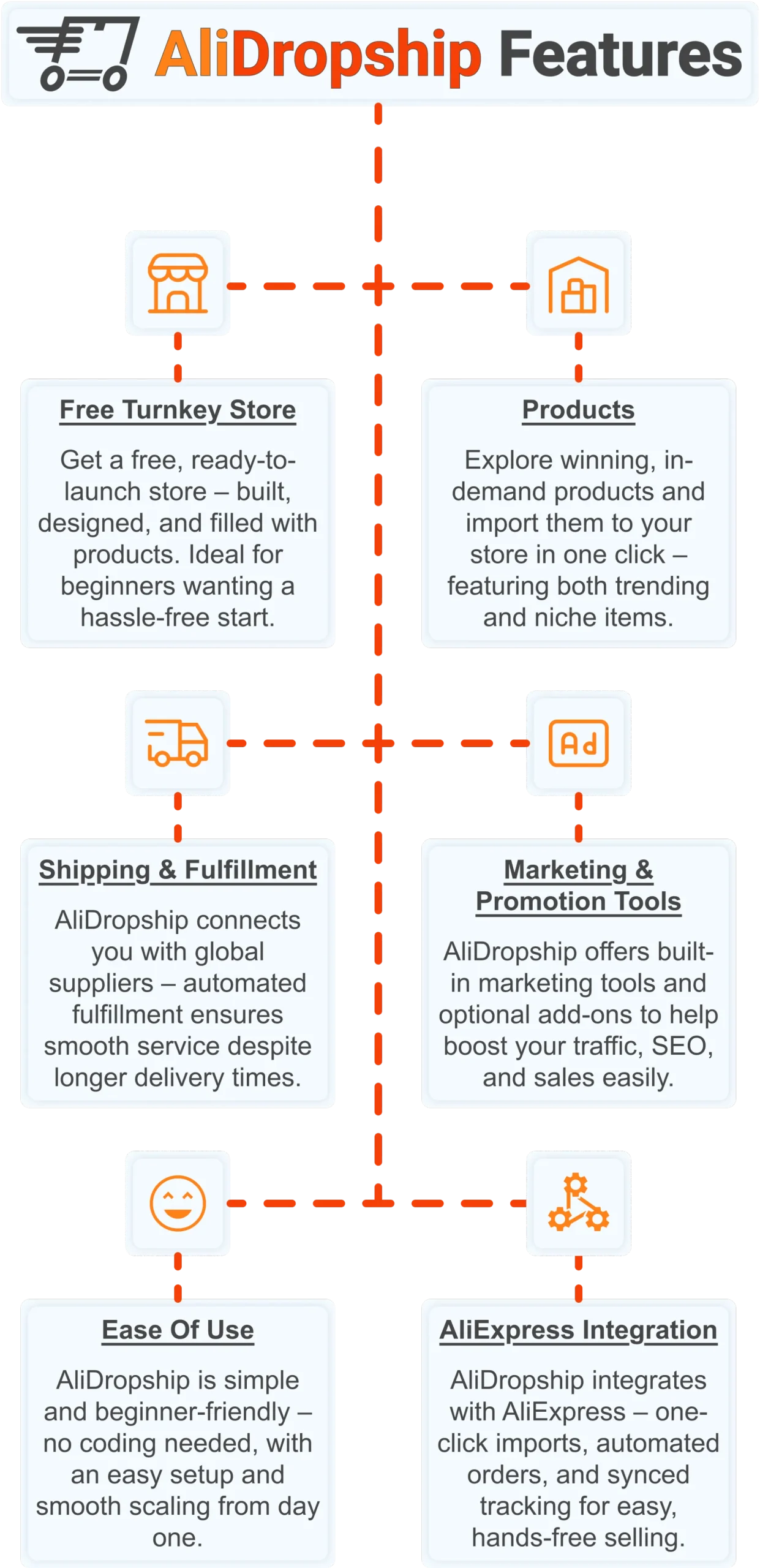
Free turnkey store ️
Get a free turnkey store – built, designed, and filled with products. Ideal for beginners wanting a hassle-free start, the store comes fully optimized to attract customers right away, saving you time on setup. Plus, it includes professional design elements to give your business a polished, trustworthy look from day one. This ready-made foundation makes it easy to move seamlessly into product selection.
Products
Once your store is set up, you can explore winning, in-demand products and import them in one click – featuring both trending and niche items. This wide selection lets you cater to diverse customer interests and test what works best. Regular updates ensure you always have fresh products, keeping your store competitive and relevant. With great products in place, smooth shipping becomes the next essential step.
Shipping & fulfillment
AliDropship connects you with global suppliers, and automated fulfillment ensures seamless order processing despite international delivery times. Customers receive real-time tracking updates, which builds confidence and trust in your store. Once shipping is handled reliably, you can focus on promoting your store and attracting traffic.
Marketing & promotion tools
To maximize sales, AliDropship offers built-in marketing tools and optional add-ons that help boost traffic, SEO, and conversions. From email campaigns and discounts to social media integration, these tools empower you to reach and retain customers without needing prior marketing experience. With promotion strategies in place, managing your business becomes simpler and more efficient.
Ease of use
AliDropship is beginner-friendly – no coding needed, with an intuitive dashboard that guides you through every step. Easy setup and smooth scaling let you expand your store without stress. As your business grows, adding new features, products, and marketing campaigns remains hassle-free, giving you more time to focus on sales.
AliExpress integration
Finally, AliDropship integrates seamlessly with AliExpress, enabling one-click imports, automated orders, and synced tracking. Your inventory stays up-to-date with the latest products and prices, while automated order processing frees you from manual tasks. Combined with the turnkey setup, reliable shipping, and built-in marketing tools, this integration ensures your dropshipping business is fully equipped for growth and success.
Frequently Asked Questions
Why should ecommerce sellers use AI apps in 2026?
AI apps allow one-person stores to compete against funded brands by automating the tasks that would otherwise require entire teams. According to PwC, 66% of businesses using AI report major time savings on routine tasks. McKinsey data shows organizations using AI see revenue increases of over 10% per business unit. In practical ecommerce terms, AI tools write product descriptions, answer customer queries around the clock, generate ad visuals, optimize listings for search, and identify trending products — all without the seller being directly involved. The combination of saved hours, better conversions, and faster decision-making makes AI tools a core operational advantage rather than an optional extra in 2026.
What are the best free AI apps for ecommerce beginners?
Three tools cover the most common pain points at zero upfront cost. ChatGPT’s free plan handles content writing, product description brainstorming, email drafting, and strategic thinking — functioning as a general-purpose AI assistant available around the clock. Tidio’s free plan provides AI chatbot and live chat functionality for customer support, FAQ handling, and order tracking, keeping response times fast without hiring support staff. Canva AI’s free plan combines a drag-and-drop design editor with an AI text generator, handling product visuals, social media posts, and store banners without any design background required. All three integrate with major ecommerce platforms and deliver meaningful value before any paid upgrade is needed.
Which AI tools work best specifically for dropshipping?
Three categories of AI tools deliver the highest value for dropshipping operations. For product research, ChatGPT can be prompted to surface trending categories, analyze competitor positioning, and stress-test product ideas against real market signals — compressing what would otherwise take hours of manual browsing. For content at scale, Jasper and AdCreative.ai generate conversion-optimized product descriptions, ad copy, and visual creatives across dozens of SKUs in minutes. For customer service without overhead, Tidio and Manychat handle routine queries — order status, returns, product questions — automatically and around the clock once the chat flows are set up, freeing the seller to focus on strategy rather than inbox management.
What mistakes should ecommerce sellers avoid when using AI apps?
Five patterns consistently reduce the value of AI tools. Treating AI output as a finished product rather than a starting point leads to errors in product descriptions and chatbot replies that damage customer trust — all AI-generated content should be reviewed before going live. Giving vague prompts to writing tools produces generic content; specific, detailed input consistently generates better output. Signing up for tools that do not integrate with your ecommerce platform creates friction rather than removing it — compatibility should be checked before committing. Over-automating customer communication that requires genuine human judgment — returns disputes, complaints, sensitive issues — creates poor experiences that no chatbot can repair. And trying to adopt too many AI tools simultaneously leads to tool overload; starting with one or two and building from there consistently outperforms trying to implement everything at once.
How should sellers choose between AI tools based on their stage of growth?
The right AI stack changes as a store scales. Complete beginners get the most value from ChatGPT, Tidio, and Canva AI — all available on free plans — which cover content creation, customer support, and product visuals at no upfront cost. Intermediate sellers scaling output without scaling hours should add Jasper for consistent high-quality copy at volume, AdCreative.ai for paid ad creatives, and Manychat for social selling automation across Instagram and WhatsApp. Advanced or multi-store sellers benefit most from Surfer SEO for long-term organic search growth, Creatify or Descript for video content production, Mokker or DoMyShoot for professional product photography at scale, and Superluminal to centralize access to multiple AI tools in a single workspace. The consistent principle across all stages is to identify the single biggest bottleneck first, pick the tool that addresses it, and only expand the stack once that tool is working consistently.
The best AI apps can sharpen your store – but AliDropship gives you the store itself, fully built and ready to sell. Claim your free ecommerce store and a $100 voucher to get started today.
 Previous post
