 ‧ Agnes Kazaryan ‧
March 20, 2026
‧ Agnes Kazaryan ‧
March 20, 2026  1061 ‧
 0
0
Thinking about starting a business but not sure which direction to go? You are not alone. The first question most new entrepreneurs get stuck on is: what are the different types of business models, and which one should I actually pick? The honest answer depends on three things – how much money you can start with, how much time you have each week, and whether you want to build something that earns independently or simply get paid faster for skills you already have.
Quick answer: The main types of business models include dropshipping, ecommerce, digital products, freelancing, affiliate marketing, and SaaS. Each has a different cost structure, time-to-profit, and income ceiling. For beginners with a limited budget, dropshipping and digital products offer the most accessible entry points in 2026.
This guide walks you through each model clearly – what it involves, what it realistically costs to start, and what you can expect to earn in the first 6 to 12 months. By the end, you will know exactly which model fits your situation and how to take the first step.
What are types of business models?
A business model is the underlying framework that explains how a business creates value, delivers it to customers, and earns money. When people talk about types of business models, they mean the structural logic of the operation – who you sell to, what you sell, how you deliver it, and how revenue flows back to you.
Two businesses can sell the exact same product and operate under completely different models. One might buy stock in bulk, warehouse it, and ship orders themselves. Another might list the same product, never touch any inventory, and have a supplier ship each order directly to the customer. The product is identical. The risk, startup cost, and daily workload are completely different.
In 2026, the gap between “I have an idea” and “I have a running business” has collapsed for several model types. You no longer need a physical location, a large team, or significant capital to launch something legitimate. What you do need is an honest understanding of which model fits your actual situation – not the one with the most impressive ceiling in a YouTube thumbnail.
Why this works in 2026: Global ecommerce is projected to exceed $7 trillion in annual sales, and the share captured by solo operators and small teams continues to grow as automation tools, supplier networks, and platform infrastructure become increasingly accessible to everyday people.
How much can you realistically earn from each model?
Before diving into the individual models, it helps to anchor your expectations with honest numbers. The income figures you see online almost always reflect the top 5% of operators who have refined their approach over 12 months or more. Here is a realistic comparison across the most widely used model types.
Dropshipping and digital products lead for beginners because they combine minimal startup cost with a realistic path to income within 60–90 days. Freelancing pays well but trades your time directly for money. SaaS has the highest ceiling but demands technical resources and a long runway before any revenue appears.
One note on the upper ranges: Those figures reflect operators putting in full-time effort, running paid traffic, and actively optimizing over 6 to 12 months. If you are starting part-time, expect the lower half of each range – particularly in the first 90 days. A model you can execute consistently at a moderate level will outperform a high-ceiling model you only manage sporadically.
Product-based business models
Dropshipping
Dropshipping is consistently ranked among the most beginner-friendly types of business models, and the reasons are straightforward. You sell products through your own online store, but you never hold physical inventory. When a customer places an order, your supplier ships the product directly to them. You keep the margin between what the customer paid and what the supplier charges.
No warehouse. No upfront stock purchase. No packing boxes. Your job is store management, product selection, and driving traffic. Platforms like AliDropship handle the heavy lifting – from importing products to automating order fulfilment – making the workflow far simpler than building everything from scratch.
Earning potential: $30–$200/day with consistent effort over 60–90 days. Full-time operators focused on a strong niche with paid traffic can push well beyond this range.
Traditional ecommerce (holding inventory)
Traditional ecommerce means buying stock upfront, storing it, and shipping it yourself or through a fulfilment centre. Margins tend to be higher than dropshipping because you negotiate bulk pricing – but the upfront capital requirement is also substantially higher. This model works well for entrepreneurs who already have supplier relationships, a specific product idea, or access to wholesale pricing.
The risk profile is different too. If products do not sell, you are sitting on dead stock that represents real money already spent. For first-time business owners, this makes traditional ecommerce a less forgiving starting point compared to dropshipping or digital products.
Earning potential: $50–$500/day once inventory is moving, but typically requires $2,000–$10,000 in startup capital to get meaningful traction.
Digital products
Selling digital products – guides, templates, courses, printables, tools – is one of the highest-margin business models available. You create or source the product once and sell it an unlimited number of times with no fulfilment cost and no inventory to manage. Delivery is instant.
The challenge for most beginners is the creation side: producing a digital product people will actually pay for takes real effort. However, platforms now exist that let you launch a digital product store pre-stocked with ready-made items, bypassing the creation step entirely.
Earning potential: $20–$150/day once your store is live and traffic is coming in. Margins are typically 70–90% since there are no per-unit supplier costs after the initial setup.
Service-based business models
Freelancing
Freelancing means selling your skills directly to clients – writing, design, development, video editing, marketing strategy, and dozens of other disciplines. Platforms like Upwork, Fiverr, and Toptal connect you with clients globally, and skilled freelancers can command strong hourly or project rates.
The path to first income is fast – sometimes within days of setting up a profile and landing your first gig. The ceiling, however, is limited by your time. Every project requires your direct involvement, which means freelancing does not scale the way product or software businesses do. When you stop working, the income stops.
Earning potential: $500–$5,000/month for most skilled freelancers, with specialists in high-demand areas like AI development, UX design, or conversion copywriting earning significantly more.
Consulting and coaching
Consulting is freelancing at a higher price point and with a more structured deliverable. You are not billing hourly for task execution – you are being paid for strategic advice, frameworks, and measurable outcomes. Coaches operate similarly, typically focusing on personal development, business growth, or career transitions.
Both models require credibility and a personal brand to attract clients at premium rates. Client acquisition is intensive early on, but per-project income can be strong once you have a clear niche and a demonstrable track record.
Earning potential: $2,000–$15,000/month for established consultants or coaches with a defined niche and documented results to back up their positioning.
Platform and traffic-based business models
Affiliate marketing
Affiliate marketing means promoting other companies’ products or services and earning a commission on every sale or lead you generate. You handle no product, no customer service, and no fulfilment. Your job is to drive qualified traffic through content, SEO, paid ads, or social media.
The model starts slowly. Building an audience or ranking content takes time – typically 6 to 12 months before you see meaningful, consistent income. Once the traffic is established, however, it can generate revenue with relatively little ongoing effort. The work you do today continues paying you months later.
Earning potential: $100–$3,000/month for most content-based affiliates, with high-ticket affiliates in finance, software, or health niches earning considerably more.
Content creation and ad revenue
YouTube channels, blogs, newsletters, and podcasts can generate income through advertising revenue, sponsorships, and audience monetisation. This model requires building an audience first – which means months of content production before any meaningful income appears.
Ad revenue per 1,000 views or page impressions is modest on its own. Most successful creators combine ad revenue with affiliate links and their own product sales to build a sustainable income. The channel is the distribution asset; how you monetise it is a separate decision.
Earning potential: $200–$2,000/month for mid-size audiences of 50,000–200,000 monthly visitors or views, scaling significantly as audience size and monetisation diversify.
SaaS (Software as a Service)
SaaS is arguably the most scalable business model available. You build a software product once and charge customers a recurring monthly or annual fee to use it. Revenue compounds as you add customers without proportionally increasing costs. Think Notion, Canva, or Stripe – all SaaS.
The barrier to entry is real. You need technical skills or the capital to hire developers, a strong product concept backed by validated market demand, and the patience to sustain 12 to 24 months of development and early-stage marketing before revenue appears. Most SaaS ideas do not reach product-market fit.
Earning potential: Essentially uncapped, but the realistic range for a bootstrapped indie SaaS after 18 months is $1,000–$15,000/month in monthly recurring revenue.
How to evaluate which model fits your situation
Choosing between the types of business models above is not about finding the “best” one in the abstract. It is about finding the best fit given your actual constraints. Four questions will narrow this down quickly.
How much startup capital do you have?
If your starting budget is under $500, your realistic options are freelancing, affiliate marketing, dropshipping, and digital products. Traditional ecommerce requires inventory capital. SaaS requires development resources. Both are effectively off the table without meaningful startup funds or technical skills.
Dropshipping stands out here because AliDropship offers a free turnkey store – meaning you can have a fully built, product-stocked store ready to launch with essentially no upfront cost. That removes the most common barrier for new entrepreneurs entirely.
How much time can you commit each week?
Freelancing and consulting require active, ongoing time – every dollar earned involves your direct effort. Dropshipping and digital products, once the store is running and marketing is in place, can generate semi-passive income. Affiliate marketing and content creation require heavy upfront time investment before revenue begins to flow.
If you have 5–10 hours per week, dropshipping with automation tools is one of the most time-efficient models available. If you have 20+ hours per week and want fast first income, freelancing gets you paid sooner. If you have 10–15 hours per week and want long-term scalable income, a content-plus-affiliate approach or a digital products store makes more sense.
Do you want to trade time for money, or build an asset?
Freelancing and consulting are high-income but non-scalable. When you stop working, the income stops. Ecommerce stores, affiliate sites, SaaS products, and digital product libraries are assets – they generate income independently of your daily hours once they are established and running.
Key principle: If your goal is financial independence rather than a higher-paying job, prioritise asset-building models over time-for-money models, even if the asset takes longer to generate its first dollar.
What is your risk tolerance?
Traditional ecommerce and SaaS carry the most downside risk – invested capital or development time can be lost if the product does not find a market. Freelancing carries almost no financial risk. Dropshipping sits comfortably in between: there is minimal financial risk since you only pay a supplier after a customer has already paid you, but there is a real time investment in building and refining the store before it generates consistent revenue.
Legal and ethical considerations when starting a business
Whichever of the types of business models you choose, there are legal and ethical foundations that apply universally. Skipping these in the early stages is one of the most consistent ways new entrepreneurs create serious problems for themselves later.
Business registration and taxes
Even a sole trader dropshipping store or a one-person freelance operation is a business in the eyes of tax authorities. In most countries, you are required to report income above a certain threshold and pay applicable taxes. Register your business early, keep clear records of income and expenses from day one, and consult a local accountant if you are unsure about your obligations in your specific country.
Important: Operating without proper registration does not protect you from tax liability – it simply delays it and adds penalties when authorities catch up.
Product and supplier compliance
If you run a dropshipping or ecommerce store, you are legally responsible for what you sell – even if a third-party supplier fulfils the orders. Selling counterfeit goods, unlicensed branded products, or items that do not meet your country’s safety standards can result in account bans, legal action, and customer refund disputes that destroy your reputation.
Stick to legitimate suppliers, verify that product descriptions match actual items, and never list branded products you do not have authorisation to sell. AliDropship’s supplier network is built around compliant, verifiable products, which removes a significant part of this risk for dropshippers using the platform.
Advertising and income claims
If you promote your business through social media or content marketing, be careful about the claims you make. Advertising regulations in the US (FTC), UK (ASA), and EU (CPC) all require that income claims be substantiated and that sponsored content be clearly disclosed.
What to avoid absolutely: fake testimonials, fabricated income screenshots, undisclosed affiliate relationships, and misleading product descriptions. These tactics might generate short-term clicks but create long-term legal exposure and destroy the customer trust that every sustainable business depends on.
Which model is right for you: Final recommendations by reader profile
After covering all the main types of business models in detail, here is a practical summary based on where you are right now.
Complete beginner with limited budget
Start with dropshipping via a platform like AliDropship, or consider a digital products store. Both give you a real, functioning business with minimal upfront cost and zero inventory risk. AliDropship’s free turnkey store option is built specifically for this profile – you get a built, stocked, and designed store without needing technical skills or startup capital. Expect your first consistent sales within 60–90 days if you put in 5–10 hours per week on marketing and optimisation.
Intermediate / part-time operator
If you already have some online income and want to diversify or scale, adding an affiliate content site alongside an ecommerce store creates a dual-channel income stream. The affiliate content drives organic traffic over time while the store generates transactional revenue today. At this stage, automation tools matter – AliDropship’s order fulfilment automation means your store can process sales without requiring your attention on every transaction.
Advanced / full-time income goal
If your goal is to replace a full-time income within 12 months, focus intensively on one model rather than spreading across several. Dropshipping with a clear niche, paid advertising, and a strong product selection strategy is one of the most proven paths to full-time income within a realistic timeframe. Operators running focused stores with $30–$50/day in ad spend commonly reach $100–$300/day in revenue within 90 days of active optimisation.
Skill-based professional
If you have a marketable skill – design, development, writing, marketing – freelancing gives you the fastest path to meaningful income, often within your first week on platforms like Upwork or Fiverr. Use this income to fund a parallel asset-building model – a dropshipping store, an affiliate site – so that over 12–18 months you are building something that earns independently of your hours. The two models work together, not against each other.
AliDropship: Your complete all-in-one solution for starting dropshipping in 2026
If you want the simplest possible way to start dropshipping – especially if you’re brand new – AliDropship remains one of the most beginner-friendly tools available in 2026. It brings together store creation, product imports, automation, and marketing into a single streamlined system designed to help you launch quickly and grow confidently.
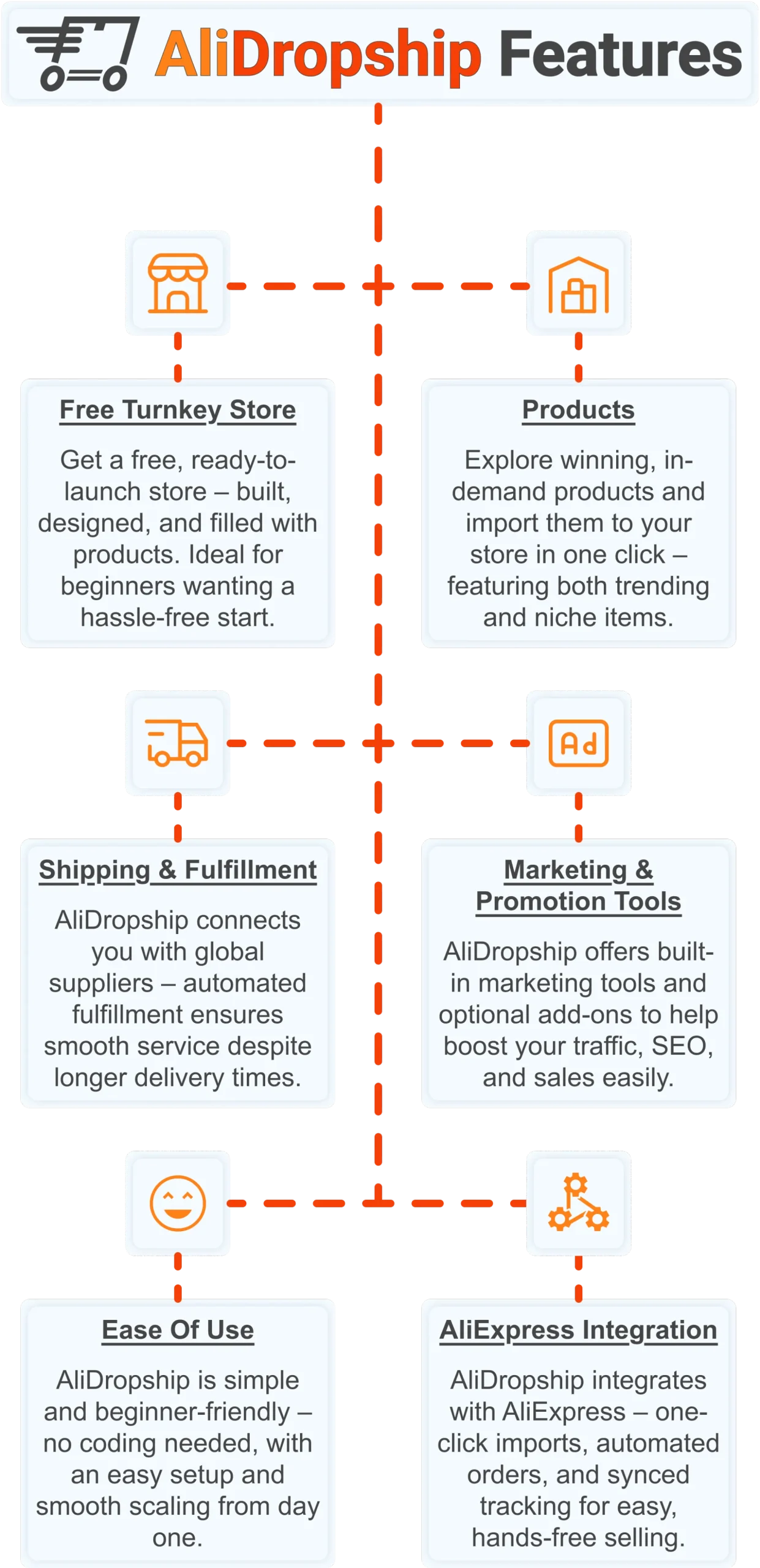
Free turnkey store ️
Get a free turnkey store – built, designed, and filled with products. Ideal for beginners wanting a hassle-free start, the store comes fully optimized to attract customers right away, saving you time on setup. Plus, it includes professional design elements to give your business a polished, trustworthy look from day one. This ready-made foundation makes it easy to move seamlessly into product selection.
Products
Once your store is set up, you can explore winning, in-demand products and import them in one click – featuring both trending and niche items. This wide selection lets you cater to diverse customer interests and test what works best. Regular updates ensure you always have fresh products, keeping your store competitive and relevant. With great products in place, smooth shipping becomes the next essential step.
Shipping & fulfillment
AliDropship connects you with global suppliers, and automated fulfillment ensures seamless order processing despite international delivery times. Customers receive real-time tracking updates, which builds confidence and trust in your store. Once shipping is handled reliably, you can focus on promoting your store and attracting traffic.
Marketing & promotion tools
To maximize sales, AliDropship offers built-in marketing tools and optional add-ons that help boost traffic, SEO, and conversions. From email campaigns and discounts to social media integration, these tools empower you to reach and retain customers without needing prior marketing experience. With promotion strategies in place, managing your business becomes simpler and more efficient.
Ease of use
AliDropship is beginner-friendly – no coding needed, with an intuitive dashboard that guides you through every step. Easy setup and smooth scaling let you expand your store without stress. As your business grows, adding new features, products, and marketing campaigns remains hassle-free, giving you more time to focus on sales.
AliExpress integration
Finally, AliDropship integrates seamlessly with AliExpress, enabling one-click imports, automated orders, and synced tracking. Your inventory stays up-to-date with the latest products and prices, while automated order processing frees you from manual tasks. Combined with the turnkey setup, reliable shipping, and built-in marketing tools, this integration ensures your dropshipping business is fully equipped for growth and success.
Of all the types of business models available in 2026, dropshipping with AliDropship gives beginners the most direct path from zero to a functioning, revenue-ready store. Claim your free turnkey store and start building your ecommerce income today.
Frequently asked questions
What are the main types of business models available in 2026?
The main types of business models include dropshipping, traditional ecommerce, digital products, freelancing, affiliate marketing, and SaaS. Each has a different cost structure, time to profit, and income ceiling depending on how it operates. For beginners with a limited budget, dropshipping and digital products offer the most accessible entry points since they require minimal startup capital. Global ecommerce is projected to exceed 7 trillion dollars in annual sales in 2026, with solo operators capturing a growing share.
How much can you realistically earn from dropshipping compared to other business models?
Dropshipping offers earning potential of 30 to 200 dollars per day, typically within 60 to 90 days of consistent effort. Digital products offer a similar range of 20 to 150 dollars per day once the catalogue is live, with margins of 70 to 90 percent. Freelancing pays 500 to 5000 dollars per month depending on skill and clients, while traditional ecommerce can reach 50 to 500 dollars per day but usually requires 2000 to 10000 dollars in startup capital. SaaS has the highest ceiling, ranging from 0 to 50000 dollars or more per month, but typically takes 12 to 24 months to generate revenue.
What is the difference between dropshipping and traditional ecommerce?
Dropshipping means selling products without ever holding inventory, since a supplier ships directly to the customer after an order is placed. Traditional ecommerce involves buying stock upfront, storing it, and shipping it yourself or through a fulfilment centre, which typically requires 2000 to 10000 dollars in startup capital. Traditional ecommerce margins tend to be higher because of bulk pricing negotiation, but the risk profile is different since unsold stock represents real money already spent. Dropshipping carries minimal financial risk because suppliers are only paid after a customer has already paid.
How does digital product income compare to freelancing income?
Digital products generate 20 to 150 dollars per day once a store is live and traffic is coming in, with margins typically running 70 to 90 percent since there are no per unit supplier costs after setup. Freelancing generates 500 to 5000 dollars per month depending on skill level and client quality, but every dollar earned requires direct time and effort. Digital products function as an asset that can generate income independently of daily hours once established, while freelancing income stops when the work stops. Specialists in high demand freelance areas like AI development or UX design can earn significantly more than the typical range.
What should beginners consider when choosing between business models?
Startup capital matters significantly, since a budget under 500 dollars limits realistic options to freelancing, affiliate marketing, dropshipping, and digital products. Time commitment also plays a role, with 5 to 10 hours per week suiting dropshipping using automation tools, while 20 or more hours per week suits freelancing for faster first income. Risk tolerance is another factor, since traditional ecommerce and SaaS carry the most downside risk of lost capital or development time. AliDropship offers a free turnkey store that removes the most common capital barrier for new entrepreneurs entirely.
 Previous post
