 ‧ Agnes Kazaryan ‧
March 20, 2026
‧ Agnes Kazaryan ‧
March 20, 2026  537 ‧
537 ‧
 0
0
Most online stores fail not because they sell bad products – but because they give shoppers no real reason to choose them over everyone else. That is where a unique selling proposition comes in. If you are launching a dropshipping store or trying to grow one you already have, your USP might be the most important piece of copy you ever write.
Quick Answer: A unique selling proposition (USP) is a clear, specific statement that explains what makes your business different from competitors – and why that difference matters to your customer. It is not a slogan. It is the core reason someone should buy from you and not the next store over.
In this guide you will learn what a strong unique selling proposition actually looks like, how to write one from scratch even if you are brand new to ecommerce, and which USP types perform best in 2026. Whether you are selling niche products, running a dropshipping store, or still figuring out your angle, there is a clear path forward.
Before diving into frameworks and examples, it helps to understand why so many store owners skip this step – and why that decision costs them in the long run. A business without a clear unique selling point is just another option in a crowded market. With one, you become the obvious choice for a specific group of people.
What is a unique selling proposition?
A unique selling proposition – also called a unique selling point or USP – is a concise statement that identifies the one thing your business does better than, or differently from, every other option your customer has. It answers the question every potential buyer is silently asking: why should I buy from you and not someone else?
A good USP is not vague. “We sell quality products at great prices” is not a unique selling proposition – every store claims that. A real USP is specific, believable, and meaningful to the exact customer you are trying to reach. Think of Domino’s Pizza’s classic positioning: hot, fresh pizza delivered in 30 minutes or you get it free. That is a USP. It is measurable, it addresses a real customer fear, and it is a promise the company can actually keep.
In ecommerce, your unique selling proposition shapes everything – your product page copy, your ad creative, your email subject lines, even the tone of your customer service. It is the thread that connects every touchpoint your customer has with your brand. Get it right and everything else becomes easier to write, easier to test, and easier to scale.
Why this works in 2026: Online shoppers are overwhelmed with options. A clear unique selling point cuts through the noise instantly and gives your ideal customer a reason to stop scrolling and actually buy.
How much does a strong USP actually affect your revenue?
It is easy to treat your unique selling proposition as a branding exercise – something you write once and then forget about. But your USP has a direct, measurable impact on your conversion rate, your customer acquisition cost, and your long-term retention. The table below shows what the numbers tend to look like across different ecommerce positioning strategies.
Stores with a strong, specific unique selling proposition consistently outperform generic competitors – not just in initial conversions but in repeat purchase rate and word-of-mouth referrals.
One note on these figures: Conversion ranges reflect industry benchmarks and vary significantly by niche, traffic source, and price point. A USP alone will not fix a broken funnel – but it is the single most powerful lever for improving top-of-funnel performance.
The good news is that you do not need a marketing degree or a big budget to develop a compelling unique selling point. You need clarity about who your customer is, what they actually want, and what gap in the market your store fills. That process is simpler than most beginners expect.
How to create a unique selling proposition step by step
Writing a USP is not about being clever. It is about being honest and specific. The following process works whether you are building your first dropshipping store or refining a brand you have been running for years.
Start with your customer’s problem, not your product
Every strong unique selling proposition starts with a customer pain point, not a product feature. Before you write a single word of your positioning statement, ask yourself: what frustration, desire, or fear does my ideal customer have that my store directly addresses?
If you sell eco-friendly pet products, the pain point might be guilt – pet owners who love their animals and hate contributing to plastic waste. If you sell posture-correcting gear, the pain point is chronic discomfort that traditional solutions have failed to fix. The more precisely you can name that problem, the sharper your unique selling point will be.
Research what your competitors are actually saying
Spend 30 minutes reading the homepage copy of your five closest competitors. What words do they use? What claims do they make? Most ecommerce stores in any given niche say almost identical things – “premium quality,” “fast shipping,” “great prices.” That sameness is your opportunity.
If every competitor focuses on product quality, you can win on customer experience. If they all compete on price, you can win on trust and community. Your unique selling proposition only needs to be different from theirs – not different from every business in the world. Reddit and Trustpilot are also useful here: read what real customers complain about in your niche and use that language directly in your USP.
Map your genuine strengths honestly
List everything your store actually does well – not what you wish it did, but what it genuinely delivers. Are you faster? More specialised? Do you serve a customer your competitors ignore? Do you have a return policy that removes all the risk? Is your product curation tighter than the big generalist stores?
Be ruthlessly honest here. A unique selling proposition built on a real strength is sustainable. One built on an aspiration will fall apart the moment a customer puts it to the test.
Earning potential: Ecommerce stores with a clearly defined unique selling proposition and a targeted niche typically generate $30–$100/day within 60–90 days of launch, compared to $5–$15/day for stores with no differentiation strategy.
Use a USP formula that forces clarity
Once you know your customer’s problem, your competitors’ weaknesses, and your genuine strengths, plug them into this formula: [What you do] + [For whom] + [That solves X] + [Unlike competitors, because Y].
You do not need to use every element in every version, but the discipline of filling in each slot forces clarity. A dropshipping store selling minimalist home goods for small-apartment dwellers might land on something like: “Space-smart home essentials for city renters who are tired of cluttered living – curated for under 400 square feet.” That is specific, relatable, and immediately differentiating.
Test it with real people before you commit
Before you put your unique selling proposition on your homepage, run it past five people who match your target customer profile. Do not ask “do you like this?” Ask “what does this make you think the store sells?” and “would this make you want to browse?”
If they get it immediately and feel something – curiosity, relief, excitement – you are on the right track. If they are confused or indifferent, go back and sharpen the specificity. Reddit communities, Facebook groups, and even friends with no ecommerce knowledge make useful quick-test audiences.
USP examples that work in ecommerce – and why
Looking at real unique selling proposition examples is the fastest way to understand what good positioning actually feels like. These are not all famous brands – some are the kind of small, focused stores that consistently outperform larger competitors because they know exactly who they are for.
Product-focused USP examples
“The only running shoes designed for flat-footed runners”
This is a niche unique selling proposition that immediately signals to a specific customer: this brand sees me. It does not try to appeal to all runners – it intentionally excludes most of them in order to become indispensable to a smaller group. That trade-off is exactly right for a new ecommerce store. You cannot out-market the biggest players in your space. You absolutely can own a specific underserved segment.
“Skincare for men who hate skincare routines”
This USP works because it meets the customer where they are – not where the brand wishes they were. It acknowledges the real barrier (complexity and time) and promises to remove it. It also has personality, which makes it memorable. The best unique selling propositions sound like something a real person would say, not a corporate mission statement.
Service and experience-focused USP examples
“Free returns, no questions, no forms, forever”
This unique selling point removes the single biggest psychological barrier to online shopping: the fear of being stuck with something that does not work. It does not compete on price or product quality – it competes on trust.
For a dropshipping store, where customers cannot physically inspect products before buying, a generous and clearly communicated return policy can be one of the most powerful differentiators available. The key is to actually deliver on it.
“Curated by a practising nutritionist, not an algorithm”
The human-curation unique selling proposition is increasingly powerful in 2026 because so much of what people encounter online feels machine-generated and generic. If you have genuine expertise in your niche – whether that is nutrition, fitness, interior design, or outdoor adventure – making that expertise the centrepiece of your USP can justify premium pricing and build a loyal community that no price-cutter can steal from you.
Important note: A service-based unique selling point only works if you can actually deliver on it. If your return policy is generous on paper but a nightmare in practice, the USP becomes a liability. Under-promise and over-deliver, every time.
Legal and ethical considerations when positioning your store
Your unique selling proposition is a promise. If you build it on claims you cannot back up, you are not just risking customer trust – you may be crossing into false advertising territory, depending on your market and jurisdiction.
Here is what to avoid absolutely when crafting your USP and positioning copy:
- Superlatives you cannot prove. “The world’s best,” “the only store that,” or “guaranteed results” all invite regulatory scrutiny if you cannot substantiate them. Stick to claims you can verify with data, reviews, or certifications.
- Fake scarcity or urgency. Countdown timers that reset, fake stock levels, and manufactured “limited time” offers erode trust the moment a customer notices the pattern. Real urgency is fine. Manufactured urgency is both unethical and increasingly illegal in many regions.
- Fabricated social proof. Fake reviews, inflated review counts, or paid testimonials presented as organic feedback violate platform terms of service and consumer protection laws in most countries. Build your review base honestly from day one – it takes longer but it lasts.
Key principle: Your unique selling proposition should be something you are proud to be held accountable to – a promise you actively work to keep, not a claim you hope no one tests.
What to do instead: build your USP around genuine advantages – your curation, your community, your expertise, your sourcing, your service standards. These are differentiators that compound over time and cannot be copied overnight by a bigger competitor.
How to choose your USP approach based on where you are now
Not every unique selling proposition strategy suits every seller. Where you are in your ecommerce journey should shape what kind of USP you lead with.
Complete beginner
If you are just starting out, keep your unique selling proposition simple and niche-focused. Pick a specific customer segment within a broad category and build everything around their particular needs. You do not need a grand brand story yet – you need clarity.
“Minimalist gifts for people who hate clutter” is a better starting point than “beautiful gifts for everyone.” Specificity is your competitive advantage when you have no track record and no budget for brand-building. Start narrow, earn trust, then expand.
Intermediate – running a store part-time
At this stage you probably have some customer feedback to work with. Use it. Real customer language – the exact words your buyers use to describe the problem your store solves – is gold for unique selling proposition refinement. Read your reviews, your support emails, your social comments. The most compelling USP you can write is one borrowed directly from the mouths of happy customers.
At this level, aim for $30–$80/day as a realistic benchmark, which most part-time stores reach within 3–6 months of consistent positioning and traffic testing.
Advanced – aiming for full-time income
At the full-time level, your unique selling proposition needs to be defensible – not just different, but difficult to replicate. This might mean exclusive supplier relationships, a proprietary product bundle, a community or membership layer, or a content-driven brand with genuine authority in your niche.
Aim for $80–$200/day as a realistic full-time ecommerce benchmark, understanding that reaching that level typically requires 6–12 months of consistent positioning, testing, and optimisation. The stores that scale are the ones with a clear unique selling proposition that gives customers a reason to return, refer, and trust.
Final thoughts – which USP approach is right for you?
Your unique selling proposition does not need to be revolutionary. It needs to be honest, specific, and meaningful to the right person. The stores that struggle are almost always the ones that tried to appeal to everyone – and ended up compelling no one.
If you are a complete beginner, start with a tight niche and a simple customer-problem statement. If you are part-time, mine your customer feedback for language that already works. If you are aiming for full-time income, build a USP that creates a moat – something rooted in expertise, community, or a curated experience that competitors cannot easily replicate.
Regardless of your level, the forward-looking reality of ecommerce in 2026 is the same: differentiation is no longer optional. The tools to build and launch a properly positioned store – and to do it fast – are more accessible than ever. The only thing standing between you and a store that converts is clarity about what makes you worth choosing.
Frequently asked questions
What is a unique selling proposition and why does it matter?
A unique selling proposition is a concise statement identifying the one thing a business does better than or differently from every other option a customer has. It is not a slogan, but the core reason someone should buy from a specific store rather than a competitor. In ecommerce, the unique selling proposition shapes product page copy, ad creative, email subject lines, and customer service tone. A generic claim like we sell quality products at great prices does not qualify, since every store claims that.
How much does a strong unique selling proposition actually affect revenue?
Stores with no clear unique selling proposition typically see conversion rates of only 0.5 to 1 percent and compete mainly on price. A generic unique selling proposition improves conversion to roughly 1 to 2 percent with some differentiation. A strong, specific unique selling proposition can push conversion rates to 3 percent or higher, along with lower ad costs and stronger customer loyalty. Ecommerce stores with a clearly defined unique selling proposition and targeted niche typically generate 30 to 100 dollars per day within 60 to 90 days of launch.
How do you create a unique selling proposition step by step?
The process starts with identifying the customer specific pain point rather than a product feature, since the sharper the problem, the sharper the unique selling point. Researching 5 competitor homepages reveals what claims are already overused, like premium quality or fast shipping, which becomes the opportunity to differentiate. A useful formula is what you do, plus for whom, plus that solves X, plus unlike competitors because Y. Testing the resulting statement on 5 real people who match the target customer profile helps confirm whether it creates genuine interest.
What are some real unique selling proposition examples that work in ecommerce?
The only running shoes designed for flat footed runners works because it intentionally excludes most runners to become indispensable to a smaller group. Free returns, no questions, no forms, forever removes the single biggest psychological barrier to online shopping, which is the fear of being stuck with something that does not work. Curated by a practising nutritionist, not an algorithm leans into genuine human expertise, which can justify premium pricing. A service-based unique selling point only works if the business can actually deliver on the promise consistently.
What legal and ethical issues apply to a store unique selling proposition?
Superlatives that cannot be proven, such as the worlds best or guaranteed results, invite regulatory scrutiny if they cannot be substantiated with data or certifications. Fake scarcity or urgency, including countdown timers that reset or manufactured limited time offers, erodes trust the moment a customer notices the pattern. Fabricated social proof, such as fake reviews or paid testimonials presented as organic feedback, violates platform terms and consumer protection laws in most countries. A unique selling proposition should be a promise a business is prepared to be held accountable to, not an unverified claim.
AliDropship: Your complete all-in-one solution for starting dropshipping in 2026
If you want the simplest possible way to start dropshipping – especially if you’re brand new – AliDropship remains one of the most beginner-friendly tools available in 2026. It brings together store creation, product imports, automation, and marketing into a single streamlined system designed to help you launch quickly and grow confidently.
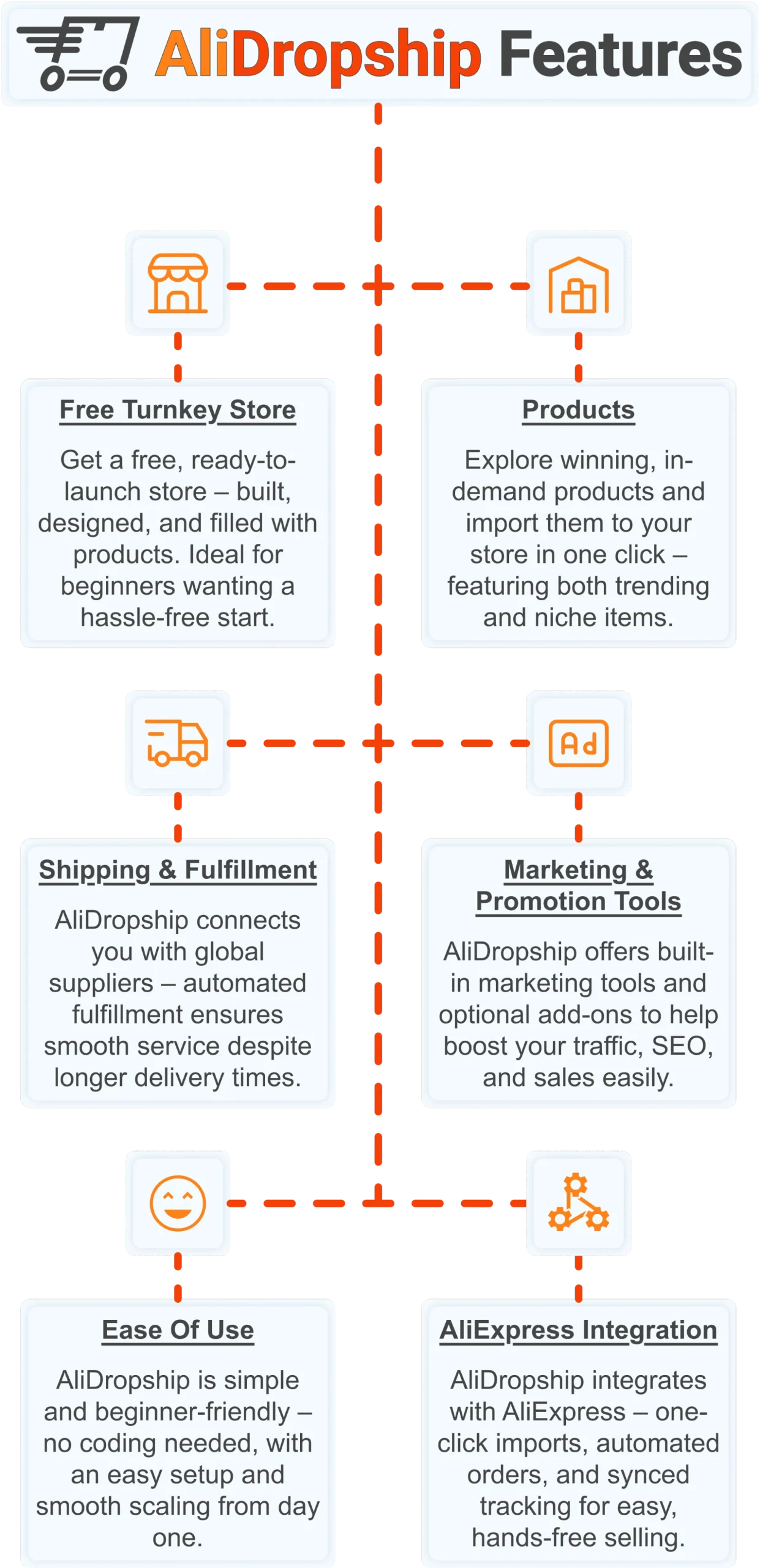
Free turnkey store ️
Get a free turnkey store – built, designed, and filled with products. Ideal for beginners wanting a hassle-free start, the store comes fully optimized to attract customers right away, saving you time on setup. Plus, it includes professional design elements to give your business a polished, trustworthy look from day one. This ready-made foundation makes it easy to move seamlessly into product selection.
Products
Once your store is set up, you can explore winning, in-demand products and import them in one click – featuring both trending and niche items. This wide selection lets you cater to diverse customer interests and test what works best. Regular updates ensure you always have fresh products, keeping your store competitive and relevant. With great products in place, smooth shipping becomes the next essential step.
Shipping & fulfillment
AliDropship connects you with global suppliers, and automated fulfillment ensures seamless order processing despite international delivery times. Customers receive real-time tracking updates, which builds confidence and trust in your store. Once shipping is handled reliably, you can focus on promoting your store and attracting traffic.
Marketing & promotion tools
To maximize sales, AliDropship offers built-in marketing tools and optional add-ons that help boost traffic, SEO, and conversions. From email campaigns and discounts to social media integration, these tools empower you to reach and retain customers without needing prior marketing experience. With promotion strategies in place, managing your business becomes simpler and more efficient.
Ease of use
AliDropship is beginner-friendly – no coding needed, with an intuitive dashboard that guides you through every step. Easy setup and smooth scaling let you expand your store without stress. As your business grows, adding new features, products, and marketing campaigns remains hassle-free, giving you more time to focus on sales.
AliExpress integration
Finally, AliDropship integrates seamlessly with AliExpress, enabling one-click imports, automated orders, and synced tracking. Your inventory stays up-to-date with the latest products and prices, while automated order processing frees you from manual tasks. Combined with the turnkey setup, reliable shipping, and built-in marketing tools, this integration ensures your dropshipping business is fully equipped for growth and success.
A sharp unique selling proposition tells customers why to choose you – AliDropship gives you the store that delivers on that promise from day one. Get your free turnkey store and start building a brand that stands out.
 Previous post
