 ‧ Agnes Kazaryan ‧
March 15, 2026
‧ Agnes Kazaryan ‧
March 15, 2026  832 ‧
832 ‧
 0
0
Over 2.77 billion people are expected to shop online in 2026, and global ecommerce revenue is on track to exceed $8 trillion this year. If you are thinking about launching an online store – or switching from a platform that is slowing you down – the choice you make here shapes everything: your monthly costs, your technical workload, and how fast you can actually start selling.
Quick answer: The top ecommerce platforms in 2026 are Shopify, WooCommerce, BigCommerce, Wix, Squarespace, and Hostinger. The right one for you depends on your budget, business model, and how much technical setup you are willing to handle. Beginners and dropshippers tend to do best on platforms that minimize friction and include built-in product sourcing tools.
This guide breaks down every major platform honestly – what each one gets right, where it falls short, and exactly who it suits. By the end, you will know which of the top ecommerce platforms matches your situation and how to get moving without wasting weeks on the wrong tool.
What is an ecommerce platform?
An ecommerce platform is the software that powers your online store. It handles the technical side of selling: product listings, shopping cart, payment processing, order management, and usually a set of marketing tools on top. Think of it as the operating system your entire business runs on.
In 2026, the best ecommerce platforms go well beyond basic store functionality. They now include AI-powered product recommendations, automated inventory syncing, multichannel selling across social platforms, and built-in analytics dashboards that used to require expensive third-party apps. The gap between beginner-friendly tools and enterprise-grade platforms has narrowed meaningfully – which is good news if you are just starting out.
There are two broad categories worth understanding before you compare options. Hosted platforms – like Shopify, Wix, and Squarespace – manage server infrastructure for you. You pay a monthly fee and focus on running your business. Self-hosted platforms – like WooCommerce – give you more control but require you to manage hosting, updates, and security yourself. For most first-time store owners, a hosted platform is the smarter starting point.
How much can you realistically earn with an online store?
Income from an online store varies a lot depending on your niche, traffic strategy, and consistency. That said, real-world data from active dropshippers and independent sellers gives a reasonable frame of reference for what to expect.
These figures reflect stores run with consistent effort over 3–12 months. Dropshipping is the most accessible entry point because you never carry inventory – your supplier ships directly to the customer.
One note on earning timelines: The $30–$80/day figure assumes a properly set-up store with a working traffic source – typically paid ads or organic SEO content. Most sellers who reach consistent daily revenue get there in 60–90 days of focused work, not 60–90 days of casual effort. Full-time income – around $40,000–$60,000 per year – is realistic but usually takes 6–18 months of iteration and reinvesting profits. The platform matters less than the consistency you bring to the business.
The top ecommerce platforms compared in 2026
Below is an honest breakdown of the most widely used ecommerce platforms this year. Each is evaluated on ease of use, pricing, scalability, and suitability for specific business models – with particular attention to dropshipping.
Hosted all-in-one platforms
These are the most popular starting points for new store owners. Everything is managed in one place – hosting, design, payments, and often marketing tools included by default.
Shopify
Shopify is the most widely used ecommerce platform in the world in 2026, with over 1 million active stores. Its strengths are well established: a clean drag-and-drop store builder, 70+ professional themes, built-in payment processing, and a huge app marketplace covering everything from upsells to email marketing. A basic store can be live in under an hour.
The Basic plan starts at $29/month billed annually. The main cost to watch beyond the plan fee is transaction charges – unless you use Shopify Payments, you pay an additional 0.5%–2% per sale depending on your plan tier. For dropshipping specifically, Shopify integrates with a wide range of supplier apps and is a reliable foundation for scaling.
Why this works in 2026: Shopify launched agentic storefronts this year, integrating AI tools directly into the merchant dashboard to automate routine tasks and personalize the shopping experience at scale.
Earning potential: $500–$10,000+/month with consistent traffic and a tested product range.
Wix
Wix has moved well beyond a simple website builder. In 2026, it consistently ranks among the top ecommerce platforms for small businesses thanks to its AI-assisted store setup, drag-and-drop design freedom, and a strong built-in feature set. Abandoned cart recovery, product subscriptions, and multichannel selling are all included on ecommerce plans starting at $29/month.
The trade-off is scalability. Wix handles stores with up to a few hundred products well, but high-volume operations tend to find inventory management and reporting less capable than Shopify or BigCommerce. Migration away from Wix is also more difficult than switching between other platforms, so factor that in if you plan to grow aggressively.
Best for: Service-based businesses, creatives, and small product stores that want a single platform for both website and ecommerce.
Squarespace
Squarespace is the strongest option for design-focused businesses – photographers, consultants, stylists, and brands where visual identity does the heaviest lifting. Its templates are genuinely some of the best available across any platform, and the 2026 Blueprint setup tool walks you through configuration based on your business goals, which significantly reduces decision fatigue for new users.
Ecommerce features start at the Business plan level. Squarespace includes built-in appointment scheduling, email marketing, and membership tools – useful if your model mixes physical products with services or digital content. Transaction fees apply on lower-tier plans, so account for that in your margin calculations before committing.
Best for: Visual brands, service providers, and sellers of digital products or courses.
Hostinger
Hostinger is the most budget-friendly hosted platform on this list. The Business plan starts at $3.99/month introductory rate (renews at $18.99/month) and includes up to 1,000 products, 100+ payment gateways, and zero transaction fees. For new sellers watching startup costs closely, those savings are real – particularly compared to Shopify at $29/month.
The limitations are real too. Hostinger’s ecommerce ecosystem is smaller and less mature than Shopify or BigCommerce. App integrations, analytics depth, and customer support all lag behind the market leaders. It is a solid starting platform if budget is your primary constraint, but plan to migrate as your store grows.
Best for: First-time sellers with tight budgets who want to test a product concept before committing to a higher-cost platform.
Open-source and self-hosted platforms
These platforms give you maximum control and customization but require significantly more technical management. They suit developers or businesses with requirements that hosted platforms cannot meet.
WooCommerce
WooCommerce is a free WordPress plugin that turns a WordPress site into a fully functional online store. It powers a substantial share of all ecommerce sites globally, primarily because of its flexibility – thousands of plugins cover every feature imaginable, and you have complete ownership of your code and data.
The catch is that “free” is somewhat misleading. You still pay for hosting ($5–$30/month), a domain, security plugins, and premium extensions for features that come built-in on paid platforms. A properly equipped WooCommerce store typically costs $20–$50/month total – comparable to hosted options – while requiring considerably more technical effort to maintain. It is the right choice if you already run a WordPress site or need deep customization that hosted platforms do not allow.
Best for: WordPress users, developers, and businesses that need custom integrations or full platform ownership.
Magento (Adobe Commerce)
Magento – now branded as Adobe Commerce – is an enterprise-level platform designed for large retailers with complex operations: multiple storefronts, B2B pricing rules, ERP integrations, and high six-figure annual revenues. It is extremely powerful and extremely demanding. Development and maintenance costs are substantial, and you will almost certainly need a developer on retainer or in-house to keep it running.
For most independent sellers and small-to-medium businesses, Magento is overkill. It is worth knowing it exists as a future migration target if you scale to a point where enterprise features become necessary.
Best for: Large retailers and enterprises with dedicated development resources and complex operational requirements.
Marketplaces vs independent store platforms
A question that comes up regularly: should you sell on Amazon or eBay instead of building your own store? The answer matters because these are structurally different business models.
Marketplaces like Amazon (estimated $300 billion in third-party sales in 2026), eBay ($39 billion GMV), and TikTok Shop ($15 billion) offer built-in traffic – you do not have to find customers from scratch. But you operate entirely on their terms: fees eat into margins, you do not own customer relationships, and your listing can be removed at any time without warning.
An independent store on Shopify or WooCommerce means you own your customer data, control your brand experience, and keep a larger share of each sale. The trade-off is that driving traffic is your responsibility. Most successful ecommerce businesses in 2026 use a hybrid approach – a primary independent store for brand building combined with marketplace listings for reach.
Top ecommerce platforms: Side-by-side comparison
Pricing reflects base ecommerce-enabled plans as of 2026. Transaction fees, app costs, and premium themes can significantly increase total monthly spend on all platforms.
What to look for when choosing an ecommerce platform
Platform comparisons get overwhelming fast. Here are the factors that actually move the needle for independent sellers and small business owners.
Ease of setup
If it takes more than a few hours to get a functional store live, your momentum will stall before you make your first sale. Prioritize platforms with intuitive store builders, ready-made templates, and guided onboarding. Shopify, Wix, and Hostinger all score well here. WooCommerce and Magento require significantly more setup time and technical knowledge.
Mobile performance
Mobile commerce now accounts for the majority of global ecommerce traffic. Your store must load fast, display correctly on small screens, and allow checkout to be completed in a few taps. All of the top ecommerce platforms covered here include mobile-optimized templates – but test any theme on a real device before publishing, not just in a desktop preview window.
Payment flexibility
Customers want to pay the way they prefer. Look for built-in support for major credit cards, Apple Pay, Google Pay, and buy-now-pay-later options. Check transaction fees carefully – on some platforms, using a third-party payment processor costs an additional 0.5%–2% per sale on top of standard processing fees, which adds up quickly at volume.
Scalability
A platform that handles 50 orders per month may not handle 5,000 smoothly. Before you commit, check whether the platform supports multi-currency selling, international shipping configurations, bulk product management, and third-party fulfillment integrations. Shopify and BigCommerce lead here. Wix and Squarespace are better suited to stores that stay in the small-to-medium range long term.
SEO and marketing tools
Built-in SEO controls – editable meta titles, alt tags, URL structures, sitemaps – make a genuine difference to organic traffic over time. Shopify, WooCommerce, and BigCommerce give you granular control. Wix and Squarespace offer solid SEO basics. Every major platform now includes email marketing integrations, though some bundle these natively while others require paid app connections.
Dropshipping support
If you plan to run a dropshipping store rather than manage your own inventory, platform compatibility with supplier integrations is critical. Shopify has the most mature dropshipping app ecosystem. WooCommerce supports it through plugins. Wix and Squarespace have more limited dropshipping tooling – workable but not optimized for it. AliDropship, covered below, is purpose-built for dropshipping and removes most of the integration complexity entirely.
Things to avoid when starting an online store
Most new ecommerce businesses make the same set of avoidable mistakes. Knowing them in advance saves you months of backtracking.
Choosing a platform based on price alone. The cheapest plan is rarely the best starting point. A platform at $4/month that requires $200/month in plugins to function properly is not a bargain. Add up realistic total costs – plan fee, payment processing, apps, themes – before comparing options.
Ignoring mobile performance at launch. Stores that look fine on desktop but load slowly or break on mobile lose a large share of potential customers immediately. Test on real devices before going live.
Stocking too many products too early. It is tempting to fill your store with hundreds of products at launch. In practice, stores that focus on a tight niche with 10–30 well-chosen products consistently outperform general stores in the first 6 months. Narrower focus means more targeted marketing and a clearer brand identity.
Skipping the legal basics. Every online store needs a privacy policy, return policy, and terms of service page – not just for legal compliance but for customer trust. Most platforms include basic templates. Customize them to reflect your actual policies before you start accepting orders.
Relying on fake reviews or misleading product claims. Review manipulation violates the policies of every major platform and payment processor. Stores caught doing it face account suspension and loss of payment access. Build social proof legitimately: follow up with customers after purchase, offer a simple incentive for honest feedback, and resolve complaints openly.
Key principle: A sustainable ecommerce business is built on accurate product descriptions, honest shipping timelines, and genuine customer relationships – not short-term conversion tricks that erode trust over time.
Which ecommerce platform should you start with?
The right platform depends almost entirely on where you are starting from. Here is a straightforward breakdown by reader profile.
Complete beginner. If you have never run an online store and want the fastest path from zero to a live, earning store, AliDropship’s free turnkey store is the lowest-friction option available. It comes built, stocked with products, and ready to accept orders – no monthly platform fee, no theme hunting, no plugin configuration. If you want to start with one of the mainstream options instead, Shopify is the most beginner-friendly choice with the broadest support resources and community.
Intermediate / part-time seller. If you already have some ecommerce experience and want to build a niche brand with room to grow, Shopify or BigCommerce give you the scalability to move from part-time income to full-time revenue without migrating platforms. BigCommerce is worth considering if you want to avoid per-transaction fees at higher sales volumes, since it includes more features at comparable price points.
Advanced / full-time goal. If you are comfortable with PHP and server administration – or have a developer available – WooCommerce gives you the most flexibility and ownership of any platform on this list. You can build almost anything on top of WordPress with no revenue-based plan upgrades or restrictions on customization. For businesses processing thousands of orders per month with complex fulfillment or multi-storefront requirements, Magento (Adobe Commerce) is the serious option – but it requires dedicated development resources.
Regardless of where you start, the consistent factor in ecommerce success is execution, not the platform. Choose the tool that removes the most barriers between you and your first sale, then iterate from there.
AliDropship: Your complete all-in-one solution for starting dropshipping in 2026
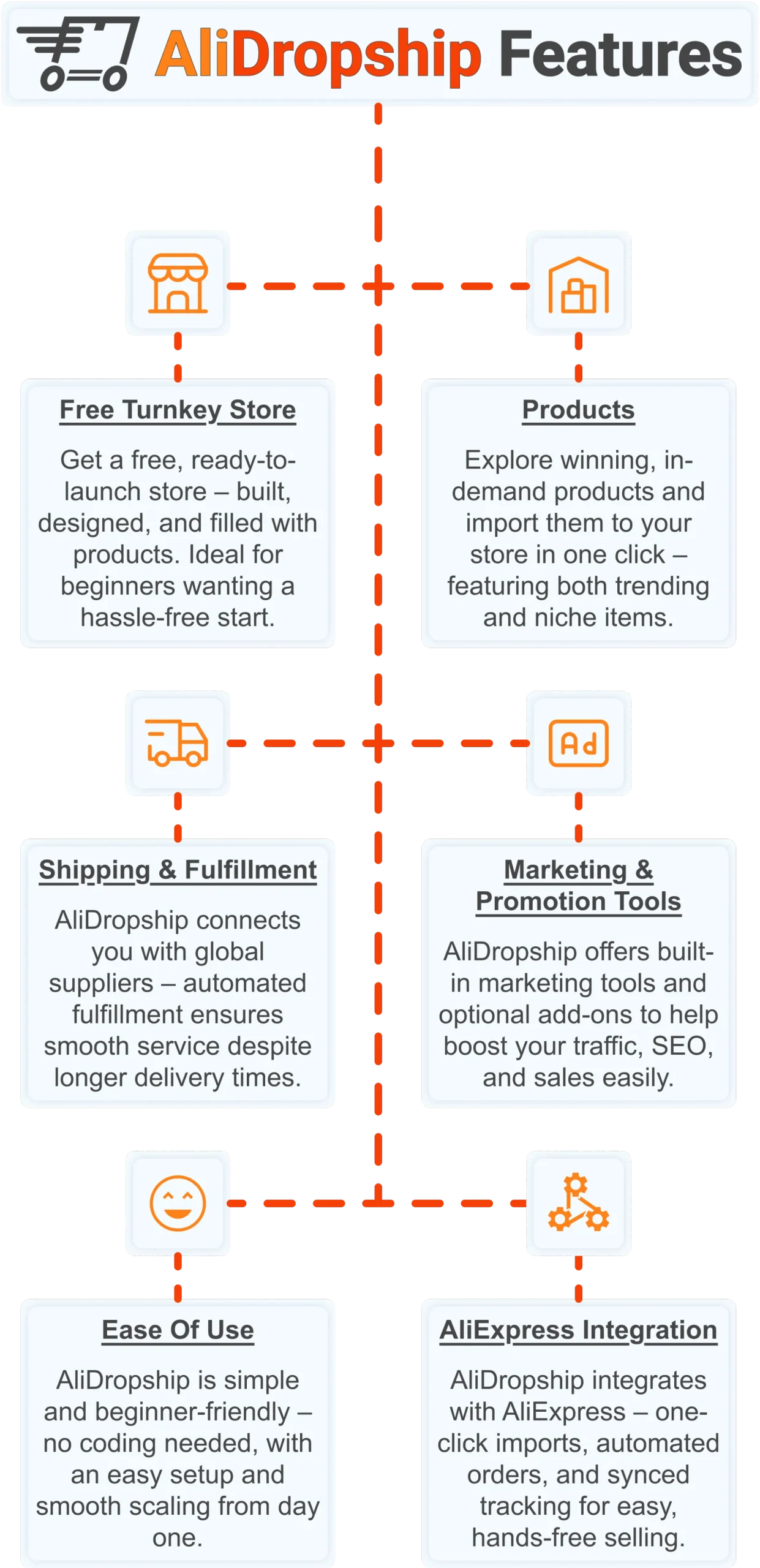
If you want the simplest possible way to start dropshipping – especially if you’re brand new – AliDropship remains one of the most beginner-friendly tools available in 2026. It brings together store creation, product imports, automation, and marketing into a single streamlined system designed to help you launch quickly and grow confidently.
Free turnkey store ️
Get a free turnkey store – built, designed, and filled with products. Ideal for beginners wanting a hassle-free start, the store comes fully optimized to attract customers right away, saving you time on setup. Plus, it includes professional design elements to give your business a polished, trustworthy look from day one. This ready-made foundation makes it easy to move seamlessly into product selection.
Products
Once your store is set up, you can explore winning, in-demand products and import them in one click – featuring both trending and niche items. This wide selection lets you cater to diverse customer interests and test what works best. Regular updates ensure you always have fresh products, keeping your store competitive and relevant. With great products in place, smooth shipping becomes the next essential step.
Shipping & fulfillment
AliDropship connects you with global suppliers, and automated fulfillment ensures seamless order processing despite international delivery times. Customers receive real-time tracking updates, which builds confidence and trust in your store. Once shipping is handled reliably, you can focus on promoting your store and attracting traffic.
Marketing & promotion tools
To maximize sales, AliDropship offers built-in marketing tools and optional add-ons that help boost traffic, SEO, and conversions. From email campaigns and discounts to social media integration, these tools empower you to reach and retain customers without needing prior marketing experience. With promotion strategies in place, managing your business becomes simpler and more efficient.
Ease of use
AliDropship is beginner-friendly – no coding needed, with an intuitive dashboard that guides you through every step. Easy setup and smooth scaling let you expand your store without stress. As your business grows, adding new features, products, and marketing campaigns remains hassle-free, giving you more time to focus on sales.
AliExpress integration
Finally, AliDropship integrates seamlessly with AliExpress, enabling one-click imports, automated orders, and synced tracking. Your inventory stays up-to-date with the latest products and prices, while automated order processing frees you from manual tasks. Combined with the turnkey setup, reliable shipping, and built-in marketing tools, this integration ensures your dropshipping business is fully equipped for growth and success.
Among all the top ecommerce platforms available in 2026, AliDropship removes every barrier that normally slows new sellers down. Get your free turnkey store and start your ecommerce journey today.
Frequently Asked Questions
What are the top ecommerce platforms to consider in 2026?
The top ecommerce platforms in 2026 include Shopify, WooCommerce, BigCommerce, Wix, Squarespace, and Hostinger. Shopify leads with over 1 million active stores worldwide and a large app marketplace covering everything from upsells to email marketing. Hostinger is the most budget friendly option, with an introductory rate of 3.99 per month and up to 1,000 products included. The right platform depends mainly on budget, business model, and how much technical setup a seller is willing to handle.
How much does it cost to start with a top ecommerce platform?
Most hosted platforms start around 29 per month, including Shopify, Wix, and BigCommerce, while Squarespace starts at 23 per month. Hostinger offers the lowest entry point at 3.99 per month introductory pricing, though it renews at 18.99 per month afterward. WooCommerce itself is free, but a properly equipped store typically costs 20 to 50 per month total once hosting, security plugins, and premium extensions are included. Transaction fees of 0.5 to 2 percent per sale can also apply on some platforms if a third party payment processor is used instead of the built in option.
Which ecommerce platform is best for dropshipping?
Shopify has the most mature dropshipping app ecosystem among the top ecommerce platforms and integrates with a wide range of supplier apps for scaling. WooCommerce supports dropshipping through plugins, giving WordPress users a flexible alternative. Wix and Squarespace offer more limited dropshipping tooling that is workable but not optimized for it. AliDropship is purpose built specifically for dropshipping and removes most integration complexity by including a free turnkey store already stocked with products.
How much money can you realistically make selling on an online store?
Earnings vary by business model, with beginner dropshipping typically reaching 30 to 80 per day within 60 to 90 days of focused effort. A niche product store can generate 500 to 3,000 per month around the six month mark with medium effort. Established branded stores operating full time can reach 5,000 to 20,000 or more per month. Full time income in the range of 40,000 to 60,000 per year is realistic but usually takes 6 to 18 months of iteration and reinvesting profits.
What is the difference between self-hosted and hosted ecommerce platforms?
Hosted platforms such as Shopify, Wix, and Squarespace manage server infrastructure for the seller, who pays a monthly fee and focuses on running the business. Self-hosted platforms such as WooCommerce give more control but require the seller to manage hosting, updates, and security independently. WooCommerce runs as a free WordPress plugin, though total costs typically land between 20 and 50 per month once hosting and extensions are factored in. Magento, also known as Adobe Commerce, is an enterprise level self-hosted platform generally reserved for large retailers with high six figure annual revenues and dedicated development resources.
 Previous post
