 ‧ Agnes Kazaryan ‧
May 27, 2026
‧ Agnes Kazaryan ‧
May 27, 2026  938 ‧
938 ‧
 0
0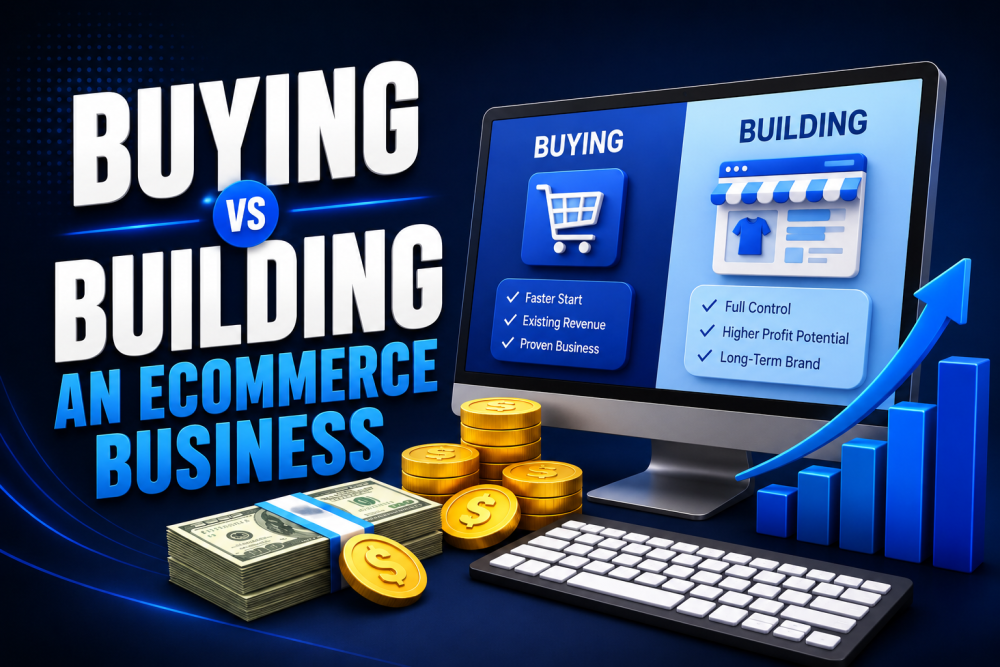
There’s a question that comes up in every dropshipping community, every Facebook group, every YouTube comment section: should I build my own store, or buy an ecommerce business that’s already running? Both routes work. Both routes also fail constantly. The honest comparison isn’t “which one is better” — it’s “which one fits your situation, your capital, and your tolerance for the specific things that go wrong on each path.” Here’s what each route actually looks like in 2026, with the numbers and the failure modes spelled out.
Building a dropshipping store from scratch: the honest math
The romantic version of building from scratch is the one you see on YouTube. Pick a winning product, set up Shopify, run $50 worth of ads, watch the first sale come in. Cue confetti. The realistic version looks different.
Time to first sale
Median time from “I decided to start a store” to “first sale” is 4 to 8 weeks for first-time operators. That’s not the time to profit — that’s just the time until someone hands you money. Time to consistent profitability (the store covers its own ad spend with margin left over) is typically 3 to 6 months, assuming you don’t hit a Meta ad account ban or a supplier issue.
Capital required
Realistic startup budget for a store you intend to actually scale: $500 to $1,500 in ad testing, plus product cost, plus apps and subscriptions. Most operators burn through their first $1,000 in testing before they find a product that converts. If you’re funded by savings, this is the most psychologically painful phase of the entire journey, because you’re spending money to learn things, and the learning curve is steep.
Skills required
Product research, copywriting, basic design, paid traffic, supplier negotiation, customer service, conversion rate optimization, inventory math. You don’t need to be an expert in any of these. You do need to be functional in all of them, because in the first six months you are the entire team.
Failure rate
A widely cited figure is that 80–90% of dropshipping stores fail to reach profitability. That number is approximately correct, but it conflates a lot of things — people who quit after three weeks count as “failed.” If you filter to people who spent at least six months actively building, the failure rate is closer to 60%. Still high. Still real.
Buying a ready-made ecommerce business: what it actually means
The word “ready-made” hides a lot of variation. There are at least three meaningfully different categories of “ecommerce business for sale”:
1) Established broker-listed businesses
This is the Empire Flippers / Flippa / Acquire end of the market. Established stores with 6–36 months of revenue history, listed by their founders. Prices typically start at $15,000 and run into seven figures. Diligence is intensive. Transfers are complex. Quality varies wildly.
2) Pre-built starter stores
These are stores someone has set up — sometimes with traffic, sometimes without — and sold “ready to launch.” Lower price point, $200 to $2,000. Most have zero verified revenue. You’re effectively buying a Shopify theme and a niche choice.
3) Platform-verified marketplaces
A newer category where a platform sells stores from inside its own ecosystem. The revenue is verified by the platform itself, not reported by the seller. The transfer is internal. Financing is structured by the platform. This category barely existed three years ago and is now the fastest-growing segment of the ecommerce-business-for-sale market.
The comparison, in one table
| Factor | Build From Scratch | Buy (Broker) | Buy (Platform Marketplace) |
| Time to first revenue | 4–8 weeks (median) | Same day (existing customers) | Same day (existing customers) |
| Upfront capital | $500–$1,500 (ad testing) | $15K–$100K+ (purchase price) | $0 first month, then monthly installments |
| Income verification | N/A — you build it | Seller-provided screenshots | Platform-generated, live data |
| Transfer complexity | N/A | 2–6 weeks, multiple integrations | Instant, single ecosystem |
| Failure rate | ~60% if you actually try | Variable, hard to measure | Backed by income guarantee on most listings |
| Best for | Builders, learners, capital-light | Operators with cash + diligence skills | First-time buyers wanting verified income |
When building from scratch is the right move
Building is the right move if you want to learn the craft. The skills you develop building a store from zero — product research, traffic, copy, customer service — are the same skills you’ll need to grow any ecommerce business, including one you might buy later. If you’ve never run a store, building one first is an excellent education, even if it eventually fails. Building is also right if you have time but limited capital. You can start with $500. You cannot buy a real, verified ecommerce business for $500.
When buying is the right move
Buying is the right move if you’ve already learned the craft (from a previous store or another business) and you want to accelerate to scale without rebuilding the foundation. You’re not paying for a product. You’re paying for time — specifically, the 6–18 months you would otherwise spend getting a store to consistent revenue. Buying is also right if you have capital but limited time. If your day job pays well and you can’t realistically spend 20 hours/week on product testing, buying lets you skip the testing phase entirely.
The middle path most people miss
There’s a third option that doesn’t get talked about enough: buying inside a platform marketplace where the financing terms make the deal accessible without a large upfront payment. Sellvia Market is the cleanest example. Every listing is a store running inside Sellvia’s infrastructure, so the revenue numbers come straight from Sellvia’s system — not from screenshots the seller put together. The first month is free. After that, the price is split into 48 equal monthly installments with no interest, no banks, and no credit checks. And if the store earns less than 50% of its stated monthly revenue in your first 30 days, you walk away with no charge. That financing structure changes the calculus. You’re not picking between “$500 to build” and “$30,000 to buy.” You’re picking between “$500 to build” and “$0 today, monthly payments from a store that’s already earning.” Many buyers report that their first month’s earnings exceed their first installment payment — meaning the business is paying for itself before they’ve spent any of their own money.
How to evaluate any ecommerce business for sale
Whatever route you choose, run every listing through these five checks:
- Is the income verified by something other than a screenshot? (Platform data, live dashboard, accountant letter — not a PDF.)
- Is the transfer instantaneous, or does it require migrating across multiple vendors?
- What happens if the business underperforms in the first 30 days — is there a refund mechanism, or is the sale final?
- How is the price financed — lump sum, installments, or earnout? What’s the interest rate?
- What’s the buyer’s exit path if it doesn’t work out — can you re-list, or are you stuck?
If a listing can’t answer all five clearly, it’s not ready to sell. Move on.
The bottom line
Building is education. Buying is acceleration. Neither is universally “better” — they solve different problems for people in different situations. But the gap between them is closing. Platform marketplaces are making the buy side cheaper to enter (zero upfront, installments) and safer (income guarantees, instant transfers). For a lot of first-time ecommerce operators in 2026, the rational starting move is no longer “build from scratch” — it’s “buy a verified store inside a platform, learn the operation from a working baseline, and then build your second store from the lessons you took from the first.”
Frequently Asked Questions
Is buying a second ecommerce store better than scaling my first?
Not always — but in specific situations it outperforms scaling. If your customer acquisition cost is rising faster than your average order value, your niche is structurally small, or you have unused operational bandwidth, acquisition gives you a diversified revenue base and a fresh audience that more ad spend simply cannot provide.
How do I know if I’ve hit a structural ceiling on my store?
Signs include: ad spend increases that no longer produce proportional revenue growth, a flattening growth curve despite new SKUs and expanded markets, and a sense that you are fighting to extract more from a saturated audience rather than genuinely growing. These are structural limits, not execution problems.
What should I look for when acquiring a second store for my portfolio?
For a portfolio acquisition, prioritize a complementary niche that does not compete with your existing store, operational overlap so you can share customer service tooling or supplier relationships, fast platform-internal transfer to minimize migration disruption, and a consistent monthly cash flow history over 12–18 months rather than a one-off revenue spike.
How much does it cost to buy an ecommerce business on Sellvia Market?
On Sellvia Market, verified stores are available with $0 due today and financing spread across 48 monthly installments after a free first month. Many operators find the store’s monthly earnings cover the installment payment, meaning the asset can effectively fund its own acquisition.
Can a second store really fund itself from day one?
It depends on the store’s earnings relative to your installment payment. Because Sellvia Market listings come with a 30-day income guarantee and platform-verified cash flow data, buyers can model whether monthly revenue will cover or exceed the monthly payment before committing — making self-funding a realistic outcome for well-chosen acquisitions.
Want to see what a platform-verified listing looks like in practice? Sellvia Market has 646+ businesses available across niches like pets, beauty, food, home, and kids — all with platform-verified income, instant transfer, and 48-month interest-free installments. Browse Businesses · $0 due today · 30-day income guarantee
 Previous post
