 ‧ Agnes Kazaryan ‧
August 14, 2026
‧ Agnes Kazaryan ‧
August 14, 2026  7 ‧
7 ‧
 0
0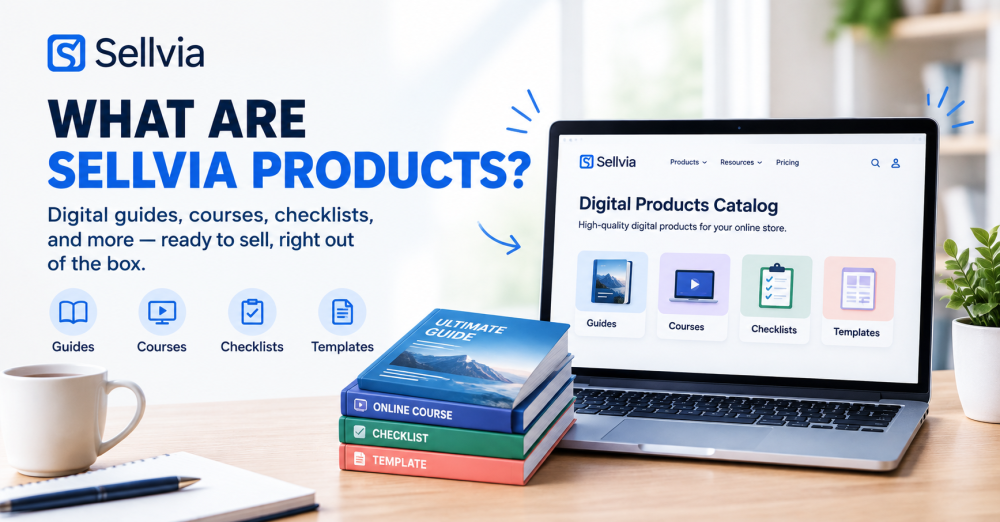
Quick Answer: Sellvia products are the ready-made digital items – guides, courses, checklists, and similar tools – that come pre-loaded in every Sellvia store, so you can start selling them the moment your store goes live without creating anything yourself.
If you have looked into starting an online store in 2026, you have probably run into the same wall most beginners hit first: what do you actually sell? Sourcing products, testing demand, and writing descriptions from scratch can eat up weeks before a single sale happens. Sellvia products exist to remove that step entirely – the catalog is already built, already described, and already organized by niche, so your job shifts from “what should I sell” to “which of these should I feature.”
This article breaks down what Sellvia products actually are, how the catalog is organized, what you keep from each sale, and how to realistically think about earning potential before you commit to a plan.
What are Sellvia products?
Sellvia products are the digital items included in Sellvia’s catalog – guides, courses, checklists, and similar tools created by Sellvia rather than by individual sellers. Every item is delivered instantly to the buyer once a sale happens, so there is no shipping, no warehouse, and no inventory for you to manage. Your role is to choose which products fit your store’s niche, feature them on your storefront, and drive traffic to them through the one-click ads built into the platform.
Because every product is digital, the economics work differently than they do for a physical-goods store. There is no restocking, no damaged-item returns, and no shipping delay between a sale and delivery – the trade-off is that your catalog is curated by Sellvia rather than sourced by you, so product selection comes down to picking well from what is already available rather than hunting for suppliers.
How much can you realistically earn selling Sellvia products?
These figures are illustrative ranges tied to effort level, not typical or guaranteed results – how close you get to them depends on which products you feature, your ad budget, and how well your store is optimized.
Important note: It is possible to make your first sale within your first week of featuring Sellvia products. It is not accurate to say most sellers do, since no published data breaks out what a typical seller earns from the catalog.
Types of digital products in the Sellvia catalog
The catalog is organized by niche rather than as one long undifferentiated list, which makes it easier to build a store around a specific audience instead of a random mix of unrelated items.
Guides and how-to resources
Structured, topic-specific guides make up a large share of the catalog – things like step-by-step resources for a hobby, skill, or life goal. These tend to work well as an entry point for a niche store because the topic itself does most of the explaining, so the product page does not need heavy persuasion to make sense to a visitor.
Courses
Multi-part courses cover topics in more depth than a single guide, walking a buyer through a subject in stages. These typically sell at a higher price point than a single guide, which can make them a useful anchor product in a store that also features lower-priced items.
Checklists and templates
Shorter, more actionable items – checklists, planners, and templates – tend to have the lowest price point in the catalog and the easiest buying decision, since the value is obvious at a glance. These work well as an impulse add-on alongside a guide or course in the same niche.
Toolkits and bundles
Some products group related guides, checklists, and templates into a single bundle around one topic. Bundles typically carry a higher price than any single item inside them, giving your store a higher-ticket option without you having to build the bundle yourself.
Why this works in 2026: Buyers increasingly favor a fast, digital answer to a specific problem over a long research process, and grouping guides, courses, checklists, and toolkits by niche makes it easier for a visitor to find something that matches what they were already looking for.
How pricing and your share work
You keep 50 to 70% of each sale as your share, before ad spend, your monthly plan, and order fees. Sellvia sets the retail price and product description for each item in the catalog, so your main lever is which products you choose to feature and how you drive traffic to them, not manual pricing decisions on individual listings.
Important: Your share depends on the specific product and any current promotional pricing, so check the listed split for a product inside your dashboard rather than assuming every item pays out at the same rate.
Choosing the right products for your store
Rather than featuring everything in the catalog at once, most stores perform better narrowed to a single niche or a small handful of related ones. A visitor arriving from an ad about one specific topic is more likely to buy when the rest of the store reinforces that same topic, rather than landing on a storefront that jumps between unrelated categories.
Key principle: A focused store built around one niche of Sellvia products is easier to market than a broad, unfocused one, since your ad targeting, product pages, and store branding can all reinforce the same audience instead of splitting attention across several.
Legal and ethical considerations
What to avoid: presenting any Sellvia product’s expected results in absolute terms, such as guaranteeing a buyer a specific outcome from a guide or course. What to do instead: let the product description speak to what it teaches or covers, and avoid adding your own promises about results on top of it.
It is also worth being transparent with your own customers about what they are buying – a digital guide, course, checklist, or toolkit – rather than implying it is something else. Clear, accurate product framing protects both your store’s reputation and your standing with payment processors, which tend to flag stores with a pattern of misleading claims.
Final thoughts: Are Sellvia products worth building a store around?
Sellvia products remove two of the biggest early obstacles for a new store owner – product sourcing and product descriptions – which is exactly why they work well as a starting point rather than an end point. Whether they are the right fit for you depends on your own situation.
- Complete beginner: Pick one niche, feature a small handful of products from that niche during the trial, and use the included ad credit to see which one gets any traction before spending your own money.
- Intermediate or part-time seller: Track which specific products convert best inside your niche, and lean your ad budget toward those rather than spreading it evenly across the whole catalog.
- Advanced or full-time goal: Consider running a small number of focused, niche-specific stores rather than one broad store, since a narrower audience match tends to perform better per ad dollar than a general one.
Sellvia: Your complete all-in-one solution for starting an online business in 2026
If you want the simplest possible way to start an online business – especially if you’re brand new – Sellvia remains one of the most beginner-friendly platforms available in 2026. It gives you a fully built online store pre-loaded with digital products you can sell right away, plus one-click ads to help bring in buyers, so there is no design, coding, or product sourcing required to get started.
Prebuilt store, ready to sell
Sign up and your store arrives already built and pre-loaded with digital products you can sell immediately – no design, coding, or product sourcing required on your end. You choose which products to feature from the Sellvia catalog rather than creating your own. The store works from your phone or computer, so there is no separate software to install. With the store itself handled, running ads is the next step.
One-click ads built in
Instead of learning Facebook or Google Ads yourself, Sellvia’s built-in advertising system handles targeting, creatives, and optimization for you. You choose a daily budget of $10 to $50, and your store can start selling the same day you turn on ads. A $40 ad credit is included free during your trial, so you can test the system before spending your own money. Turning ads on gets your store in front of buyers – how much you sell from there still depends on your products and how you run things.
Digital products, no logistics headaches
Every product in the Sellvia catalog is digital – guides, courses, checklists, and similar tools created by Sellvia, not by you. There is no inventory, no shipping, and no warehouse involved, since each purchase is delivered to the buyer instantly. You keep 50 to 70% of each sale as your share, before ad spend, your monthly plan, and order fees. This removes the operational side that slows down most physical-product businesses.
Built for zero experience, zero tech skills
Every part of Sellvia is designed for someone who has never done this before – the dashboard works from a phone, the language stays simple, and a personal growth manager is available to answer questions as you go. There is no coding, design, or marketing background required to get your store live. This is one of the clearest differences between Sellvia and store-builder platforms like Shopify or Wix, which expect you to build, source, and market on your own. Once your store and ads are running, understanding the real costs is worth doing upfront.
A low monthly plan, costs shown upfront
Sellvia’s monthly plan costs $39, or about $1.30 a day, after a 14-day free trial that includes a $40 ad credit. During the trial the store itself is free to use; order fees only apply once a sale actually happens. After the trial ends, the $39 monthly plan continues automatically – you can cancel anytime before then with no charge. Beyond the base plan, ad spend, product packs, and other upgrades are separate costs worth budgeting for as you grow.
Backed by real recognition
Sellvia is a member of the Forbes Communications Council and the Entrepreneur Leadership Network, and it ranked 1,818th on the 2022 Inc. 5000 list of fastest-growing private companies. The platform has also picked up industry awards from TITAN, Hermes Creative Awards, MarCom, and dotCOMM. More than 1,500,000 stores have launched on Sellvia, and store owners have earned $1.5B+ in total. These are the kinds of independent, checkable signals worth looking for before trusting any online business platform.
The fastest way to see the actual catalog is to look inside your own store. Get your free Sellvia store and browse the products.
Free for 14 days with a $40 ad credit. $39/month after the trial. Cancel anytime before then – no charge.
 Previous post
