 ‧ Agnes Kazaryan ‧
March 17, 2026
‧ Agnes Kazaryan ‧
March 17, 2026  832 ‧
832 ‧
 0
0
Most people using ChatGPT right now are getting mediocre results. Not because the tool is bad – but because the prompts are vague. Type a lazy question and you get a generic answer. Type a specific, well-structured prompt and you get a Fiverr gig description, a product launch email, or a store homepage that is actually ready to use. The difference between the two groups is not talent. It is knowing what to ask.
This guide gives you the exact ChatGPT prompts to make money online across the most accessible income categories in 2026 – plus the context you need to actually use them.
Quick answer: The best ChatGPT prompts to make money assign a clear role, define a specific task, and include a constraint – like a word count, a platform, or a target audience. Prompts like “Act as a freelance coach and write a Fiverr gig description for [your service]” consistently outperform vague one-liners. Income potential ranges from $30–$80 per day for beginners to $200–$500 per day for those who build consistent systems.
What are ChatGPT money-making prompts?
A ChatGPT prompt is simply the instruction you type into the chat window. But when you frame that instruction with a specific role, task, and constraint, the output shifts from conversational filler to something with real commercial value – a gig listing, a sales page, a content outline, a product description, or an email sequence.
In 2026, the gap between people who earn with AI and those who do not is not about access. ChatGPT’s free tier handles most tasks on this list. The gap is about execution. A well-structured prompt is like a well-written brief – it saves you hours of editing and gives you something usable the same day.
Why this works in 2026: The market for AI-assisted services has matured. Clients on Upwork and Fiverr are no longer surprised that freelancers use AI – they expect it. What they pay for is quality output delivered fast, and the right prompt is what makes that possible.
How much can you realistically earn?
Income from AI-assisted work varies widely depending on which method you choose, how consistently you execute, and whether you treat it as a side project or a real income stream. Here is a realistic breakdown:
These figures reflect consistent part-time effort of roughly 10–20 hours per week. Beginners should expect 60–90 days before income becomes reliable – most methods need a client base or content library to build up first.
One note on the ecommerce figure: Unlike service-based income that pays once per deliverable, a well-run online store compounds. Every product description you write with a ChatGPT prompt can generate repeat sales for months.
The best ChatGPT prompts to make money online
Below are the highest-value categories with prompts you can copy and use today. Each one follows the same structure: assign a role, define the task, and add a constraint. Adjust the bracketed placeholders to your situation before sending.
ChatGPT prompts for freelancing
Freelancing is one of the fastest paths to your first AI-assisted dollar. Platforms like Upwork, Fiverr, and Contra have millions of active buyers looking for writers, marketers, and developers. These prompts help you position yourself, write pitches, and land work faster.
Find your most valuable skill
Before you can sell a service, you need to know which skill has the most commercial traction. This prompt skips the guesswork:
“Act as a freelance career coach. I have experience in [list 3–5 things you are good at]. Identify which has the highest earning potential on Upwork or Fiverr right now, explain why, and give me a 3-step plan to start landing clients within 30 days.”
Run this with honest inputs and you will often get a more useful answer than hours of browsing Reddit forums. It does not just rank your skills – it explains the demand-side logic behind the ranking.
Earning potential: $20–$80 per hour for writing and marketing services; $40–$120 per hour for development and technical work.
Write a Fiverr gig description
The biggest bottleneck for new freelancers is the listing itself. A weak gig description kills conversions before a single buyer sees your portfolio. Use this prompt to write one that converts:
“Write a compelling Fiverr gig description for a beginner offering [your service]. Include a clear headline, 3 bullet points of what the buyer gets, a short paragraph about my experience, and a call-to-action. Keep the tone professional but approachable. Maximum 250 words.”
Edit the output once for your own voice, verify it reads naturally, and publish. Most beginners spend 3–4 hours on their first gig description. This prompt gets you a solid draft in under 60 seconds.
Write a cold outreach pitch for Upwork
Generic proposals get ignored. Personalized ones get hired. This prompt structures a pitch that addresses the client’s specific pain point instead of just listing your credentials:
“Write an Upwork proposal for a [type of job] posting. The client needs [paste the first 2–3 sentences of the job description]. My relevant experience includes [1–2 sentences]. Open with a line that addresses their specific problem, not a generic introduction. Keep it under 150 words.”
Important: Always customize the output before sending. Copy-pasted proposals – even good ones – are detectable. Use ChatGPT to get 80% of the way there, then add one personal detail that shows you actually read the posting.
ChatGPT prompts for content creation
Content creators who use AI prompts strategically can produce significantly more output without sacrificing quality – as long as they edit what comes out. These prompts cover the three highest-traffic content formats: blog posts, YouTube scripts, and newsletters.
Generate a full blog post outline
Ranking on Google in 2026 requires depth and structure. A well-organized outline is the foundation of a post that earns organic traffic. This prompt builds one in under 30 seconds:
“Act as an SEO content strategist. Create a detailed outline for a blog post targeting the keyword [your keyword]. Include an H1 title, 5–7 H2 sections with 2–3 H3 subpoints each, and a recommended word count per section. The article should be suitable for a beginner audience and aim for 2,500 words total.”
Use the outline to write the full post section by section using additional prompts. Posts over 2,000 words on competitive topics consistently outperform shorter content in organic search.
Earning potential: $50–$300 per article as a freelance writer; $100–$1,500 per month in ad revenue or affiliate commissions from your own blog.
Write a YouTube script
YouTube scripts written for the ear – not the eye – perform better on camera. This prompt bakes that principle in from the start:
“Write a 7-minute YouTube script on [topic]. Open with a hook that creates curiosity in the first 15 seconds. Use conversational language throughout, include one personal story or example in the middle, and end with a CTA to subscribe. No bullet points in the script – make it flow like spoken dialogue.”
Read the output aloud once before recording. Adjust any lines that feel unnatural. The goal is to sound like yourself on your best day.
Write a paid newsletter issue
Paid newsletters are one of the most underrated income sources in 2026. Platforms like Substack and Beehiiv make it straightforward to charge $5–$15 per month per subscriber. This prompt gives you a consistent issue format:
“Write a newsletter issue for a [niche] audience. Include: a short personal intro (2–3 sentences), one actionable insight or framework (300–400 words), a curated resource recommendation with a 1-sentence explanation, and a closing question to drive replies. Keep the tone [casual/professional] and the reading time under 5 minutes.”
Publish consistently – weekly or bi-weekly – and start free. Once you reach 300–500 subscribers, introduce a paid tier. Most newsletters that convert to paid do so at a 5–15% rate, which means 500 subscribers can realistically generate $150–$750 per month.
ChatGPT prompts for digital product creation
Digital products – ebooks, templates, guides, and courses – are the closest thing to genuinely passive income online. You create them once and sell them repeatedly, with no inventory and no shipping. ChatGPT dramatically cuts the creation time.
Outline an ebook or guide
“Act as a non-fiction book editor. Create a detailed table of contents for a [page count]-page ebook on [topic] aimed at [target audience]. Each chapter should include a title, a 1-sentence description of what it covers, and 3–5 sub-topics. The overall arc should take the reader from [problem] to [solution].”
Once you have the outline, use additional prompts to write each chapter section by section. A 5,000-word ebook on a specific niche topic can sell for $9–$29 on Gumroad or Etsy and generate $200–$1,000 per month with consistent traffic.
Write a product description for Etsy or Gumroad
“Write a product description for a digital product called [product name]. The product is [1-sentence description]. The target buyer is [audience]. Include: a compelling opening line, 4–5 bullet points of what is included, a short paragraph on who it is for, and a closing sentence that creates urgency. Keep it under 200 words.”
Earning potential: $200–$2,000 per month once your product library has 5–10 items and you have consistent traffic from SEO, Pinterest, or social media.
ChatGPT prompts for ecommerce and product descriptions
Ecommerce is where ChatGPT prompts have the highest leverage. Writing product descriptions, email sequences, and ad copy manually at scale is one of the biggest time sinks in running an online store. These prompts solve that directly.
Write a product description that converts
“Write a product description for [product name]. The product [1–2 sentences on what it does]. The target customer is [describe them]. Focus on benefits over features, use sensory language where relevant, and end with a single clear call-to-action. Keep it under 150 words and write in a [confident/casual/authoritative] voice.”
Run this for every product in your store. For a store with 50 products, that is 50 conversion-optimized descriptions in an afternoon instead of a week. The quality difference between a ChatGPT-assisted description and a supplier copy-paste is significant – and it directly affects your conversion rate.
Write a product launch email sequence
“Write a 5-email launch sequence for a new [product type] in a [niche] ecommerce store. Email 1: tease the launch and build curiosity. Email 2: introduce the product with the main benefit. Email 3: social proof and objection handling. Email 4: urgency and scarcity. Email 5: last-chance reminder. Each email should be under 200 words, written in a conversational tone, and include a CTA button label in ALL CAPS.”
Why this works in 2026: Email still delivers the highest ROI of any marketing channel – roughly $36 for every $1 spent. A good launch sequence does not just drive first-day sales; it builds a customer relationship that generates repeat purchases.
Write ad copy for Facebook or TikTok
“Write 3 variations of a Facebook ad for [product name]. Each variation should use a different hook – one curiosity-based, one problem-based, one social-proof-based. Include a headline (under 40 characters), primary text (under 125 characters), and a description line. The product costs [price] and ships in [timeframe].”
Test all three variations with a small budget ($5–$10 per day per ad) and scale the one that performs. Generating multiple hook variations upfront with ChatGPT is significantly cheaper than paying a copywriter to iterate.
Earning potential: Established dropshipping stores with optimized copy regularly generate $1,000–$5,000 per month in net profit at scale.
ChatGPT prompts for social media monetization
Growing a monetizable social media presence used to require either raw talent or a lot of time. AI prompts reduce the time component significantly – especially for caption writing, content calendars, and repurposing.
Build a 30-day content calendar
“Act as a social media strategist. Create a 30-day content calendar for a [niche] account on [platform]. For each day, include: the content type (reel, carousel, static post, story), a short caption idea (2–3 sentences), and a relevant hashtag cluster of 5–8 tags. Vary the content mix between educational, entertaining, and promotional posts in a 70/20/10 ratio.”
The 70/20/10 ratio – 70% value, 20% entertainment, 10% promotion – is the baseline most successful creator accounts follow. ChatGPT cannot make your content go viral, but it can make sure you are never stuck staring at a blank screen on posting day.
Write Instagram or TikTok captions
“Write 5 Instagram caption options for a post about [topic]. Each caption should be under 150 words, include a hook in the first line, naturally incorporate the hashtag [main hashtag], and end with a question to drive comments. Vary the tone – make 2 conversational, 2 informational, and 1 bold or provocative.”
Earning potential: Monetization through brand deals, affiliate links, or your own products typically activates at 5,000–10,000 engaged followers. Nano-influencers in specific niches regularly earn $200–$800 per sponsored post.
ChatGPT prompts for starting a dropshipping business
Dropshipping is the income model where ChatGPT prompts have the most compounding value – not just for writing, but for research, positioning, and scaling. You can use AI to validate a niche, write your entire store, and plan your first marketing campaign before you spend a single dollar on ads.
Validate a niche before you invest
“Analyze the dropshipping potential of the [niche] market for a beginner in 2026. Identify 3 sub-niches with high demand and lower competition, explain the typical customer profile for each, and name 3–5 specific product types that are likely to sell well. Include any red flags I should watch for – saturated products, shipping complications, or seasonal demand.”
This prompt does not replace real market research, but it gives you a structured starting point in 2 minutes instead of 2 hours. Use it as a first filter before going deeper on any niche with Google Trends or a tool like Sell The Trend.
Write a complete store homepage
“Write homepage copy for a dropshipping store in the [niche] niche. Include: a hero headline and subheadline (benefit-focused), a 3-point value proposition section, a featured products section with 3 placeholder product names, a trust section with 3 social proof elements, and a footer tagline. Write in a confident, clean brand voice. The store name is [name].”
Earning potential: New dropshipping stores typically reach $30–$80 per day in profit within 60–90 days of consistent effort. Stores with strong positioning and a tested product line scale to $200–$500 per day within 6–12 months.
How to write ChatGPT prompts that actually produce useful output
Most people get mediocre results from ChatGPT because they write mediocre prompts. The structure of a good prompt is not complicated – it just requires being specific about three things: the role you assign, the exact task you want completed, and the constraints that shape the output.
Assign a clear role
Starting your prompt with “Act as a [role]” changes the frame of reference for the entire response. “Act as a Fiverr copywriting expert” produces a different output than “help me write a gig.” The role tells ChatGPT what knowledge base and communication style to draw from. Common high-value roles include: freelance career coach, SEO content strategist, ecommerce copywriter, email marketing specialist, and social media manager.
Define the exact deliverable
Vague instructions produce vague results. Instead of “write something about my product,” specify the format, length, tone, and intended platform. “Write a 150-word product description for [product] targeting [audience] in a confident but approachable tone, optimized for Shopify product pages” gives ChatGPT everything it needs to produce something usable immediately.
Add constraints
Constraints are the most underused element of prompt writing. Word count limits, reading level targets, tone specifications, platform requirements – each one narrows the output toward something more useful. A prompt with no constraints will almost always produce something too long, too generic, or too formal for your actual use case.
Iterate, do not regenerate
If the first output is close but not quite right, do not regenerate – follow up. Type “Make the opening paragraph more direct” or “Shorten this to 100 words” or “Rewrite the call-to-action to focus on speed instead of value.” Iteration is faster than starting over and usually produces better results because you are building on what already worked.
Edit before you publish or deliver
Raw ChatGPT output is a first draft, not a finished product. For freelance work especially, always review what you are delivering. Add one personal observation, catch any factual assumptions the AI made, and adjust the tone to match your client’s brief. Quality control is what separates freelancers who get repeat clients from those who get one-star reviews.
What to avoid when using ChatGPT to make money
AI tools lower the barrier to entry for almost every income method in this guide. That is mostly a good thing. But lower barriers also mean more competition and, in some cases, more ways to go wrong. Here is what to watch out for.
Passing off AI work without review
Publishing raw ChatGPT output – without editing, fact-checking, or personalizing – is the fastest way to damage your reputation as a freelancer or content creator. Clients and readers can detect it. More importantly, unreviewed AI content often contains confidently stated inaccuracies, especially on topics involving specific statistics, dates, or platform policies. Always treat the output as a draft and add your own verification layer before it goes anywhere public.
Trying to game platforms with AI-generated spam
Some people use ChatGPT to flood platforms like Medium, Substack, or Upwork with bulk AI-generated content. This violates most platform terms of service and gets accounts suspended. It also does not work – distribution algorithms on every major platform now flag low-effort AI content. The money is in quality, not volume.
Key principle: Use AI to produce better work faster – not to replace the judgment, editing, and expertise that makes the work worth paying for.
Skipping the niche research
ChatGPT can help you research a niche, but it cannot guarantee that a market exists. Before building a digital product, a blog, or a store around a topic, validate demand independently – use Google Trends, check search volume with a free tool like Ubersuggest, and browse Reddit communities to see what problems people are actually paying to solve. A great prompt on a topic nobody is searching for will not earn you anything.
Ignoring platform-specific rules
Different platforms have different policies on AI-generated content. Amazon KDP requires disclosure for AI-assisted ebooks. Some freelance platforms flag accounts that rely entirely on AI output. Etsy has specific rules around digital products that misrepresent their nature. Always read the terms of service for the platform you are selling on before you scale. A suspended account undoes months of work.
Which approach is right for you?
The best ChatGPT money-making strategy depends on where you are starting from, how much time you have, and what kind of income you are after – a quick first dollar or a scalable long-term system.
Complete beginner
Start with freelancing. The path from first prompt to first paid gig is shorter than any other method here. Use the skill-identification prompt first, then write a Fiverr gig description. Spend your first two weeks sending 5–10 proposals per day using the Upwork pitch prompt. Your first $100 is more achievable this way than through content or product creation, both of which require an audience before they pay anything meaningful.
Intermediate – part-time income goal
If you already have a skill or a following, layer in digital product creation or content monetization. Use the ebook outline prompt to build one product, publish it on Gumroad, and drive traffic from your existing social media. The ecommerce prompts are also within reach here – especially if you can dedicate 10–15 hours per week to testing products and running ads.
Advanced – full-time income goal
Build a system around ecommerce. Use ChatGPT prompts to write product descriptions, email sequences, and ad copy at scale. Combine that with a tool like AliDropship – which handles the store infrastructure, product imports, and order automation – and your time shifts from operational tasks to marketing and optimization. Full-time ecommerce income ($3,000–$10,000 per month) typically takes 6–12 months to build, but the leverage of combining AI-assisted copy with automated fulfillment is the clearest path to that number in 2026.
Whichever profile you identify with, the common thread is the same: pick one method, run the relevant prompts consistently for 30 days, and iterate based on what the market tells you. The people earning real money with ChatGPT are not doing ten things at once – they are doing one thing very well.
AliDropship: Your complete all-in-one solution for starting dropshipping in 2026
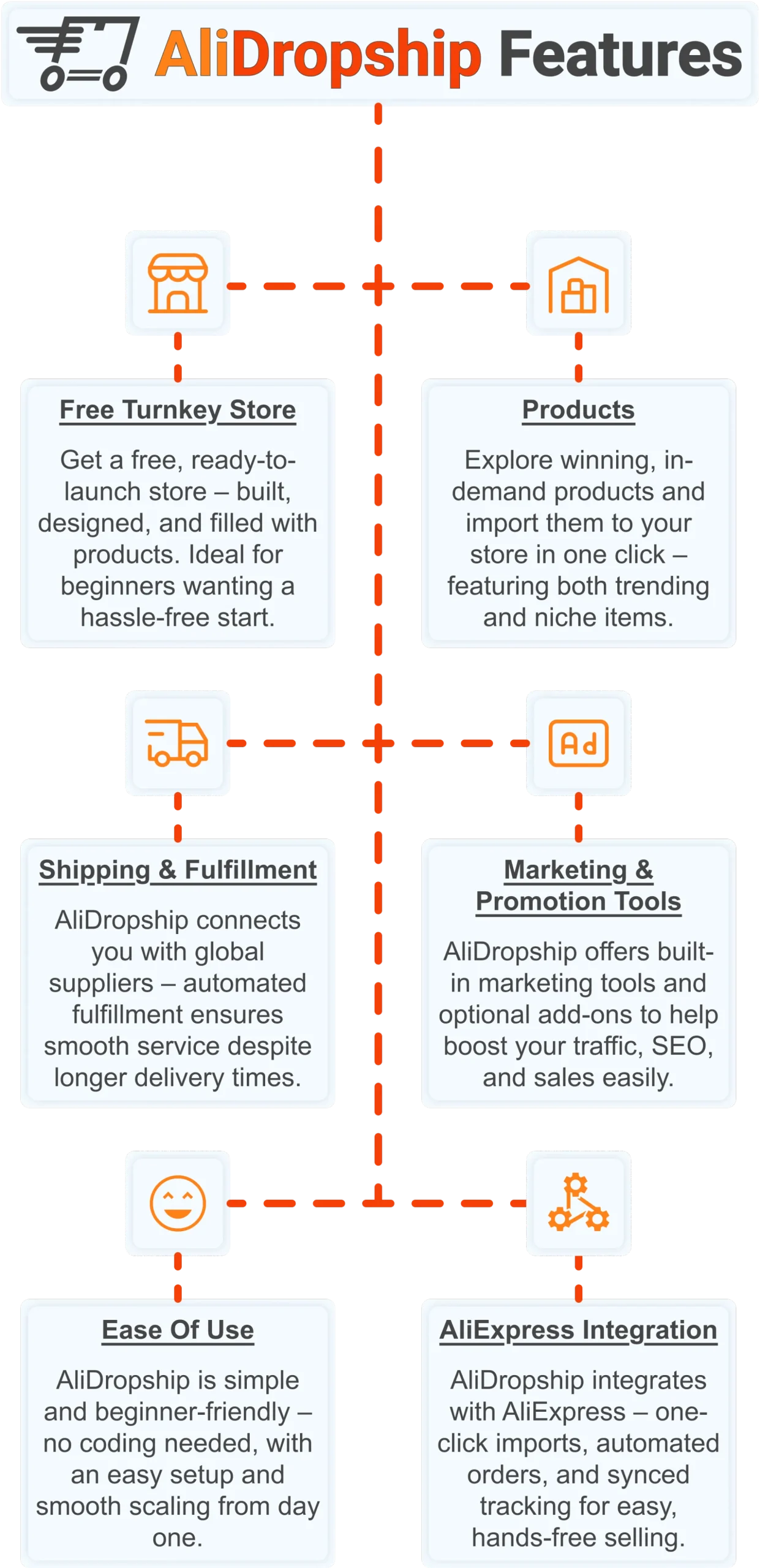
If you want the simplest possible way to start dropshipping – especially if you’re brand new – AliDropship remains one of the most beginner-friendly tools available in 2026. It brings together store creation, product imports, automation, and marketing into a single streamlined system designed to help you launch quickly and grow confidently.
Free turnkey store ️
Get a free turnkey store – built, designed, and filled with products. Ideal for beginners wanting a hassle-free start, the store comes fully optimized to attract customers right away, saving you time on setup. Plus, it includes professional design elements to give your business a polished, trustworthy look from day one. This ready-made foundation makes it easy to move seamlessly into product selection.
Products
Once your store is set up, you can explore winning, in-demand products and import them in one click – featuring both trending and niche items. This wide selection lets you cater to diverse customer interests and test what works best. Regular updates ensure you always have fresh products, keeping your store competitive and relevant. With great products in place, smooth shipping becomes the next essential step.
Shipping & fulfillment
AliDropship connects you with global suppliers, and automated fulfillment ensures seamless order processing despite international delivery times. Customers receive real-time tracking updates, which builds confidence and trust in your store. Once shipping is handled reliably, you can focus on promoting your store and attracting traffic.
Marketing & promotion tools
To maximize sales, AliDropship offers built-in marketing tools and optional add-ons that help boost traffic, SEO, and conversions. From email campaigns and discounts to social media integration, these tools empower you to reach and retain customers without needing prior marketing experience. With promotion strategies in place, managing your business becomes simpler and more efficient.
Ease of use
AliDropship is beginner-friendly – no coding needed, with an intuitive dashboard that guides you through every step. Easy setup and smooth scaling let you expand your store without stress. As your business grows, adding new features, products, and marketing campaigns remains hassle-free, giving you more time to focus on sales.
AliExpress integration
Finally, AliDropship integrates seamlessly with AliExpress, enabling one-click imports, automated orders, and synced tracking. Your inventory stays up-to-date with the latest products and prices, while automated order processing frees you from manual tasks. Combined with the turnkey setup, reliable shipping, and built-in marketing tools, this integration ensures your dropshipping business is fully equipped for growth and success.
If you are already using ChatGPT prompts to build income online, pairing that skill with a ready-made ecommerce store is the most direct path to a scalable revenue stream in 2026. Get your free AliDropship turnkey store today and put your prompts to work in a real business.
Frequently asked questions
How much money can you realistically make using ChatGPT prompts?
Income potential ranges from 30 to 80 dollars per day for beginners to 200 to 500 dollars per day for those who build consistent systems. Freelance writing and copywriting using ChatGPT prompts typically earns 500 to 3000 dollars per month, while ecommerce and product descriptions can generate 1000 to 5000 dollars or more per month. Beginners should expect 60 to 90 days before income becomes reliable, since most methods need a client base or content library to build up first. These figures reflect consistent part-time effort of roughly 10 to 20 hours per week.
What makes a ChatGPT prompt actually effective for making money?
An effective prompt assigns a clear role, defines the exact deliverable, and adds specific constraints like word count or platform. Starting a prompt with a phrase like act as a Fiverr copywriting expert produces meaningfully different output than a vague request to help write a gig. Constraints such as word count limits and tone specifications narrow the output toward something immediately usable. Iterating on an existing output with a follow up request is generally faster and more effective than regenerating from scratch.
Can ChatGPT prompts help with freelancing on platforms like Fiverr and Upwork?
Yes, freelancing is considered one of the fastest paths to a first AI-assisted dollar since prompts can generate gig descriptions, pitches, and skill assessments in under a minute. Writing and marketing services using these prompts typically pay 20 to 80 dollars per hour, while development and technical work can reach 40 to 120 dollars per hour. A well-structured Fiverr gig description prompt can produce a solid draft in under 60 seconds, compared to the 3 to 4 hours most beginners spend writing one manually. Personalizing the output before sending is still necessary, since copy-pasted proposals are detectable to clients.
How can ChatGPT prompts support a dropshipping business specifically?
ChatGPT prompts can validate a niche, write complete store homepage copy, and generate product descriptions and ad copy at scale before any money is spent on advertising. New dropshipping stores using these methods typically reach 30 to 80 dollars per day in profit within 60 to 90 days of consistent effort. Stores with strong positioning and a tested product line can scale to 200 to 500 dollars per day within 6 to 12 months. A single niche validation prompt can provide a structured starting point in about 2 minutes instead of 2 hours of manual research.
What mistakes should you avoid when using ChatGPT to make money online?
Publishing raw ChatGPT output without editing or fact-checking is one of the fastest ways to damage a freelancer or content creator reputation, since unreviewed content can contain confidently stated inaccuracies. Using ChatGPT to flood platforms like Medium or Upwork with bulk generated content violates most platform terms of service and can lead to account suspension. Skipping independent niche research before building a product or store means there is no guarantee that real demand exists for the topic. Platforms also differ in their rules, since Amazon KDP requires disclosure for AI-assisted ebooks while other platforms flag accounts relying entirely on AI output.
 Previous post
