 ‧ Agnes Kazaryan ‧
March 14, 2026
‧ Agnes Kazaryan ‧
March 14, 2026  557 ‧
557 ‧
 0
0
Most online store owners spend months hunting for the perfect product – then realize too late that great products alone don’t build a business. Marketing does. And in 2026, the stores pulling ahead aren’t necessarily the ones with the biggest ad budgets. They’re the ones using creative marketing ideas that cut through the noise, build genuine trust, and turn casual browsers into repeat buyers.
The good news? You don’t need a marketing degree or a $10,000 monthly ad spend to make this work. Whether you’re just launching your first dropshipping store or trying to push past your first $1,000 month, this guide covers the most effective, realistic, and low-cost marketing strategies working right now.
Quick Answer: The most effective creative marketing ideas for ecommerce in 2026 include short-form video content, user-generated content (UGC) campaigns, micro-influencer partnerships, email storytelling, and interactive social tactics – many of which cost little to nothing to start.
What are creative marketing ideas for ecommerce?
Creative marketing ideas are promotional strategies that go beyond the standard “run an ad, get a sale” loop. They lean on originality, community, storytelling, or timing to generate attention – often at a fraction of the cost of traditional paid advertising. For dropshipping stores specifically, this matters a lot, because you’re competing against thousands of other sellers, many of whom are running the exact same ads to the exact same audiences.
In 2026, standing out requires something different. Consumers are savvier than ever – they scroll past generic product shots, ignore templated email blasts, and skip ads within two seconds. What actually works is content that feels real, relevant, and worth sharing. Creative marketing is how you build that kind of connection without a massive budget. It’s not just theory, either. Data shows that over 60% of consumers discovered new products via short-form video in 2024, and 40% made impulse purchases based on trends they saw online. That kind of momentum is available to any store owner willing to put in the work.
How much can you realistically earn with better marketing?
It’s worth being upfront here: marketing alone doesn’t print money. It’s a multiplier – it amplifies what you already have. But the results can be significant for dropshipping stores that apply even a handful of these tactics consistently.
These ranges reflect realistic outcomes for store owners who work consistently, test their content, and refine what works. Dropshipping stores in growing niches – pet products, home gadgets, wellness accessories – tend to hit the faster end of these timelines when marketing is applied intentionally from day one.
One note on the upper figures: Reaching $200+ per day typically requires full-time effort, a proven product-market fit, and at least 3–4 months of consistent creative output. It’s achievable – but it’s a business, not a passive income shortcut. The point is that marketing isn’t optional for a dropshipping store. Even the most perfectly sourced product will sit unnoticed without promotion.
Content-driven creative marketing ideas for your store
These are tactics built around the content you create – videos, emails, blog posts, and visual assets. They require time and consistency, but they compound over months in a way that paid ads simply don’t.
Short-form video marketing
TikTok and Instagram Reels remain the most powerful free traffic channels for ecommerce in 2026. The format rewards creativity over production budget – a 30-second product demo filmed on a smartphone can outperform a polished studio ad if the hook is strong enough. For dropshipping stores, the ideal short-form content shows the product solving a real problem, demonstrates a before-and-after result, or leans into current platform trends like popular sounds and challenges.
Start by posting 3–5 videos per week on one platform before spreading to others. Consistency matters far more than perfection here. Most viral product videos follow a simple structure: product in action, one sentence of context, call to action in the caption.
Why this works in 2026: Over 40% of consumers make impulse purchases based on short-form video they discover while scrolling – making this one of the highest-conversion discovery channels available at zero cost.
Email storytelling campaigns
Email marketing consistently outperforms social media in return on investment for ecommerce – and in 2026, the stores winning with email aren’t the ones sending “SALE: 30% OFF” blasts every week. They’re telling stories. A well-crafted email sequence that walks a subscriber through your brand story, introduces your products through customer narratives, and delivers genuine value builds the kind of trust that converts subscribers into loyal buyers.
Start with a 3-email welcome sequence: one to introduce your brand story, one to showcase your bestsellers through a customer lens, and one with a first-purchase incentive. This alone can add $20–$50/day in incremental revenue within your first 60 days of consistent list-building.
Earning potential: $15–$50/day from email alone, scaling with list size and segmentation quality.
SEO content and blog articles
Search engine optimization is one of the most underused online marketing ideas for small ecommerce businesses – probably because results take time. But that’s exactly what makes it so valuable: once a blog post ranks for a relevant keyword, it delivers free traffic month after month without ongoing ad spend.
For a dropshipping store, the most effective blog content targets buyer-intent keywords – things like “best [product type] for [use case]” or “how to choose [product category].” You don’t need to be a professional writer. Helpful, honest, and specific beats polished and generic every time. Aim for one well-researched article per week and give it 3–4 months to start generating consistent organic traffic.
Why this works in 2026: Google continues to reward helpful, experience-based content – exactly the kind a store owner who knows their products can produce without hiring an agency.
Product comparison and “vs.” content
One of the most effective low-cost marketing ideas for ecommerce is creating honest comparison content – “Product A vs. Product B” posts, YouTube videos, or social media carousels. This works because people search for this type of content right before they buy. Positioning your store as the unbiased resource that helps them decide builds trust and drives purchase intent at the same time. If one of the products you’re comparing is something you sell, you capture a warm buyer at exactly the right moment in their decision process.
Community and social proof strategies that actually work
These tactics put other people at the center of your marketing – customers, creators, and communities. They’re powerful precisely because they’re more trusted than anything the brand says about itself.
User-generated content (UGC) campaigns
User-generated content – photos, videos, and reviews created by your actual customers – is one of the highest-converting creative marketing ideas available, and it costs almost nothing to collect. Shoppers trust peer content far more than brand advertising, which makes UGC a direct revenue driver when displayed on product pages, in ads, and across social channels.
The simplest way to start: after a purchase is delivered, send a follow-up email asking for a photo or short video review in exchange for a small discount on their next order. Even a 10–15% response rate can quickly generate a library of authentic content that outperforms professionally shot material in ads and on social media.
Earning potential: UGC-powered ads typically see 20–50% higher click-through rates than standard brand creative – translating directly into lower cost per acquisition and higher return on ad spend.
Micro-influencer partnerships
Mega-influencers with millions of followers are expensive and often ineffective for niche ecommerce stores. Micro-influencers – creators with 5,000 to 50,000 engaged followers in a specific niche – are a far smarter investment in 2026. Their audiences trust them, engagement rates are significantly higher than macro accounts, and many are open to product-for-post deals rather than paid arrangements, which keeps costs low.
To find relevant micro-influencers, search hashtags related to your product niche on TikTok and Instagram, look for accounts whose content style aligns with your brand, and reach out with a simple, personal pitch. Offer a free product and ask for an honest review or unboxing. A single post from the right micro-influencer can drive $500–$2,000 in revenue for a niche store with a well-chosen product.
Important note: Always disclose sponsored or gifted content – both for legal compliance and because transparency actually increases trust with modern audiences.
Referral and loyalty programs
One of the most overlooked creative marketing ideas for ecommerce is simple: make your existing customers do some of the marketing for you. A referral program that rewards buyers for bringing in new customers is one of the most cost-effective growth channels available – you only pay for results, and the social proof built into a personal recommendation is far stronger than any ad.
Basic referral programs can be set up with affordable apps for any major ecommerce platform. The reward doesn’t need to be large – a $5 store credit or 10% off for both the referrer and new buyer is enough to motivate action. Stores that implement this consistently typically see 15–25% of new customers arriving through referral within 6 months.
Community building on Reddit, Facebook groups, and Discord
Participating in online communities around your product niche – without spamming or hard-selling – is one of the most sustainable low-budget marketing tactics for ecommerce stores in 2026. When you show up on Reddit threads, in niche Facebook groups, or on Discord servers as a genuinely helpful voice, you build authority and brand recognition that eventually drives traffic and sales organically.
The key rule: never drop a store link without being asked. Answer questions, share knowledge, and let your profile and reputation do the selling. This approach takes 4–8 weeks to generate noticeable traffic but has an extremely high trust rate – people who arrive at your store via a community recommendation are far more likely to buy.
Why this works in 2026: Communities on Reddit and Discord have grown significantly as users migrate away from algorithmically noisy social feeds, making niche community presence increasingly valuable for organic store discovery.
Giveaways and contests
A well-run giveaway is one of the fastest low-cost marketing ideas for building an audience from scratch. When the entry mechanic requires participants to follow your account, tag a friend, or share a post, one giveaway can generate hundreds of new, relevant followers within 48 hours – at the cost of one or two free products.
The product you’re giving away should be directly related to what you sell, so the audience you attract actually has purchase intent. A giveaway of a random high-value item like cash or consumer electronics will attract prize hunters, not buyers. A giveaway of your best-selling niche product will attract real potential customers.
Earning potential: A single well-executed giveaway can generate $300–$1,000 in immediate sales from the new audience it creates, plus long-term value from followers who convert over time.
Interactive content – quizzes, polls, and product finders
Interactive content consistently outperforms static posts in engagement and time-on-site metrics – and it’s a surprisingly underused creative marketing idea for small ecommerce businesses. A “find your perfect [product type]” quiz on your website or social profile does two things simultaneously: it helps visitors find the right product for their needs (increasing conversion rate) and it generates shareable content that extends your organic reach.
Simple quiz tools can be integrated into most ecommerce platforms with little technical knowledge. On social media, polls and “this or that” product comparison posts are quick to create and reliably generate high engagement – which signals to platform algorithms that your content is worth distributing to more users.
Legal and ethical considerations for ecommerce marketing
Creative marketing is powerful – but a few tactics cross lines that can seriously damage your store’s reputation or expose you to legal risk. It’s worth knowing what to avoid before you invest time building a marketing strategy.
What to avoid absolutely
Key principle: Every marketing claim you make – about your products, your prices, or your results – must be honest and verifiable.
Fake reviews are one of the most common and damaging mistakes new ecommerce store owners make. Purchasing fake reviews on platforms like Trustpilot or Google violates those platforms’ terms of service and can result in your store being delisted. More importantly, modern consumers are extremely good at spotting inauthentic review patterns – identical language, a flood of 5-star reviews with no substance, or all reviews posted within a short window. The short-term social proof isn’t worth the long-term trust damage.
Misleading income claims in your marketing – for example, claiming your products “guarantee results” or that customers “always earn X” – can attract regulatory attention in many countries, including FTC scrutiny in the US. Qualify everything. Hidden fees at checkout and bait-and-switch pricing are not just unethical – they generate chargebacks, negative reviews, and irreversible reputation damage.
What to do instead
Build your social proof the right way – through post-purchase review request emails, product sampling to genuine micro-influencers, and by responding professionally to every public review, including negative ones. Authentic reviews from real customers, even if slower to accumulate, are worth exponentially more than manufactured ones.
For influencer and affiliate marketing, always ensure proper disclosure of commercial relationships. The FTC in the US and equivalent bodies in other markets require clear labeling of sponsored content – and audiences increasingly respect, rather than penalize, brands that are transparent about this.
How to choose your marketing approach
Not every tactic on this list is right for every store or every stage of growth. Here’s how to think about which creative marketing ideas to prioritize based on where you are right now.
Complete beginners
If you’re just launching your store and have minimal budget, start with the tactics that cost time instead of money. Short-form video on TikTok or Instagram Reels, combined with community participation in relevant Reddit and Facebook groups, gives you the fastest path to organic visibility. Set up a basic 3-email welcome sequence from day one – even a small list of 50 subscribers is worth nurturing. Focus on one channel at a time and master it before spreading further.
Intermediate / part-time sellers
If you’re already generating some sales ($500–$2,000/month) and want to scale, micro-influencer partnerships and a structured UGC collection process are your highest-leverage moves. Both can be implemented for under $200 in product costs and have the potential to significantly reduce your cost per acquisition. Add a simple referral program at this stage – it’s low-effort to set up and compounds steadily over time.
Advanced / full-time goal
If you’re targeting $5,000+ per month and treating this as a serious business, a multi-channel strategy combining SEO content, email automation, UGC-powered paid ads, and community presence is the sustainable path. At this level, it’s also worth investing in a loyalty and referral program that systematically converts one-time buyers into repeat customers – since customer retention is where most of the profit in ecommerce actually lives.
Whichever stage you’re at, the most important thing is consistency. Marketing is not a one-time effort – it’s a system you build over 90–180 days, with each piece reinforcing the others. The stores that win long-term aren’t the ones who found one magic tactic. They’re the ones who showed up every week, tested what works, and kept refining their approach.
AliDropship: Your complete all-in-one solution for starting dropshipping in 2026
If you want the simplest possible way to start dropshipping – especially if you’re brand new – AliDropship remains one of the most beginner-friendly tools available in 2026. It brings together store creation, product imports, automation, and marketing into a single streamlined system designed to help you launch quickly and grow confidently.
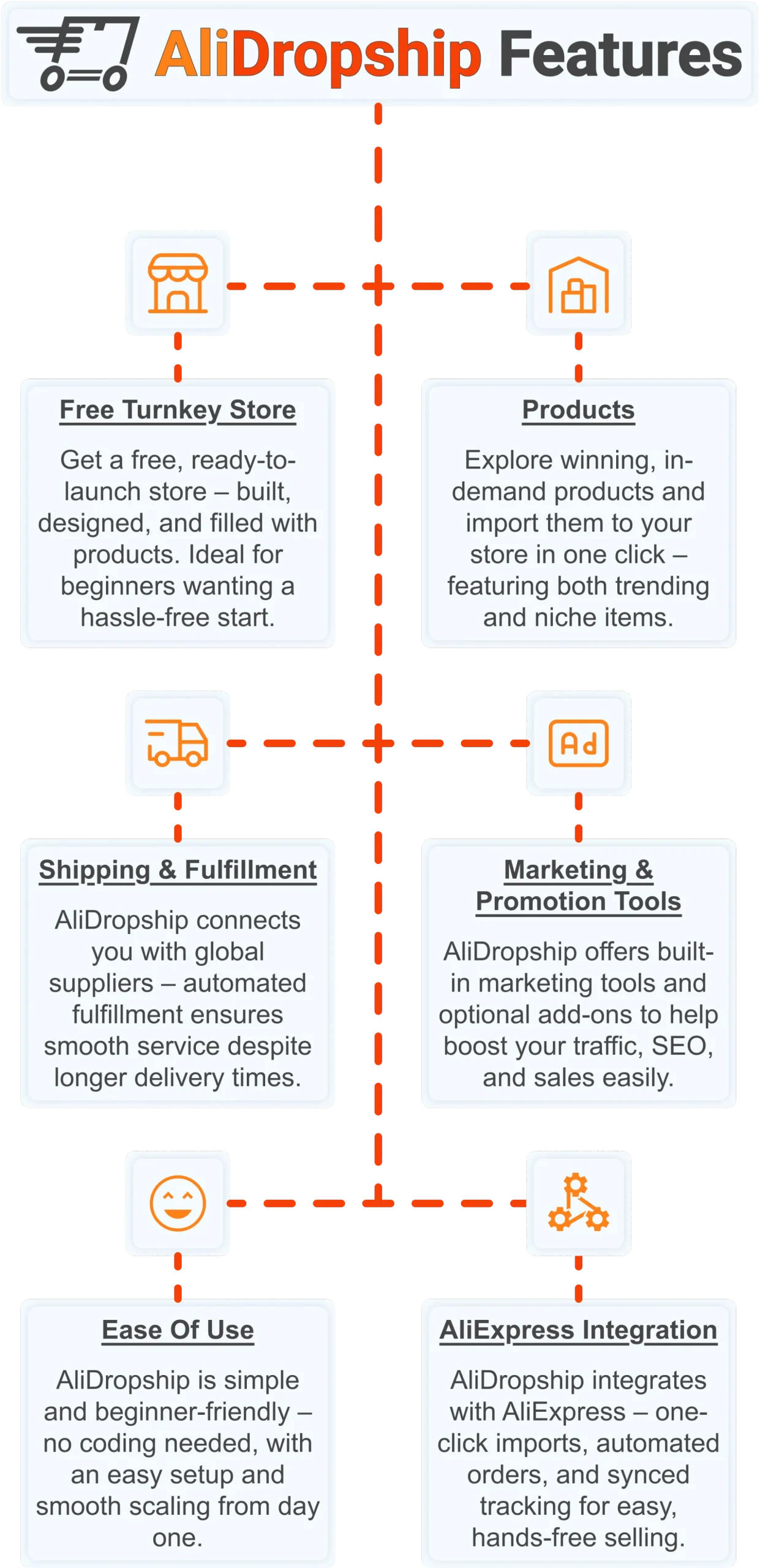
Free turnkey store ️
Get a free turnkey store – built, designed, and filled with products. Ideal for beginners wanting a hassle-free start, the store comes fully optimized to attract customers right away, saving you time on setup. Plus, it includes professional design elements to give your business a polished, trustworthy look from day one. This ready-made foundation makes it easy to move seamlessly into product selection.
Products
Once your store is set up, you can explore winning, in-demand products and import them in one click – featuring both trending and niche items. This wide selection lets you cater to diverse customer interests and test what works best. Regular updates ensure you always have fresh products, keeping your store competitive and relevant. With great products in place, smooth shipping becomes the next essential step.
Shipping & fulfillment
AliDropship connects you with global suppliers, and automated fulfillment ensures seamless order processing despite international delivery times. Customers receive real-time tracking updates, which builds confidence and trust in your store. Once shipping is handled reliably, you can focus on promoting your store and attracting traffic.
Marketing & promotion tools
To maximize sales, AliDropship offers built-in marketing tools and optional add-ons that help boost traffic, SEO, and conversions. From email campaigns and discounts to social media integration, these tools empower you to reach and retain customers without needing prior marketing experience. With promotion strategies in place, managing your business becomes simpler and more efficient.
Ease of use
AliDropship is beginner-friendly – no coding needed, with an intuitive dashboard that guides you through every step. Easy setup and smooth scaling let you expand your store without stress. As your business grows, adding new features, products, and marketing campaigns remains hassle-free, giving you more time to focus on sales.
AliExpress integration
Finally, AliDropship integrates seamlessly with AliExpress, enabling one-click imports, automated orders, and synced tracking. Your inventory stays up-to-date with the latest products and prices, while automated order processing frees you from manual tasks. Combined with the turnkey setup, reliable shipping, and built-in marketing tools, this integration ensures your dropshipping business is fully equipped for growth and success.
All the creative marketing ideas in this guide work best when you have a professional, conversion-ready store to send traffic to. Get your free AliDropship turnkey store today and start putting these strategies to work.
Frequently asked qestions
What are the most effective creative marketing ideas for ecommerce in 2026?
The strongest approaches include short-form video content, user generated content campaigns, micro-influencer partnerships, email storytelling, and interactive social tactics. Many of these cost little to nothing to start, which makes them accessible to new store owners. Over 60 percent of consumers discovered new products via short-form video in 2024. About 40 percent of consumers made impulse purchases based on trends they saw online.
How much can better marketing realistically increase ecommerce earnings?
Stores with no active marketing typically earn 0 to 10 dollars per day from organic drift alone. Basic social media and email marketing can generate 20 to 60 dollars per day within 60 to 90 days. A multi-channel creative strategy applied consistently can reach 80 to 250 dollars per day within 6 to 12 months. Reaching 200 dollars or more per day typically requires full-time effort and at least 3 to 4 months of consistent creative output.
How effective is short-form video marketing for ecommerce stores?
TikTok and Instagram Reels remain the most powerful free traffic channels for ecommerce in 2026. A 30-second product demo filmed on a smartphone can outperform a polished studio ad if the hook is strong enough. Over 40 percent of consumers make impulse purchases based on short-form video they discover while scrolling. Posting 3 to 5 videos per week on one platform before expanding to others is the recommended starting cadence.
How much revenue can micro-influencer partnerships generate for a store?
Micro-influencers with 5,000 to 50,000 engaged followers in a specific niche are a smarter investment than mega-influencers with millions of followers. A single post from the right micro-influencer can drive 500 to 2,000 dollars in revenue for a niche store with a well-chosen product. Many micro-influencers are open to product-for-post deals rather than paid arrangements, which keeps costs low. Always disclose sponsored or gifted content for legal compliance and to maintain audience trust.
Are referral programs and giveaways worth the investment for a new store?
Referral programs are a cost-effective growth channel since you only pay for results, and stores that implement them consistently see 15 to 25 percent of new customers arriving through referral within 6 months. A basic reward of 5 dollars in store credit or 10 percent off for both the referrer and new buyer is enough to motivate action. A single well-executed giveaway can generate 300 to 1,000 dollars in immediate sales from the new audience it creates. The giveaway product should relate directly to what the store sells so entrants have genuine purchase intent rather than being prize hunters.
 Previous post
