 ‧ Agnes Kazaryan ‧
March 14, 2026
‧ Agnes Kazaryan ‧
March 14, 2026  579 ‧
579 ‧
 0
0
Around 90% of new online businesses fail within their first few months. Not because the ideas were bad – but because the founders skipped steps, picked the wrong model, or simply didn’t know what they were getting into. If you’re seriously thinking about how to start a business online, this guide gives you the full picture: what works, what doesn’t, how much you can realistically make, and the fastest route to your first sale.
Quick Answer: To start a business online in 2026, pick a model that fits your budget and skills – dropshipping, freelancing, digital products, or affiliate marketing – set up a store or website, handle payment processing and legal basics, then drive traffic through SEO or social media. Most beginners see their first sales within 30–90 days of launch.
The barrier to entry has never been lower. Global ecommerce sales are on track to hit $6.3 trillion in 2026, and you don’t need a warehouse, a team, or a business degree to claim your share of it. What you do need is a clear plan – and that’s what this guide is for.
Before we get into the methods, let’s get clear on what “starting a business online” actually means in 2026 – and why the model you choose matters more than the idea itself.
What starting a business online actually means in 2026
Starting an online business means building a system that generates income through the internet – whether that’s selling physical products, delivering a service, creating digital content, or earning commissions by promoting other brands. The key difference from a traditional business is that your storefront, inventory, customer support, and marketing can all run with minimal physical infrastructure.
In 2026, this looks meaningfully different from even five years ago. AI tools have made it faster to build websites, write product descriptions, and handle customer service. Platforms like AliDropship, Shopify, and Etsy have removed most of the technical barriers. And the pool of online shoppers keeps growing – mobile commerce now accounts for over 60% of all ecommerce traffic worldwide.
The real question isn’t whether you can start an online business. It’s which model fits your situation, and how to avoid the mistakes that stop most beginners before they gain any momentum.
How much can you realistically earn from an online business?
This depends heavily on the model, the time you put in, and how quickly you can drive traffic. Here’s an honest comparison across the most common options.
These ranges reflect part-time to full-time effort across tested models. Dropshipping and print-on-demand have the lowest startup costs and can launch for under $100. Freelancing pays faster but scales slowly unless you move toward an agency model. Digital products take longer to build but generate passive income once an audience is in place.
One note on the upper figures: The top end of every range assumes consistent effort, solid marketing, and months of iteration. Most beginners earn $200–$800/month in their first 60–90 days – which is a healthy, realistic starting point, not a ceiling.
The main online business models explained
There are more ways to start a business online than ever before, but most fall into a handful of well-tested categories. Each has its own startup cost, time investment, and income ceiling. Here’s what you need to know about the most accessible ones.
Product-based online businesses
Dropshipping
Dropshipping is one of the most popular ways to start a business online with little or no money upfront. You set up an online store, list products from a supplier, and when a customer places an order, the supplier ships directly to them. You never handle inventory or pack a single box.
The model works because your upfront risk is almost zero – you only pay for products after you’ve already made a sale. Platforms like AliDropship make it straightforward to connect your store with AliExpress suppliers, automate order fulfillment, and import products with a single click.
Why this works in 2026: Supplier networks are faster and more reliable than they were three years ago, and automated fulfillment tools mean you can run a store with minimal daily involvement once it’s set up.
Print-on-demand
Print-on-demand (POD) lets you sell custom-designed products – t-shirts, mugs, phone cases, posters – without holding any stock. Services like Printful or Printify connect to your store and produce items only when someone orders them.
Your margin per item is smaller than dropshipping, typically $5–$15 per sale, but the creative angle gives you a strong brand differentiator. POD works best for niche audiences with clear visual identities – pet lovers, hobbyist communities, fans of specific aesthetics.
Earning potential: $100–$2,000/month with consistent design output and a targeted niche audience.
Traditional ecommerce
Running a traditional ecommerce store means sourcing and stocking your own inventory, then selling through your website. This gives you more control over product quality, packaging, and margins – but it requires more upfront capital, typically $500–$2,000 to get started with a small stock run.
It’s a stronger long-term play if you want to build a branded product line. For most beginners starting from scratch, though, dropshipping is a more sensible entry point that can later evolve into a hybrid model with branded products.
Service-based online businesses
Freelancing
If you already have a skill – writing, design, development, marketing, video editing, bookkeeping – freelancing is the fastest way to make your first dollar online. You offer that skill as a service, find clients through platforms like Upwork or Fiverr, and get paid for projects or hours.
Software developers on Upwork typically earn $20–$150/hour. Writers and designers tend to range from $15–$80/hour depending on experience and niche. The income is real and arrives quickly compared to content-based models – but it trades time for money rather than building a scalable asset.
Earning potential: $500–$8,000/month depending on skill, niche, and hours invested.
Consulting and coaching
Consulting and coaching are extensions of freelancing – but instead of doing work for clients, you advise them on how to do it themselves. Business coaches, marketing consultants, fitness coaches, and career advisors all operate under this model. Rates are typically higher, ranging from $75–$500/hour, and the income is more relationship-driven.
This model works best if you have proven results in a specific area. Generic coaching with no track record is a hard sell. Genuine expertise in a defined niche – paid ads for Shopify stores, nutrition for endurance athletes – is what attracts clients willing to pay premium rates.
Content and audience-based online businesses
Affiliate marketing
Affiliate marketing means earning a commission by promoting other companies’ products or services. You create content – blog posts, YouTube videos, social media – that drives traffic to an affiliate link, and you earn a percentage of every sale made through it.
Amazon Associates pays 1–10% per sale. Software affiliate programs often pay 20–40% in recurring commissions. The numbers sound appealing, but affiliate marketing typically takes 6–18 months of consistent content creation before most people see meaningful income. It’s a long game, not a quick win.
Earning potential: $50–$3,000/month with 12+ months of consistent effort in a well-chosen niche.
Digital products and online courses
Selling digital products – ebooks, templates, presets, spreadsheets, online courses – is one of the highest-margin online business models available. You create the product once and sell it indefinitely with no production cost per unit.
Platforms like Gumroad, Teachable, and Podia make it easy to host and sell digital products. The challenge is building an audience willing to pay. Most successful digital product creators come from a freelancing or blogging background where they’ve already built trust with a specific audience.
Earning potential: $100–$10,000+/month once an audience is established – but audience building typically takes 12–24 months.
Step-by-step: How to start an online business from scratch
No matter which model you choose, the foundational steps are the same. Here’s how to move from idea to launch in 2026.
Step 1 – Pick a niche
A niche is the specific market you’re serving. “Fitness” is not a niche. “Resistance band workouts for people over 50” is a niche. The more specific your positioning, the easier it is to attract an audience, rank on search engines, and stand out from larger competitors.
Use Google Trends, Reddit communities, and Amazon bestseller lists to find areas with genuine demand. Look for niches where people are already spending money, asking questions, and feeling underserved by existing options.
Step 2 – Validate the idea
Before investing serious time or money, check that real people want what you plan to sell. For product businesses, search your main product on Amazon and AliExpress – if multiple sellers have strong reviews, demand is there. For service businesses, check job boards like Upwork to confirm people are actively hiring for the skill you plan to offer.
A quick validation shortcut: set up a simple landing page and run $20–$50 in Facebook or Google ads to it. If people click through and try to buy, you have a signal worth building on.
Step 3 – Write a simple business plan
You don’t need a 40-page document. A one-page plan covering your niche, target customer, revenue model, startup costs, and 90-day goals is enough to keep you focused. The main value of writing it down is that it forces you to confront gaps before they become expensive problems.
Step 4 – Choose your platform and build your store or website
For dropshipping and ecommerce, AliDropship (built on WordPress/WooCommerce) and Shopify are the two most recommended platforms for beginners. AliDropship is particularly strong if you want a one-time investment model without ongoing platform fees. Shopify works well if you prefer a hosted solution with a broader app ecosystem.
For service businesses and freelancers, a clean portfolio website is usually enough to start. Squarespace and Wix both offer beginner-friendly templates that can be live within a day.
Step 5 – Sort out the legal basics
Register your business as a sole proprietorship, LLC, or limited company depending on your country. This matters for tax purposes and for opening a business bank account. Most beginners in the US start as a sole proprietor and form an LLC once they’re generating consistent revenue.
You’ll also need a privacy policy and terms of service on your website, especially if you’re collecting emails or processing payments. Free generators like Termly or Shopify’s built-in tools handle this in minutes.
Step 6 – Set up payments and fulfillment
Stripe and PayPal are the standard starting points for payment processing. Both integrate easily with major ecommerce platforms and support buyers in most countries. If you’re running a dropshipping store, fulfillment is handled by your supplier – but test the full order flow before going live so you know exactly what your customers will experience.
Step 7 – Drive traffic
A store with no traffic earns nothing. The two main approaches are organic (free but slow) and paid (fast but costs money). Organic traffic comes from SEO – optimizing your product pages and blog posts to rank on Google – and social media content. Paid traffic means running ads on Google, Facebook, Instagram, or TikTok to send targeted visitors to your store.
Most beginners start with one organic channel – usually Instagram, TikTok, or Pinterest depending on the niche – and add paid ads once they’ve confirmed a product actually converts.
Legal and ethical considerations when starting an online business
The internet makes it easy to cut corners – but the shortcuts that look tempting early on tend to create serious problems later. Here’s what to avoid absolutely, and what to do instead.
What to avoid absolutely
Fake reviews are one of the most common ways new online business owners try to build credibility fast. Paying for fake reviews on Amazon, Trustpilot, or Google violates the terms of service on every major platform and can get your account permanently banned. Beyond the risk, it’s simply dishonest to customers making real purchasing decisions.
Dropshipping counterfeit or branded goods without authorization is another grey area that catches beginners out. If a supplier is offering Nike shoes or designer handbags at suspiciously low prices, those are almost certainly fakes. Selling them exposes you to trademark infringement claims regardless of whether you knew the products were counterfeit.
Misleading income claims in marketing – “I made $10,000 in my first week” – are both ethically questionable and increasingly regulated. In the US, the FTC requires that income claims in advertising reflect typical results, not outlier success stories.
Key principle: Build your reputation on honest claims, real reviews, and genuine customer value – it compounds over time in ways that shortcuts never do.
What to do instead
Ask your first genuine customers for honest feedback and reviews. Even 3–5 real five-star reviews built on genuine experience are worth far more to your long-term brand than 50 fake ones. Use follow-up emails to request reviews naturally after delivery confirmation.
Source products from verified suppliers with documented track records. On AliDropship and AliExpress, look for suppliers with 4.7+ ratings, 500+ orders on the specific product, and responsive communication. This takes an extra 10 minutes per product and saves you from fulfillment headaches down the line.
How to choose the right online business model for you
There’s no single best way to start a business online – the right choice depends entirely on your starting position. Here’s a breakdown by reader profile.
Complete beginner
If you’ve never run a business before and have limited capital, dropshipping is the most logical starting point. Your costs are minimal, you don’t need to create a product, and the fulfillment side is automated. Focus on one niche, start with 20–30 products, and spend your first 30 days learning how to drive traffic through TikTok or Instagram before spending anything on ads.
AliDropship’s free turnkey store offer is purpose-built for this profile – you get a fully set-up store with products already loaded, saving weeks of technical setup so you can focus on marketing from day one.
Intermediate / part-time
If you already have some online experience and want to build a real side income, consider combining a dropshipping store with content marketing. A blog or YouTube channel in your niche brings in organic traffic, which reduces your dependence on paid ads and lowers your cost per acquisition over time.
Budget 10–15 hours per week, aim for a first $1,000/month milestone within 90 days, and reinvest early profits into paid ads once you’ve identified your best-converting products.
Advanced / full-time goal
If your goal is to replace a full-time salary, you need a scalable model with genuine margin. Dropshipping at scale, a branded ecommerce store, or a digital product business with a paid traffic funnel are all viable paths. Plan for a 6–12 month ramp-up period, a monthly ad budget of $500–$1,500 once you’re testing products, and a target of $3,000–$5,000/month before you consider going full-time.
The fastest route is usually: start with a turnkey dropshipping setup to learn the fundamentals, identify your two or three best-selling products, and build those into a branded sub-store with stronger margins and a distinct identity.
Whichever profile fits you, ecommerce will keep growing in 2026 and beyond. Global online retail is adding tens of millions of new buyers every year – the opportunity isn’t shrinking, but the window for establishing yourself early in a niche doesn’t stay open forever.
AliDropship: Your complete all-in-one solution for starting dropshipping in 2026
If you want the simplest possible way to start dropshipping – especially if you’re brand new – AliDropship remains one of the most beginner-friendly tools available in 2026. It brings together store creation, product imports, automation, and marketing into a single streamlined system designed to help you launch quickly and grow confidently.
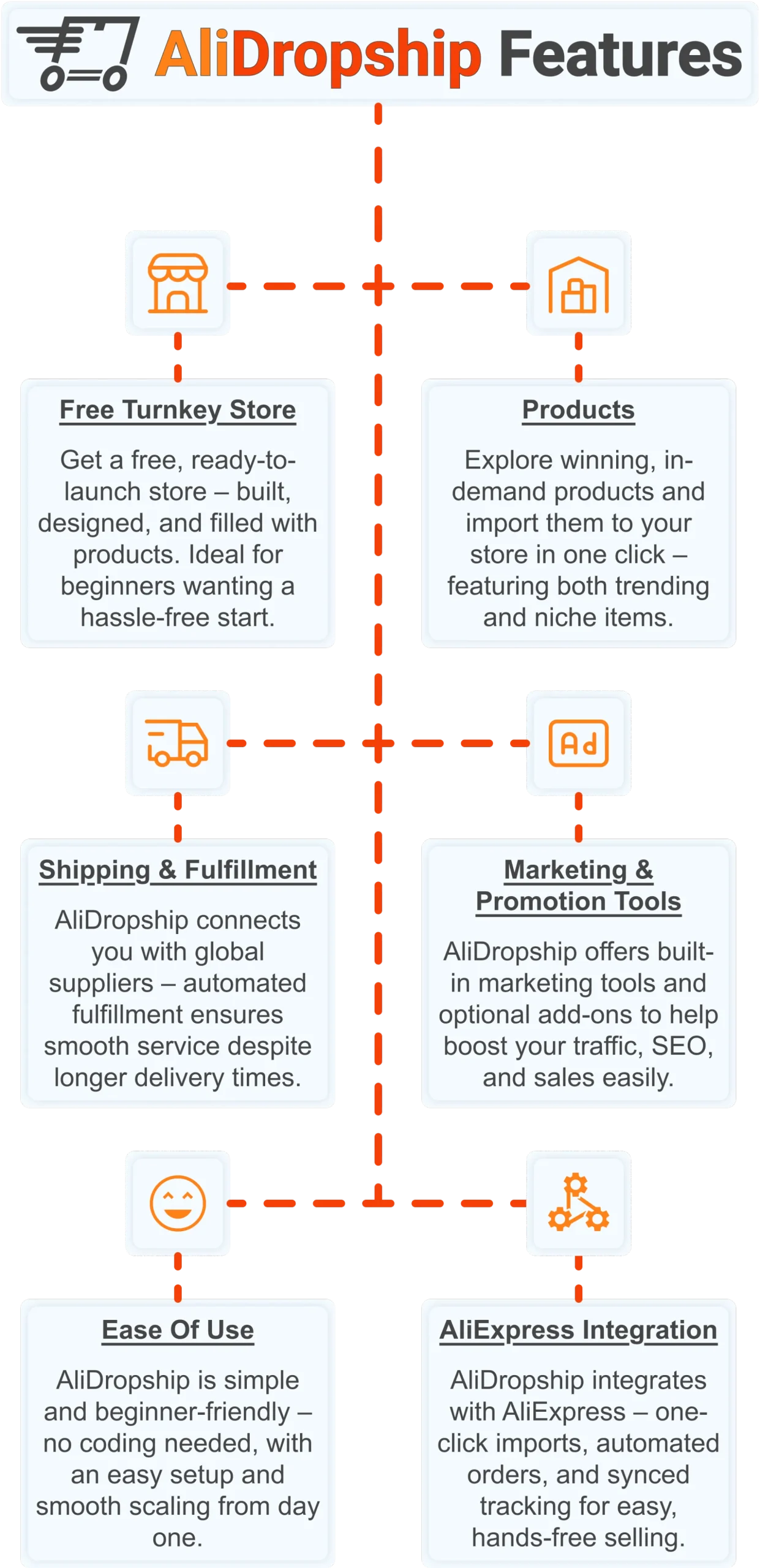
Free turnkey store ️
Get a free turnkey store – built, designed, and filled with products. Ideal for beginners wanting a hassle-free start, the store comes fully optimized to attract customers right away, saving you time on setup. Plus, it includes professional design elements to give your business a polished, trustworthy look from day one. This ready-made foundation makes it easy to move seamlessly into product selection.
Products
Once your store is set up, you can explore winning, in-demand products and import them in one click – featuring both trending and niche items. This wide selection lets you cater to diverse customer interests and test what works best. Regular updates ensure you always have fresh products, keeping your store competitive and relevant. With great products in place, smooth shipping becomes the next essential step.
Shipping & fulfillment
AliDropship connects you with global suppliers, and automated fulfillment ensures seamless order processing despite international delivery times. Customers receive real-time tracking updates, which builds confidence and trust in your store. Once shipping is handled reliably, you can focus on promoting your store and attracting traffic.
Marketing & promotion tools
To maximize sales, AliDropship offers built-in marketing tools and optional add-ons that help boost traffic, SEO, and conversions. From email campaigns and discounts to social media integration, these tools empower you to reach and retain customers without needing prior marketing experience. With promotion strategies in place, managing your business becomes simpler and more efficient.
Ease of use
AliDropship is beginner-friendly – no coding needed, with an intuitive dashboard that guides you through every step. Easy setup and smooth scaling let you expand your store without stress. As your business grows, adding new features, products, and marketing campaigns remains hassle-free, giving you more time to focus on sales.
AliExpress integration
Finally, AliDropship integrates seamlessly with AliExpress, enabling one-click imports, automated orders, and synced tracking. Your inventory stays up-to-date with the latest products and prices, while automated order processing frees you from manual tasks. Combined with the turnkey setup, reliable shipping, and built-in marketing tools, this integration ensures your dropshipping business is fully equipped for growth and success.
Starting a business online is one of the best decisions you can make in 2026 – and AliDropship gives you everything you need to do it right from day one. Claim your free turnkey store and start building your online income today.
Frequently asked questions
What is the fastest way to start a business online in 2026?
The fastest path is to pick a model that fits your budget and skills, such as dropshipping, freelancing, digital products, or affiliate marketing, then set up a store or website and drive traffic through SEO or social media. Most beginners see their first sales within 30 to 90 days of launch. Global ecommerce sales are on track to hit 6.3 trillion dollars in 2026, showing the scale of the opportunity. Around 90 percent of new online businesses fail within their first few months, usually because founders skip steps or pick the wrong model.
How much money can you realistically make with an online business?
Dropshipping typically generates 200 to 5,000 dollars per month, while freelancing can bring in 500 to 8,000 dollars per month depending on skill and hours invested. Digital products have the widest range, from 100 to over 10,000 dollars per month, but usually take 12 to 24 months to build an audience. Affiliate marketing tends to produce 50 to 3,000 dollars per month after 12 or more months of consistent effort. Most beginners earn 200 to 800 dollars per month in their first 60 to 90 days.
Which online business model requires the least money to start?
Dropshipping and print on demand have the lowest startup costs and can both launch for under 100 dollars. Dropshipping works because you only pay for products after a sale has already been made, removing upfront inventory risk. Print on demand earns a smaller margin per item, typically 5 to 15 dollars per sale, but requires no stock either. Traditional ecommerce with your own inventory usually needs 500 to 2,000 dollars to get started, making it a bigger commitment.
What are the essential steps to launch an online business from scratch?
The process includes seven steps: picking a niche, validating the idea, writing a simple business plan, choosing a platform, sorting out legal basics, setting up payments and fulfillment, and driving traffic. A quick validation method is running 20 to 50 dollars in Facebook or Google ads to a simple landing page to see if people click through. Most beginners start as a sole proprietor and form an LLC once they are generating consistent revenue. Stripe and PayPal are the standard starting points for setting up payment processing.
How much can freelancing or consulting earn compared to dropshipping?
Freelancing typically earns 500 to 8,000 dollars per month, with software developers on Upwork earning 20 to 150 dollars per hour and writers or designers earning 15 to 80 dollars per hour. Consulting and coaching rates run higher, from 75 to 500 dollars per hour, but depend heavily on having proven results in a specific niche. Dropshipping earns 200 to 5,000 dollars per month with lower hourly effort once a store is automated. Freelancing pays faster since it trades time for money, while dropshipping and digital products can scale into more passive income over time.
 Previous post
