 ‧ Agnes Kazaryan ‧
March 13, 2026
‧ Agnes Kazaryan ‧
March 13, 2026  556 ‧
556 ‧
 0
0
Most online stores don’t fail because the products are wrong. They fail because nobody finds them. That’s the core problem ecommerce marketing exists to solve – and in 2026, getting it right has never been more achievable for independent sellers starting from scratch.
Whether you’re launching your first store or trying to grow an existing one, a structured ecommerce marketing strategy is the single biggest difference between stores that compound over time and stores that stall after the first few months.
Quick answer: Ecommerce marketing is the process of driving traffic, converting visitors, and retaining customers for an online store. The most effective approach in 2026 combines SEO, social media, email automation, and paid advertising – each channel reinforcing the others rather than working in isolation.
Before jumping into individual channels, it’s worth understanding why the order matters. Most new store owners pick one tactic at random, get uneven results, and give up. A strategy-first approach to digital marketing for ecommerce means every channel you add strengthens what’s already working – rather than competing with it for your time and attention.
What is ecommerce marketing?
Ecommerce marketing is the full set of activities used to bring potential customers to an online store, turn them into buyers, and encourage them to come back. It covers everything from how your store ranks on Google to what happens when someone abandons their cart at checkout.
Unlike traditional retail, ecommerce marketing is largely measurable. Every ad click, email open, and organic visit can be tracked – which means you can identify what’s not working and double down on what is. That data-driven feedback loop is one of the biggest structural advantages independent online sellers have over legacy retail brands.
In 2026, ecommerce marketing also means competing in a landscape where consumer attention is spread across more platforms than ever before. TikTok, Instagram Reels, Google Shopping, Pinterest, and YouTube all function as product discovery channels.
The stores winning in this environment aren’t necessarily spending the most – they’re showing up consistently in the right places with the right message for the right audience.
How much can you realistically earn from a well-marketed store?
This is one of the most searched questions in the ecommerce space – and one that deserves an honest answer. Results vary significantly depending on niche, channel mix, and how consistently the strategy is executed. Here’s a realistic breakdown by channel:
These figures reflect stores actively executing a strategy – not passive results. Most stores earning $3,000–$8,000 per month are running at least three of these channels simultaneously, with systems in place rather than ad-hoc effort.
One note on the upper ranges: The ceiling figures above apply to stores with optimized funnels, tested creatives, and established audiences. A brand-new store in its first 90 days should expect $500–$1,500/month while building its foundation. Paid advertising can move faster but requires upfront budget. SEO and email take 60–90 days to build momentum but compound in value over time.
The core ecommerce marketing channels explained
A solid online store marketing plan doesn’t require mastering every channel at once. Start with one or two, build repeatable systems, then expand. Here’s what each channel actually involves in 2026 – and what you can realistically expect from it.
Search engine optimization for ecommerce
Ecommerce SEO is the process of optimizing your store so it appears in organic search results when people look for products or information related to your niche. It’s one of the highest-ROI channels over the long term because traffic doesn’t stop the moment you stop paying for it.
On-page SEO
On-page SEO for online stores covers product titles, meta descriptions, image alt text, and URL structure. Each product page should target a specific keyword phrase that reflects how real customers search – “lightweight waterproof backpack for hiking” rather than just “backpack.”
Use your primary keyword naturally in the first 100 words of each product description, and avoid duplicating content across similar product variants.
Earning potential: $500–$3,000/month from organic product page traffic alone, within 4–6 months of consistent on-page optimization.
Content marketing and blogging
Publishing helpful blog content is one of the most underused tools in ecommerce marketing. A blog lets you rank for informational keywords – “best gifts for runners,” “how to choose a standing desk” – that bring buyers in earlier during their research phase. These visitors are warmer leads than cold ad traffic because they arrived looking for help, not just a deal.
Aim for at least two well-researched posts per month targeting mid-funnel keywords in your niche. Internal links from blog posts to product pages also build your store’s overall domain authority over time, which raises all rankings across the site.
Why this works in 2026: Google’s helpful content updates continue to reward depth and genuine usefulness over keyword-stuffed filler. Stores with strong content libraries are increasingly outranking pure product pages in competitive niches.
Technical SEO basics
Technical SEO covers the backend factors that affect how search engines crawl and index your store – page speed, mobile responsiveness, structured data, and clean URL architecture. A store that loads in under 2 seconds on mobile has a measurable conversion and ranking advantage over a slower competitor.
Use Google Search Console to monitor crawl errors and PageSpeed Insights to identify load time issues before they compound.
Social media marketing for ecommerce
Social media marketing for ecommerce in 2026 means far more than posting product photos on a schedule. The platforms driving the most ecommerce revenue – TikTok, Instagram, Pinterest, and Facebook – each have distinct content formats, audience behaviors, and ad ecosystems worth understanding separately.
TikTok and short-form video
TikTok has become one of the most powerful product discovery platforms available to independent sellers. Short-form video showing products in real use – unboxings, before-and-after demos, problem-solution formats – consistently outperforms static image ads for conversion rate. Stores in home, beauty, fashion, and gadget niches are particularly well-positioned here.
You don’t need a professional studio. Authentic, lo-fi smartphone content regularly outperforms polished creative because it feels native to the platform. Aim for 3–5 videos per week during the growth phase, and use TikTok’s built-in analytics to identify which hooks are driving the most profile visits and link clicks.
Earning potential: $300–$2,500/month in attributable store revenue from organic TikTok alone, scaling faster when combined with TikTok Shop integration.
Instagram and Pinterest
Instagram remains a strong channel for lifestyle and visual product niches. Reels get the widest organic reach, but Stories and product tags in feed posts drive direct click-throughs to your store. Pinterest is particularly valuable for evergreen product categories – home décor, wedding, fitness, food – where a single post can continue driving traffic for months or years after it’s published.
For both platforms, consistency beats volume. Posting three times a week with strong visual branding and keyword-optimized captions will outperform daily posting with inconsistent quality every time.
Facebook and community-based marketing
Facebook Groups remain a surprisingly effective organic channel for niche stores. Building or participating in communities around your product category – parenting, fitness, pet care, home improvement – lets you establish authority and introduce your store to engaged, targeted audiences without ad spend.
Facebook Marketplace is also an underused channel for physical product sellers looking for local or national visibility at zero cost.
Email marketing: The highest-ROI channel once you’re set up
Email marketing consistently delivers among the highest ROI of any digital marketing for ecommerce channel – commonly cited at $36–$42 return per dollar spent across the industry. The reason is straightforward: you own your email list. Unlike social media followers or ad audiences, your list can’t be taken away by an algorithm update or a platform policy change.
Automated flows that drive revenue
The three email automations every ecommerce store needs are: a welcome series (3–5 emails introducing your brand and best sellers), an abandoned cart sequence (2–3 emails recovering lost purchases), and a post-purchase flow (thank you, review request, cross-sell offer). These three flows alone can recover 10–15% of would-be lost revenue with minimal ongoing effort once they’re live.
Earning potential: $500–$3,000/month from automated email flows in a store with a list of 1,000–5,000 subscribers.
Broadcast campaigns and segmentation
Beyond automations, regular broadcast emails – product launches, seasonal promotions, curated roundups – keep your audience engaged and buying between automated touchpoints. Segmenting your list by purchase history or browsing behavior means you can send relevant offers instead of generic blasts, which significantly improves open rates and reduces unsubscribes over time.
Platforms like Klaviyo and Omnisend offer ecommerce-specific segmentation built for exactly this use case.
Paid advertising for ecommerce: Fastest path to traffic
Paid advertising is the fastest way to generate traffic to a new store – but also the easiest way to burn through budget without a clear strategy. The two dominant paid channels for ecommerce are Google Shopping ads and Meta (Facebook/Instagram) ads, each playing a distinct role in the marketing funnel.
Google Shopping ads
Google Shopping campaigns place your products directly in front of people who are actively searching to buy. Because the intent is already there, conversion rates are typically higher than social ads – often 2–4% versus 0.5–1.5% for cold social traffic. The tradeoff is cost: competitive niches can have cost-per-click rates of $1–$4, so having a solid average order value and healthy margin is essential before scaling spend.
Important note: Google Shopping requires a well-optimized product feed through Google Merchant Center. Errors in your feed – missing GTINs, vague titles, policy violations – will limit your ad visibility significantly and can get campaigns paused.
Meta ads and retargeting
Meta ads across Facebook and Instagram excel at top-of-funnel awareness and retargeting. Cold audiences respond well to video creative and problem-solution angles, while warm retargeting audiences – site visitors, cart abandoners, past buyers – can be served direct-response ads at significantly lower cost per purchase.
Even a modest retargeting budget of $5–$10 per day can recover meaningful revenue from visitors who didn’t convert on their first visit.
Influencer marketing and user-generated content
Influencer marketing has matured considerably since its early years. In 2026, micro-influencers – creators with 5,000–50,000 followers in a specific niche – consistently outperform mega-influencers for ecommerce conversion. Their audiences are more engaged, and their recommendations feel more genuine because they’re coming from someone the audience actually follows for the content, not the brand deals.
Finding the right influencers
Start by searching hashtags related to your product niche on Instagram and TikTok. Look for creators whose content style matches your brand, whose engagement rate (likes plus comments divided by followers) sits above 3%, and who have a history of sharing product recommendations.
Reach out directly with a brief, personalized message offering free product in exchange for an honest review. Many micro-influencers at this level work on a gifting-only basis – making this one of the most cost-effective channels available to new stores.
Earning potential: $500–$4,000/month in attributable revenue from a consistent micro-influencer gifting program with 5–10 active partners.
User-generated content as a marketing asset
Every piece of genuine customer content – a review photo, an unboxing video, a tagged Instagram Story – is a marketing asset you didn’t have to create yourself. Encourage UGC by including a card in your packaging asking customers to share their purchase with a branded hashtag, and offer a small discount on their next order in exchange.
Reposting UGC on your own channels builds social proof while cutting your content creation workload at the same time.
Legal and ethical considerations in ecommerce marketing
As online advertising regulation tightens globally, understanding the legal boundaries of ecommerce marketing is no longer optional. The following areas carry real risk for store owners who cut corners – and they’re also the areas where shortcuts tend to backfire with customers the most.
Key principle: Transparency builds long-term customer trust and protects you from regulatory action – always disclose paid partnerships, honor your refund policies, and represent your products accurately in all marketing material.
- FTC disclosure rules: In the US, any paid promotion or gifted product review must be clearly disclosed. Influencers must state when content is sponsored or when they received free product. Failure to disclose is an FTC violation that can result in fines for both the brand and the creator.
- Email marketing compliance: All marketing emails must include a clear unsubscribe option and your business mailing address under CAN-SPAM (US) and GDPR (EU). Never add people to your list without explicit opt-in consent.
- Fake reviews: Posting fake reviews on your own products – or paying for them – violates platform terms of service and, in many jurisdictions, consumer protection laws. A post-purchase email flow asking for genuine reviews is a more sustainable and legally sound approach.
- Ad creative accuracy: Your ads must accurately represent your products. Misleading before-and-after claims, false scarcity tactics, and exaggerated results are all violations of Meta and Google advertising policies – and lead to ad account restrictions that are difficult to reverse.
How to choose your ecommerce marketing strategy by experience level
Not every channel makes sense at every stage. The right strategy depends on your current situation – how much time you have, whether you have ad budget, and where you are in your store’s growth. Here’s an honest breakdown by experience level.
Complete beginner
If you’re launching your first store with a limited budget, start with organic social – specifically TikTok or Instagram Reels – combined with basic on-page SEO for your product pages. These two channels cost nothing to start, build skills that compound over time, and give you real audience feedback on your products before you spend on ads.
Set up your abandoned cart email automation from day one – it’s a one-time setup that recovers revenue passively while you’re focused on growth.
Intermediate / part-time seller
If you have an existing store generating some revenue – $500–$2,000/month – and you’re ready to accelerate, add a content marketing blog targeting mid-funnel keywords in your niche, and launch small Meta retargeting campaigns at $5–$10 per day to capture visitors who didn’t convert.
At this stage, start segmenting your email list and expanding your automated flows beyond the basics. This is the phase where multiple channels start reinforcing each other.
Advanced / full-time goal
If your goal is a full-time income of $5,000+/month, you need all five channels working in coordination: SEO-driven content feeding organic traffic, social media maintaining brand awareness, email retaining and monetizing your existing customers, paid ads scaling your best-performing products, and an influencer program generating ongoing UGC.
At this level, the biggest lever is usually improving conversion rate rather than adding more traffic – a 1% improvement in your store’s conversion rate is worth more than doubling your ad spend.
Store owner with a winning product
If you already know your winning products and want to double down on what’s working, Google Shopping is your fastest path to scalable, intent-based traffic. Combine it with a growing email list to reduce your dependence on paid channels over time. Pinterest is also worth adding for evergreen product categories – content posted today can still drive traffic two years from now at zero ongoing cost.
AliDropship: Your complete all-in-one solution for starting dropshipping in 2026
If you want the simplest possible way to start dropshipping – especially if you’re brand new – AliDropship remains one of the most beginner-friendly tools available in 2026. It brings together store creation, product imports, automation, and marketing into a single streamlined system designed to help you launch quickly and grow confidently.
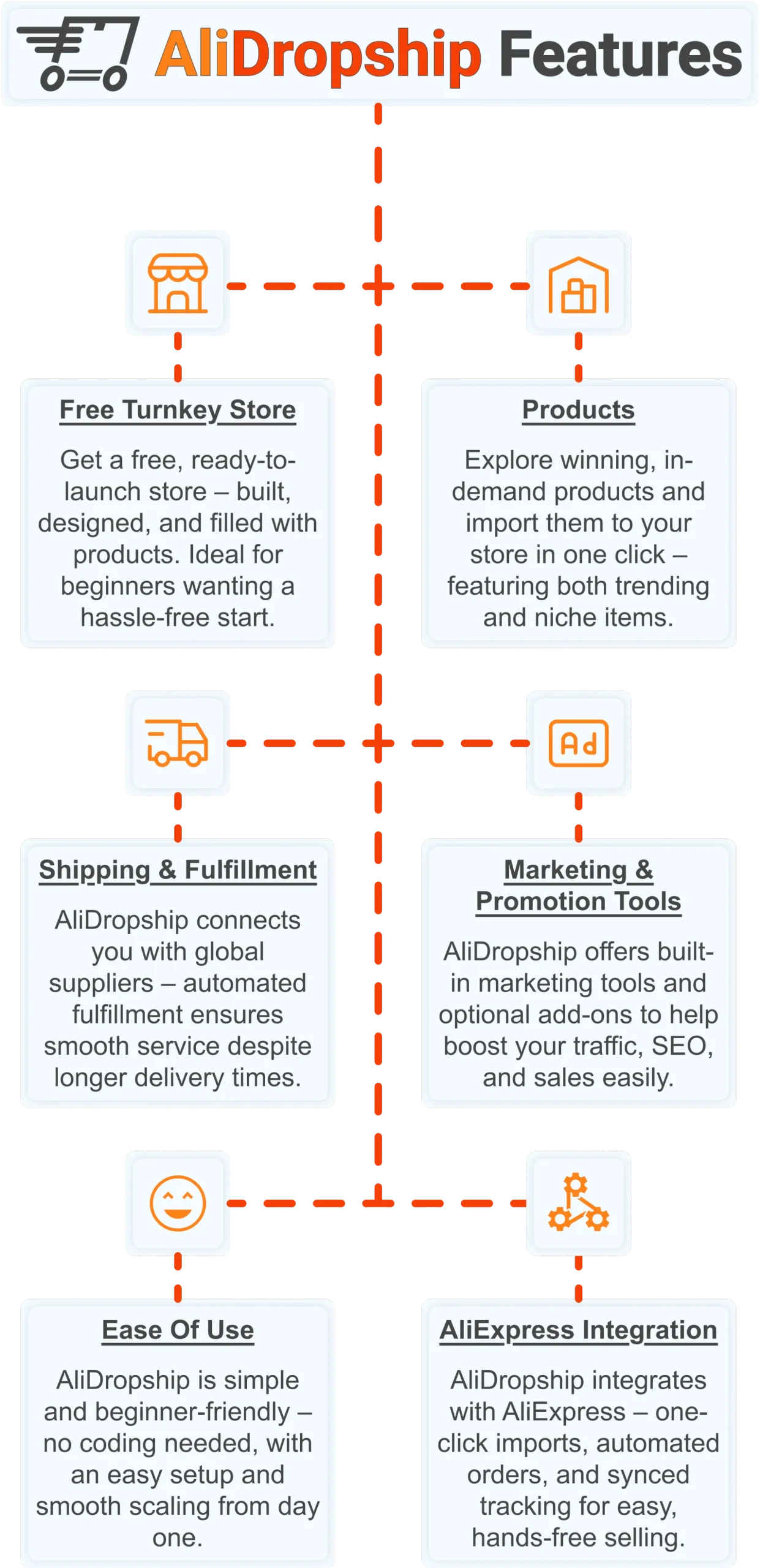
Free turnkey store ️
Get a free turnkey store – built, designed, and filled with products. Ideal for beginners wanting a hassle-free start, the store comes fully optimized to attract customers right away, saving you time on setup. Plus, it includes professional design elements to give your business a polished, trustworthy look from day one. This ready-made foundation makes it easy to move seamlessly into product selection.
Products
Once your store is set up, you can explore winning, in-demand products and import them in one click – featuring both trending and niche items. This wide selection lets you cater to diverse customer interests and test what works best. Regular updates ensure you always have fresh products, keeping your store competitive and relevant. With great products in place, smooth shipping becomes the next essential step.
Shipping & fulfillment
AliDropship connects you with global suppliers, and automated fulfillment ensures seamless order processing despite international delivery times. Customers receive real-time tracking updates, which builds confidence and trust in your store. Once shipping is handled reliably, you can focus on promoting your store and attracting traffic.
Marketing & promotion tools
To maximize sales, AliDropship offers built-in marketing tools and optional add-ons that help boost traffic, SEO, and conversions. From email campaigns and discounts to social media integration, these tools empower you to reach and retain customers without needing prior marketing experience. With promotion strategies in place, managing your business becomes simpler and more efficient.
Ease of use
AliDropship is beginner-friendly – no coding needed, with an intuitive dashboard that guides you through every step. Easy setup and smooth scaling let you expand your store without stress. As your business grows, adding new features, products, and marketing campaigns remains hassle-free, giving you more time to focus on sales.
AliExpress integration
Finally, AliDropship integrates seamlessly with AliExpress, enabling one-click imports, automated orders, and synced tracking. Your inventory stays up-to-date with the latest products and prices, while automated order processing frees you from manual tasks. Combined with the turnkey setup, reliable shipping, and built-in marketing tools, this integration ensures your dropshipping business is fully equipped for growth and success.
Frequently Asked Questions
What is ecommerce marketing and why does it matter?
Ecommerce marketing is the combination of SEO, social media, email, and paid advertising used to drive traffic, convert visitors, and retain customers for an online store. It matters because most stores fail not from poor products but from lack of visibility, and every channel can be tracked and measured. In 2026, sellers are competing across at least 5 major discovery platforms, including TikTok, Instagram, and Pinterest. A structured, multi-channel approach consistently outperforms single-tactic efforts over time.
How much can a new store earn from ecommerce marketing?
Earnings vary widely depending on niche and channel mix, but a brand-new store in its first 90 days should expect 500 to 1500 per month while building its foundation. Stores running at least 3 channels simultaneously, such as SEO, email, and paid ads, often reach 3000 to 8000 per month. SEO and email typically take 60 to 90 days to build momentum but compound in value afterward. Paid advertising can generate faster results but requires upfront budget to test.
Which social media platforms work best for ecommerce marketing?
TikTok, Instagram, Pinterest, and Facebook each play a distinct role in ecommerce marketing strategies. TikTok performs especially well for home, beauty, fashion, and gadget niches, with sellers posting 3 to 5 videos per week during a growth phase. Pinterest stands out for evergreen categories like home decor and fitness, where a single post can drive traffic for 2 years or more after publishing. Consistency, such as posting 3 times weekly, tends to outperform daily posting with inconsistent quality.
Why is email marketing considered a high-ROI channel in ecommerce marketing?
Email marketing is considered one of the highest-ROI digital marketing for ecommerce channels because it commonly returns 36 to 42 dollars for every 1 dollar spent industry-wide. Three core automations, a welcome series, an abandoned cart sequence, and a post-purchase flow, can recover 10 to 15 percent of otherwise lost revenue. A list of 1000 to 5000 subscribers can generate 500 to 3000 per month from automated flows alone. Because the list is owned by the store, it is not affected by algorithm changes the way social platforms are.
What legal rules apply to ecommerce marketing campaigns?
Ecommerce marketing must follow disclosure and compliance rules to avoid regulatory risk. Under FTC rules, any paid promotion or gifted product review must be clearly disclosed, and failure to do so can result in fines. Marketing emails must include a clear unsubscribe option and business mailing address under CAN-SPAM and GDPR regulations. Fake reviews and misleading ad claims also violate platform policies from both Meta and Google, which can lead to ad account restrictions.
Every ecommerce marketing strategy in this guide works best when it’s backed by a store that’s built to convert. Get your free turnkey store today and start putting these strategies to work.
 Previous post
