 ‧ Agnes Kazaryan ‧
March 27, 2026
‧ Agnes Kazaryan ‧
March 27, 2026  642 ‧
642 ‧
 0
0
Every time someone clicks “buy” on an online store, a chain of events kicks off behind the scenes. That chain – from confirmed order to package at the door – is called ecommerce order fulfillment. If you are running a store or planning to start one, this process is going to define whether customers come back or whether they leave a one-star review.
Get it right and your store runs smoothly, builds trust, and earns repeat customers. Get it wrong and you are dealing with disputes, refund requests, and a reputation that is hard to recover.
Quick answer: Ecommerce order fulfillment is the complete process of receiving an order, picking and packing the product, and delivering it to the customer – including inventory management, shipping, and returns. For most new store owners, automated dropshipping fulfillment is the most practical and cost-effective way to start.
This guide walks through every stage of the order fulfillment process, compares the main fulfillment methods, and explains which approach makes sense depending on where you are in your ecommerce journey.
What is ecommerce order fulfillment?
Ecommerce order fulfillment refers to every step that happens between a customer placing an order and that order arriving at their door. It begins the moment a purchase is confirmed and ends when the package is delivered – or returned, if something goes wrong.
The core stages look like this:
- Receiving inventory – products arrive at a storage location and are logged into your system.
- Storage – products are organized so they can be picked quickly when an order comes in.
- Order processing – payment is verified, the order is confirmed, and picking instructions go out.
- Picking and packing – the right items are selected, packaged securely, and labelled for shipping.
- Shipping – the package is handed to a carrier and tracked to the customer’s address.
- Returns and exchanges – returned items are inspected and either restocked or disposed of.
In 2026, ecommerce shipping and fulfillment has become significantly more automated. Even solo store owners now have access to tools that handle most of these steps with little to no manual input. That shift has made it possible to run stores serving hundreds of customers a month without being involved in the logistics side at all.
Why this works in 2026: Consumer expectations for fast, tracked, reliable delivery have raised the bar across the board – and the platforms that meet those expectations are now affordable and accessible for stores of every size.
How much can you realistically earn from an ecommerce store?
Before getting into the mechanics of how to fulfill orders online, it is worth setting honest expectations. A lot of the income figures circulating online are headline numbers stripped of context. Here is a more grounded breakdown:
These figures reflect what active store owners consistently report across communities like Reddit’s r/dropship and r/ecommerce. Results vary based on niche, product selection, and how much effort goes into marketing.
One note on earning potential: The ceiling figures above represent stores that are already optimized, marketed, and generating returning customers. New stores in their first 60 days should expect to be in test-and-learn mode – not hitting maximum revenue from week one.
Dropshipping fulfillment attracts so many new entrepreneurs because the startup cost and operational overhead are the lowest of the three options. You do not buy stock upfront, you do not rent warehouse space, and you do not run to the post office. The supplier handles physical fulfillment and you focus entirely on running and growing the store.
The main ecommerce order fulfillment methods explained
There is no single correct answer when it comes to fulfillment for online stores. The best approach depends on your budget, your product type, your order volume, and how involved you want to be in the day-to-day. Here is a detailed look at each method.
Self-fulfillment
Self-fulfillment means you personally handle every stage of the order fulfillment process. You buy stock, store it somewhere, pick and pack each order, print labels, and take packages to the carrier. For very early-stage stores – or makers selling handmade goods – this can make sense. You keep full control over packaging quality and can add personal touches that third parties cannot replicate.
Getting started with self-fulfillment
Set up a dedicated storage area, even if it is just a corner of a spare room. Use a spreadsheet or basic inventory management tool to track stock levels. Connect your store to a label printing service to cut the time and cost of processing shipments manually.
Earning potential: $500–$2,500/month once you have steady traffic, but your time cost is significant – expect to spend 10–20 hours per week on fulfillment tasks alone at moderate order volume.
When self-fulfillment stops making sense
Most store owners hit a wall around 20–40 orders per day. At that volume, packing and shipping eats the working day and leaves no time to grow the business. That is typically the point where people move to a 3PL or restructure toward dropshipping fulfillment.
Third-party logistics (3PL)
A 3PL warehouse receives your inventory in bulk, stores it, and fulfills orders on your behalf when they come in. Companies like ShipBob and Amazon FBA are well-known examples. You pay for storage space and a per-order handling fee, but you outsource the physical labor entirely.
How the 3PL order fulfillment process works
You send a batch of stock to the 3PL facility. When a customer orders, your store forwards the order data to the 3PL automatically. They pick, pack, and ship within the agreed timeframe – often same day or next day for US-based warehouses. Tracking information is sent back to your store and directly to the customer.
Important note: 3PL pricing structures vary widely. Always factor in inbound receiving fees, monthly storage fees, pick-and-pack fees, and return processing fees before comparing costs to other fulfillment methods.
3PL pros and limitations
3PLs make sense when you have proven products, predictable order volume, and enough margin to absorb per-order fees. They are less practical for new store owners because you need to buy and send inventory before you have validated demand. If a product does not sell, you are paying storage fees on dead stock.
Dropshipping fulfillment
Dropshipping fulfillment flips the traditional model. Instead of holding inventory, your store connects directly to suppliers who ship products to your customers on your behalf. You never touch the product. When a customer orders, the order goes to your supplier, they pack and ship it, and you keep the margin between what the customer paid and what the supplier charged.
How automated order fulfillment works in dropshipping
With a properly set-up dropshipping store, the order fulfillment process is almost entirely automated. A customer places an order. Your store software forwards the order details to the supplier. The supplier ships the item – often with your store’s branding on the packing slip. Tracking information is automatically sent to the customer. You receive payment minus the supplier cost, all without manually touching a single thing.
Platforms like AliDropship connect your store to AliExpress suppliers and handle all of this automatically. That is why dropshipping fulfillment is the most popular starting point for new ecommerce entrepreneurs in 2026.
Earning potential: $30–$80/day is a realistic target within 60–90 days for an actively marketed dropshipping store. Established stores with paid traffic and optimized product pages regularly earn $200–$500/day or more.
Supplier reliability and shipping times
The main concern people raise about AliExpress-based dropshipping is delivery time. Standard shipping from China to the US or Europe can take 10–20 days. However, many suppliers now offer ePacket or AliExpress Standard Shipping, which cuts that to 7–14 days for most markets. Some suppliers have warehouses in the US or EU, enabling 3–7 day delivery. When setting up your store, filter specifically for suppliers with local warehouse options in your target market to reduce this friction.
Hybrid fulfillment
Some store owners combine methods. They dropship for most products to test demand, then move their top-selling lines into a 3PL to offer faster delivery on items they know will sell. This is a smart growth path once you have real data to work from.
For example, a store might start 100% on dropshipping fulfillment in month one. By month six, they identify three products that account for 70% of revenue and move those to a US-based 3PL – cutting delivery time from 14 days to 3 days. Everything else stays on autopilot through dropshipping. The result is faster delivery on proven sellers, without the risk of holding inventory for products that have not yet validated themselves.
How to optimize the order fulfillment process for your store
Whichever fulfillment method you use, a handful of consistent practices will improve customer satisfaction, reduce complaints, and increase repeat purchases.
Set accurate delivery expectations upfront
Most customer complaints about shipping are not actually about speed – they are about surprise. A customer who expects 14 days and receives in 12 is happy. A customer who expected 5 days and received in 12 is writing a negative review.
Display estimated delivery times clearly on product pages, at checkout, and in your order confirmation email. For dropshipping fulfillment, be specific and honest: “Ships from our supplier within 1–3 business days, estimated delivery 10–15 business days.”
Automate tracking notifications
Customers want to know where their order is. Set up automated tracking emails at three key moments: when the order is confirmed, when it ships, and when it is out for delivery. Most ecommerce shipping and fulfillment platforms handle this automatically. Reducing “where is my order?” messages saves you time and signals professionalism to your buyers.
Build a clear returns policy
A visible, easy-to-understand returns policy increases conversion rates. Customers are more likely to buy when they know they can return something without a fight. For dropshipping stores, align your returns policy with your supplier’s policy – and add a buffer. If your supplier accepts returns within 15 days, offer your customers 30 days. You absorb minor losses in exchange for stronger trust and fewer disputes.
Monitor your fulfillment metrics
Track these numbers monthly as a minimum: order processing time, on-time delivery rate, return rate, and customer satisfaction score. If your dropshipping fulfillment partner starts missing shipment windows, you need to know early enough to switch suppliers before your store reviews start to suffer.
Use order management tools to stay on top of volume
As your store grows, manual order management becomes unsustainable fast. Platforms built for fulfillment for online stores – including AliDropship – centralize everything: order status, supplier communication, tracking updates, and inventory alerts. This is what makes scaling from 10 to 100 to 1,000 orders per month manageable without hiring a team.
Pro Tip: Before scaling your ad spend, run a small test batch of real orders through your fulfillment workflow end to end. Find any gaps in automation, tracking, or supplier response time before volume turns small issues into big problems.
Legal and ethical considerations in ecommerce order fulfillment
Running a legitimate ecommerce store means being transparent about what you sell, where it ships from, and what your policies are. The order fulfillment process has a few specific areas where new store owners can drift into grey territory – often without realizing it.
What to avoid
Key principle: Never misrepresent shipping times, product origin, or stock availability to close a sale you cannot actually fulfil as described.
Common issues to avoid include advertising “ships in 24 hours” when your supplier takes 3–5 business days to process, listing a product as “in stock” when it is on backorder, copying competitor descriptions that include false claims about materials or certifications, and hiding international shipping origin instead of addressing it honestly.
What to do instead
Build your store around honest, specific communication. If your ecommerce shipping and fulfillment relies on international suppliers, say so – and explain why it works in the customer’s favor (lower prices, wider product range, competitive quality).
Include a clear FAQ on your store covering shipping times, returns, and what to do if an order does not arrive. Customers who feel informed are far less likely to dispute charges or leave negative reviews.
Important: For stores targeting EU customers, you are legally required to offer a 14-day right of withdrawal under EU consumer law. This applies to virtually all physical goods sold online in the EU, including dropshipped items.
How to choose the right fulfillment approach for your situation
The right ecommerce order fulfillment method depends on where you are in your business right now – not where you want to be in three years. Here is a practical breakdown by reader profile.
Complete beginner
If you have never run an online store before, dropshipping fulfillment is the correct starting point. You do not need startup capital for inventory. You do not need a warehouse. You do not need to understand logistics software. You set up your store, connect it to a supplier platform, and focus entirely on marketing and customer experience while the fulfillment layer runs automatically behind the scenes. The learning curve is about running a business – not about packing boxes.
Intermediate – part-time seller
If you have been running a store for 3–6 months and have some consistent bestsellers, start looking at hybrid fulfillment. Keep the bulk of your catalogue on dropshipping automation. Identify your top 2–3 products and explore whether a US or EU-based 3PL can deliver them faster – improving reviews and repeat purchase rates for your most important lines.
Advanced – full-time goal
If your goal is a business generating $5,000–$20,000/month, your fulfillment for online stores strategy needs to evolve alongside your revenue. At that level, you should be working with dedicated 3PL account managers, negotiating rates, and building direct supplier relationships. Dropshipping remains useful for testing new products quickly, but your core catalogue should have the reliability of a professional fulfillment partner behind it.
Final thoughts: Matching your fulfillment method to your goals
Ecommerce order fulfillment is not a one-size-fits-all decision. The right method shifts as your store grows, your volume increases, and your products prove themselves in the market. What matters most at the start is removing the barriers that stop people from launching at all.
Dropshipping fulfillment removes the biggest barrier: upfront inventory cost. It lets you learn how to fulfill orders online, test products, build customer relationships, and generate real revenue – before committing capital to warehouse space or stock. That is why it remains the most common entry point to ecommerce in 2026.
As your store matures, a hybrid approach gives you the best of both worlds – automated fulfillment for new and unproven products, faster 3PL-backed shipping for your proven bestsellers. The key is making decisions based on your actual data, not assumptions.
- Complete beginner: Start with dropshipping fulfillment. Zero inventory risk, fully automated, and you can launch within days.
- Intermediate / part-time: Move your top sellers to a 3PL for faster delivery while keeping the rest on dropshipping autopilot.
- Advanced / full-time goal: Build a hybrid model with direct supplier relationships, dedicated 3PL partnerships, and dropshipping reserved for product testing.
AliDropship: Your complete all-in-one solution for starting dropshipping in 2026
If you want the simplest possible way to start dropshipping – especially if you’re brand new – AliDropship remains one of the most beginner-friendly tools available in 2026. It brings together store creation, product imports, automation, and marketing into a single streamlined system designed to help you launch quickly and grow confidently.
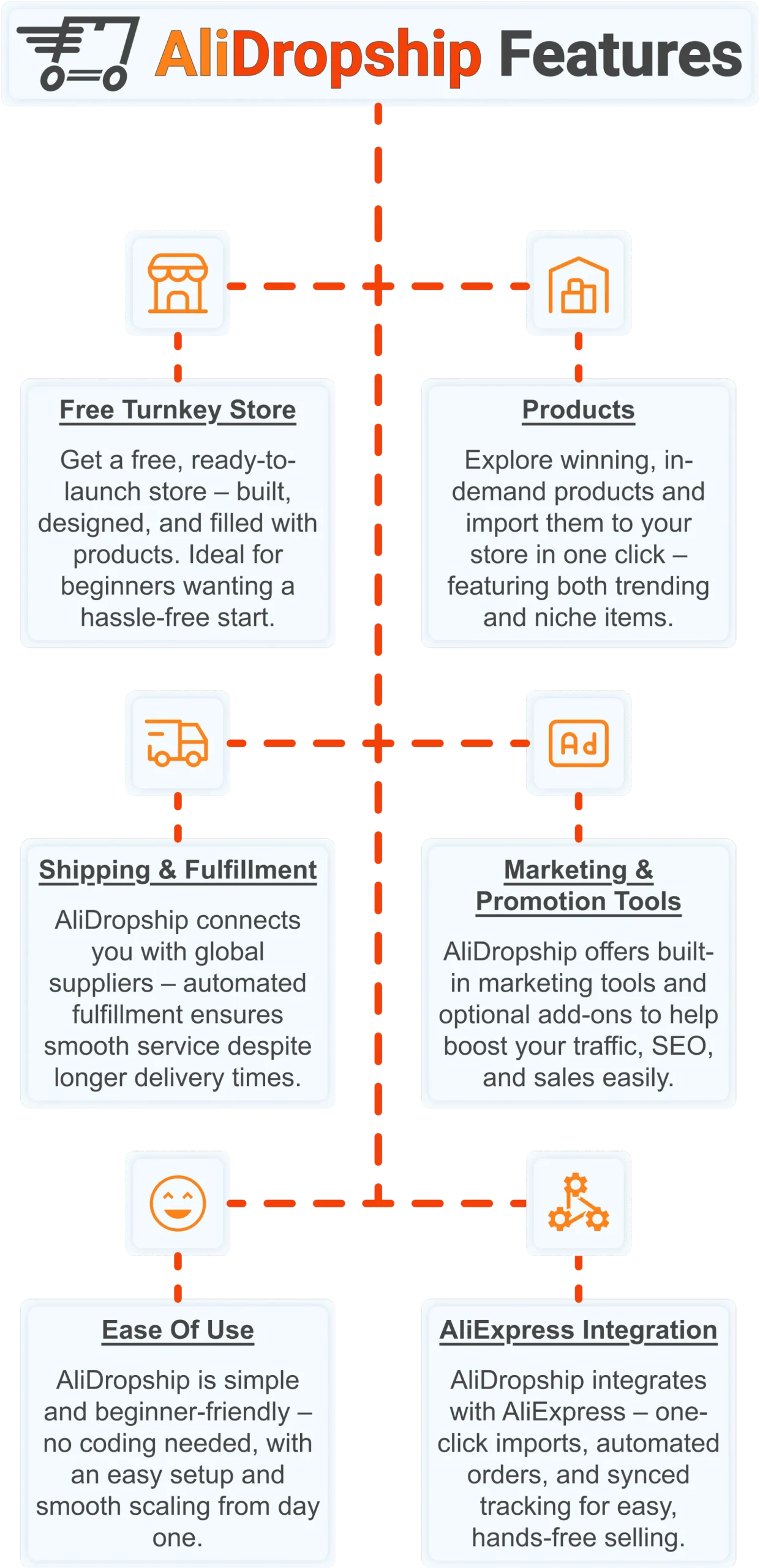
Free turnkey store ️
Get a free turnkey store – built, designed, and filled with products. Ideal for beginners wanting a hassle-free start, the store comes fully optimized to attract customers right away, saving you time on setup. Plus, it includes professional design elements to give your business a polished, trustworthy look from day one. This ready-made foundation makes it easy to move seamlessly into product selection.
Products
Once your store is set up, you can explore winning, in-demand products and import them in one click – featuring both trending and niche items. This wide selection lets you cater to diverse customer interests and test what works best. Regular updates ensure you always have fresh products, keeping your store competitive and relevant. With great products in place, smooth shipping becomes the next essential step.
Shipping & fulfillment
AliDropship connects you with global suppliers, and automated fulfillment ensures seamless order processing despite international delivery times. Customers receive real-time tracking updates, which builds confidence and trust in your store. Once shipping is handled reliably, you can focus on promoting your store and attracting traffic.
Marketing & promotion tools
To maximize sales, AliDropship offers built-in marketing tools and optional add-ons that help boost traffic, SEO, and conversions. From email campaigns and discounts to social media integration, these tools empower you to reach and retain customers without needing prior marketing experience. With promotion strategies in place, managing your business becomes simpler and more efficient.
Ease of use
AliDropship is beginner-friendly – no coding needed, with an intuitive dashboard that guides you through every step. Easy setup and smooth scaling let you expand your store without stress. As your business grows, adding new features, products, and marketing campaigns remains hassle-free, giving you more time to focus on sales.
AliExpress integration
Finally, AliDropship integrates seamlessly with AliExpress, enabling one-click imports, automated orders, and synced tracking. Your inventory stays up-to-date with the latest products and prices, while automated order processing frees you from manual tasks. Combined with the turnkey setup, reliable shipping, and built-in marketing tools, this integration ensures your dropshipping business is fully equipped for growth and success.
Ecommerce order fulfillment does not have to be complicated – with the right platform, the entire process runs automatically from the moment a customer buys. Get your free turnkey store today and start fulfilling orders without touching a single package.
Frequently Asked Questions
What is ecommerce order fulfillment?
Ecommerce order fulfillment covers every step between a customer placing an order and that order arriving at their door. The core stages include receiving inventory, storage, order processing, picking and packing, shipping, and handling returns and exchanges. In 2026, most of these steps are automated, allowing solo store owners to serve hundreds of customers a month without manual logistics work. This automation is a major reason dropshipping fulfillment has become the most common entry point for new stores.
What is the difference between dropshipping fulfillment and third-party logistics?
Dropshipping fulfillment means a supplier ships directly to the customer, so the seller never touches or stores the product. Third-party logistics, or 3PL, requires sending inventory in bulk to a warehouse, which then picks, packs, and ships each order for a fee. Dropshipping fulfillment realistically earns 30 to 80 per day within 60 to 90 days of launch. 3PL providers like ShipBob and Amazon FBA often deliver same day or next day for US-based warehouses, but require paying storage and per-order handling fees.
How long does shipping take with dropshipping fulfillment?
Standard shipping from China to the US or Europe can take 10 to 20 days. Many suppliers now offer ePacket or AliExpress Standard Shipping, which reduces that window to 7 to 14 days for most markets. Some suppliers maintain warehouses in the US or EU, enabling delivery in 3 to 7 days. Filtering for suppliers with local warehouse options in the target market is one of the most effective ways to reduce this delay.
How much can you earn from an ecommerce store depending on fulfillment method?
Self-fulfillment can generate 500 to 3000 per month after 3 to 6 months of consistent effort, but requires 10 to 20 hours per week of manual work. Third-party logistics can reach 1000 to 8000 per month with sufficient order volume. Dropshipping fulfillment realistically earns 30 to 200 per day within 60 to 90 days of launch. Established dropshipping stores with paid traffic and optimized product pages can reach 200 to 500 per day or more.
What legal requirements apply to ecommerce order fulfillment?
Sellers should never misrepresent shipping times, product origin, or stock availability just to close a sale. Advertising a product as shipping in 24 hours when a supplier actually takes 3 to 5 business days is a common example of this issue. Stores targeting EU customers are legally required to offer a 14-day right of withdrawal under EU consumer law. This requirement applies to virtually all physical goods sold online in the EU, including dropshipped items.
 Previous post
