 ‧ Agnes Kazaryan ‧
March 27, 2026
‧ Agnes Kazaryan ‧
March 27, 2026  588 ‧
588 ‧
 0
0
Global ecommerce sales crossed $6 trillion in 2024 – and the barrier to entry has never been lower. If you have been wondering how to do ecommerce, the short answer is: pick a model, set up a store, source products, and drive traffic. That is the whole game. The longer answer – which is what this guide covers – is how to do each of those things without wasting months or blowing your budget on the wrong approach.
Quick Answer: To do ecommerce, you choose a business model (dropshipping, print-on-demand, or selling your own products), set up an online store, add products, and bring in customers through paid or organic marketing. Dropshipping is the most accessible starting point because it requires no upfront inventory.
You do not need a business degree or a large budget to get started. What you need is a clear plan and the discipline to follow it. This guide walks you through everything in the right order – from picking your niche to making your first sale and scaling from there.
What is ecommerce and why does it matter in 2026?
Ecommerce – short for electronic commerce – is the buying and selling of goods or services over the internet. It covers everything from a single seller on Etsy to global retailers like Amazon. In practical terms, it means you can run a store that operates 24 hours a day, reaches customers in any country, and does not require a physical premises or a large team.
In 2026, ecommerce is not a trend – it is the default for a growing share of consumer spending. Mobile shopping, one-click payments, and same-day delivery expectations have permanently shifted how people buy. Businesses without an online presence are losing ground every year. For entrepreneurs, this shift is an opportunity: the tools needed to run an online store have never been more accessible or more affordable.
If you are worried about the technical side, modern platforms handle most of the complexity for you. Store builders, payment processors, and automation tools have removed the need for coding skills. The main ability you need is identifying what customers want – and reaching them effectively. That is a learnable skill, not an innate talent.
How much can you realistically earn from an ecommerce business?
Earnings in ecommerce vary widely depending on the model, the niche, and the effort involved. Here is a realistic overview:
Dropshipping has the lowest barrier to entry and is consistently where new sellers begin. Print-on-demand suits creative entrepreneurs who want unique products. Private label carries the highest ceiling but requires capital and experience.
One note on these figures: The ranges above reflect stores that are actively marketed and properly optimised. Most new ecommerce stores take 60–90 days to generate consistent daily revenue. The first 3 months should be treated as a testing and learning phase rather than an income phase. The upside is that ecommerce scales in a way most income streams do not – once you find a winning product and a reliable traffic source, increasing revenue does not proportionally increase your workload.
Step 1 – choose your ecommerce business model
Your business model determines everything: how you source products, how much capital you need, and how you handle fulfilment. The four most practical models for new sellers are dropshipping, print-on-demand, selling your own products, and digital products. Each has real trade-offs worth understanding before you commit.
Dropshipping
Dropshipping is the most popular entry point for ecommerce beginners because it requires no upfront stock purchase. You list products in your store, and when a customer places an order, you forward it to a supplier who ships directly to the buyer. Your margin is the difference between the supplier price and your retail price – typically 20% to 50% depending on the niche.
The main trade-off is that you do not control shipping times or packaging. Working with reliable suppliers via platforms like AliExpress – and using an automation tool like AliDropship – largely mitigates this. Order forwarding, tracking updates, and inventory syncing all happen automatically.
Why this works in 2026: Supplier networks have become faster and more transparent, and dropshipping automation tools now handle the operational side almost entirely, freeing you to focus on marketing.
Earning potential: $30–$200/day with an established store and consistent traffic.
Print-on-demand
Print-on-demand (POD) works similarly to dropshipping but applies to customizable products – T-shirts, mugs, phone cases, and posters. You upload a design, a POD provider prints and ships when an order comes in. Platforms like Printful and Printify integrate with most major store builders.
POD suits creative sellers who want product differentiation without managing inventory. Margins are thinner than dropshipping – typically 15%–35% – but your designs are exclusive, which makes standing out easier.
Earning potential: $10–$80/day with an established catalogue and consistent social media or paid traffic.
Selling your own products
If you make something – handmade goods, food products, cosmetics, crafts – ecommerce gives you a direct sales channel without relying on wholesale buyers. Margins are significantly higher, often 60%–80%, and brand loyalty tends to be stronger. The trade-off is the time and cost involved in manufacturing and fulfilment.
Most sellers in this category start on marketplaces like Etsy or eBay to validate demand before building a standalone store. This two-stage approach lets you test products without paying for paid traffic from day one.
Digital products
Ebooks, templates, courses, software, and stock assets have no inventory or shipping costs. Once created, a digital product can be sold an unlimited number of times. That makes them the highest-margin ecommerce option available – but they require a strong content or marketing angle to compete with free alternatives online.
Earning potential: $20–$150/day once a product is established and traffic is consistent.
Step 2 – pick a niche and validate demand
A niche is a specific market segment – a group of people with a shared interest or problem that your products address. Selling “clothing” is not a niche. Selling “performance activewear for recreational runners” is. The more specific you are, the easier it is to market and build a loyal customer base. Trying to sell everything to everyone is one of the most common mistakes new ecommerce sellers make.
How to find a profitable niche
Start with genuine interest and then stress-test it against demand data. Use Google Trends to check whether search interest in your topic is growing, stable, or declining. Browse Reddit communities and Facebook groups in your target category to understand what buyers actually want – and what they complain about. Check Amazon and eBay best-seller lists for validated product demand. If something sells there at scale, people are actively buying it.
A strong ecommerce niche has three characteristics: consistent or growing search volume, products with clear buyer intent, and manageable competition. You do not need to be the only seller – you just need a compelling reason for buyers to choose you over existing options.
Validate before you build
Before committing to a full store build, spend a few hours confirming real spending in your niche. Search your target keyword on Google and note how many paid ads appear – advertisers do not waste money on dead niches. Check databases like Dropship.me or Ecomhunt for winning dropshipping products. Look at Trustpilot reviews for existing stores in your niche to find gaps you can exploit.
Pro Tip: Niches with passionate hobbyists – fishing, board games, pet owners, home espresso setups – tend to convert better than generic product niches because buyers already have strong purchase intent before they reach your store.
Step 3 – set up your online store
Once you have a model and a niche, you need a store. Your two main options are a hosted ecommerce platform or a self-hosted store built on WordPress with WooCommerce. Both work – your choice depends on how much control you want versus how quickly you want to launch.
Hosted platforms
Hosted platforms like Shopify, Wix, and BigCommerce handle server maintenance, security, and updates for you. Shopify is the most widely used option for dropshippers because of its app ecosystem and clean checkout experience. Plans start at around $29/month. The main trade-off is ongoing fees and less control over your store’s technical structure. For most beginners, this is an acceptable trade-off – the time saved on maintenance is worth the cost.
Self-hosted stores with AliDropship
If you want full ownership and flexibility, WordPress with WooCommerce gives you complete control. Add the AliDropship plugin and you can import products directly from AliExpress, automate orders, and manage your dropshipping business from one dashboard – with no monthly platform fee after initial setup.
This is the route that makes the most long-term sense for serious dropshippers. You own your data, your design, and your store structure. AliDropship also offers a free turnkey store option where the build is done for you – so you can skip the setup phase entirely and start with a finished, product-filled store from day one.
Step 4 – source and import products
Product sourcing depends on your business model. For dropshipping, AliExpress is the most widely used supplier platform – it carries millions of products across virtually every category, and shipping times to major markets have improved considerably over the past few years. For print-on-demand, connect your store to Printful or Printify. For your own products, photograph and list them directly.
When selecting products, prioritise items with a clear value proposition, strong supplier reviews, and a retail price that leaves room for a healthy margin after advertising costs. A practical rule of thumb: if you cannot price the product at 2.5–3x the supplier cost and still remain competitive, the margins are too thin to build a sustainable business around.
Important: Do not import 200 products and hope something sticks. Start with 10–20 well-researched products and test them properly before expanding your catalogue.
Step 5 – set up payments and logistics
Payment processing is non-negotiable. You need at least one card payment method and ideally PayPal as a backup – a significant portion of online buyers will abandon checkout if PayPal is not available. Shopify Payments handles this natively if you are on Shopify. WooCommerce integrates with Stripe, PayPal, and most regional processors.
For logistics, your key tasks are writing a clear shipping policy, configuring order confirmation emails, and deciding on a returns policy. Even if your supplier handles physical fulfilment, you are responsible for the customer experience from purchase to delivery. A clearly written “what to expect” shipping page – with honest delivery timelines – reduces support tickets significantly and builds buyer confidence before any issues arise.
Important note: If products ship from overseas and take 2–3 weeks, say so clearly on your product pages and at checkout. The short-term conversion lift from hiding this detail is not worth the refund requests and chargebacks that follow.
Step 6 – drive traffic to your ecommerce store
Traffic is the lifeblood of any online store. No traffic means no sales, regardless of how good your products or store design are. There are two main channels to understand from the start: paid traffic and organic traffic. Most successful ecommerce businesses use both.
Paid advertising
Meta Ads – Facebook and Instagram – remain the dominant paid channel for ecommerce sellers because of their visual ad formats and precise audience targeting. Google Shopping ads work particularly well for buyers who are already searching for specific products. Start with $5–$15/day when testing new products and scale spend on ads that show a positive return on ad spend (ROAS) over 3–5 days. Do not pour money into ads before you have confirmed the product and the audience.
SEO for ecommerce
Search engine optimisation is slower but compounds over time. Target long-tail keywords related to your products – “best resistance bands for home gym” converts far better than “resistance bands” – and build out product descriptions, category pages, and blog content that answers questions your target buyers are searching for. Results typically appear after 60–120 days of consistent effort, but the traffic is free and sustainable once established.
Why this works in 2026: Google’s AI-powered search results now surface ecommerce content more prominently for product-related queries, making on-page SEO more impactful than it was even two years ago.
Social media and email
TikTok, Instagram Reels, and Pinterest are powerful organic channels for product discovery – particularly in visual niches like home decor, fashion, fitness, and beauty. Short-form video showing products in real use consistently outperforms static posts. Build a posting rhythm of 3–5 times per week and repurpose content across platforms to maximise reach without proportionally increasing effort.
Email marketing is the highest-converting channel for repeat purchases once you have a customer base. Start collecting email addresses from day one using an exit-intent popup or a discount offer. Set up an automated welcome sequence and an abandoned cart flow – these two automations alone can recover a meaningful percentage of otherwise lost revenue.
Legal and ethical considerations for selling online
Ecommerce is a legitimate business and should be run like one. There are a handful of legal and ethical points every new seller needs to understand before going live – skipping them creates problems that are far more expensive to fix later.
Business registration and taxes
In most jurisdictions, you are legally required to register your business once it generates income – even if you are operating as a sole trader. A basic LLC structure is popular with US-based ecommerce sellers because it separates personal and business liability. Consult a local accountant or use a setup service like Stripe Atlas or Firstbase to get your entity in order.
Sales tax in ecommerce is complex, particularly in the US where each state has its own thresholds and requirements. If you are selling to US customers, use a tool like TaxJar or Avalara to automate compliance from the start rather than untangling it later.
What to avoid absolutely
Fake reviews are one of the most common shortcuts in ecommerce – and one of the most damaging when caught. Amazon and Google both penalise sellers found to be purchasing or incentivising reviews in violation of platform policies. Build social proof legitimately: follow up with buyers via email, make it easy to leave a review, and respond professionally to negative feedback.
Misleading product descriptions – particularly around shipping times and product quality – lead directly to disputes, chargebacks, and damaged reputation. Neither platform penalties nor refund costs are worth the short-term conversion gains.
Key principle: Long-term ecommerce success is built on repeat buyers and word-of-mouth – both of which require trust, and trust requires honesty from the first interaction.
Consumer protection and returns
Buyers in the EU have a statutory 14-day right of return for online purchases regardless of your stated policy. In the US, there is no federal return requirement, but a no-return policy will hurt your conversion rate – most buyers check the returns page before purchasing. A 30-day return window is the de facto standard that builds the most trust without creating excessive operational burden for a new store.
How to choose the right ecommerce approach for your situation
Not every model suits every person. Here is a practical framework for matching your starting point to the right approach – based on experience, available time, and financial goals.
Complete beginner
If you have never run an online business before, start with dropshipping. It removes inventory risk, requires minimal upfront capital, and teaches you the core mechanics of ecommerce – product selection, store setup, traffic, and conversion – without the complexity of manufacturing or fulfilment. Focus on one niche and one traffic channel for the first 90 days rather than spreading yourself thin. A turnkey solution like AliDropship gets your store live quickly so that time goes into marketing rather than setup.
Intermediate / part-time seller
If you have some online selling experience – perhaps from eBay or Etsy – you are ready to build a branded standalone store. This is where private label or a premium dropshipping store with custom branding comes into play. Focus on building an email list from the start, running retargeting ads, and optimising your product pages for conversion rate. At this stage, profitability over raw revenue is the key metric: a store making $50/day profit is more valuable than one generating $200/day in revenue with negative margins after advertising costs.
Advanced / full-time goal
If you are aiming to replace a full-time income – typically $3,000–$5,000/month net profit – treat ecommerce as a business from day one. That means proper bookkeeping, a clear marketing budget, defined product testing criteria, and a roadmap for scaling winners through increased ad spend and additional channels. At scale, the operational advantages of a tool like AliDropship become even more pronounced: automated order processing, real-time inventory syncing, and bulk product management free up the time needed for strategy and growth rather than daily logistics.
Whatever your starting point, the ecommerce opportunity in 2026 is large and growing. The sellers who succeed are not necessarily the most experienced – they are the ones who start, test, and iterate faster than everyone else.
AliDropship: Your complete all-in-one solution for starting dropshipping in 2026
If you want the simplest possible way to start dropshipping – especially if you’re brand new – AliDropship remains one of the most beginner-friendly tools available in 2026. It brings together store creation, product imports, automation, and marketing into a single streamlined system designed to help you launch quickly and grow confidently.
Free turnkey store ️
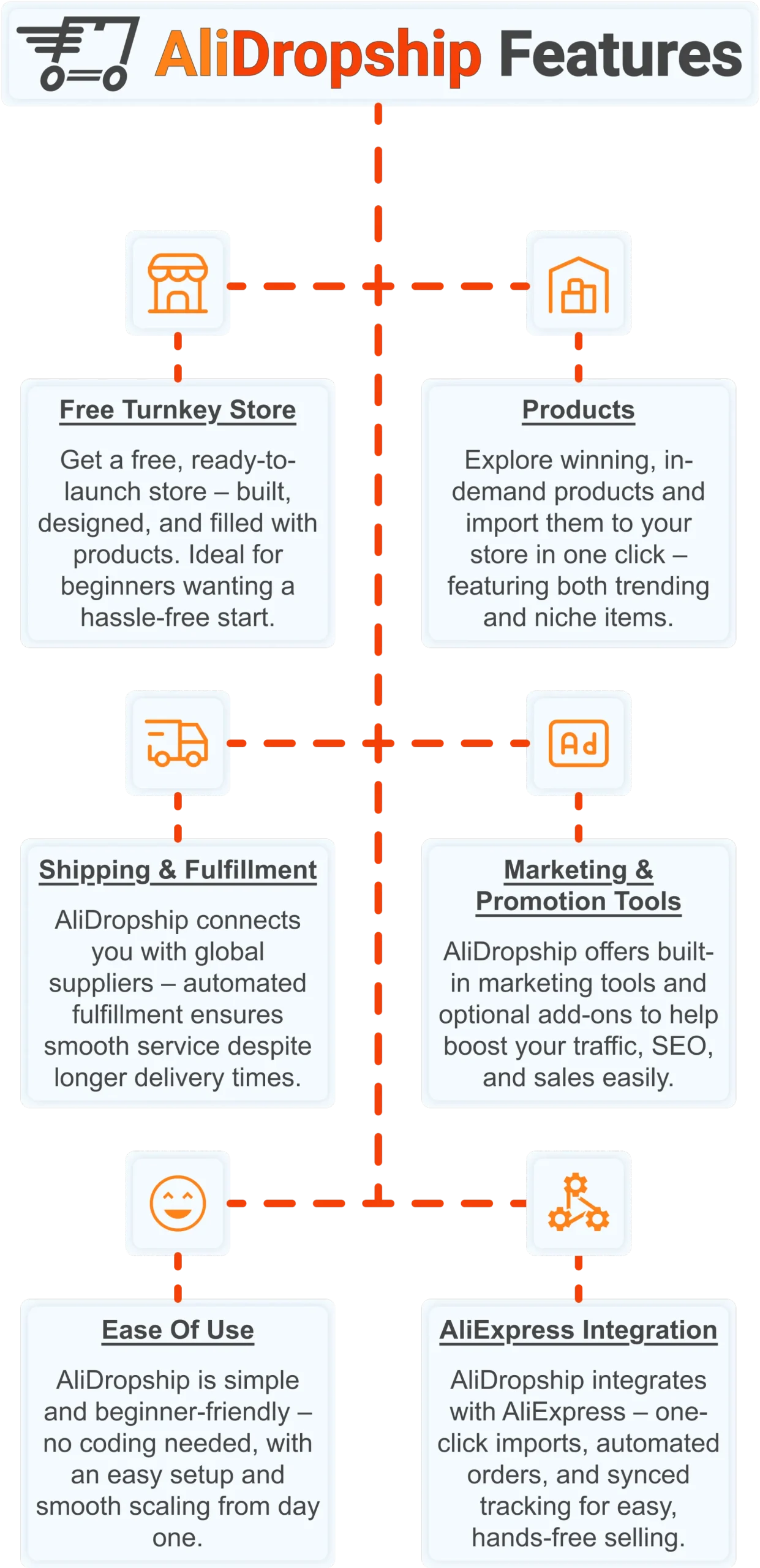
Get a free turnkey store – built, designed, and filled with products. Ideal for beginners wanting a hassle-free start, the store comes fully optimized to attract customers right away, saving you time on setup. Plus, it includes professional design elements to give your business a polished, trustworthy look from day one. This ready-made foundation makes it easy to move seamlessly into product selection.
Products
Once your store is set up, you can explore winning, in-demand products and import them in one click – featuring both trending and niche items. This wide selection lets you cater to diverse customer interests and test what works best. Regular updates ensure you always have fresh products, keeping your store competitive and relevant. With great products in place, smooth shipping becomes the next essential step.
Shipping & fulfillment
AliDropship connects you with global suppliers, and automated fulfillment ensures seamless order processing despite international delivery times. Customers receive real-time tracking updates, which builds confidence and trust in your store. Once shipping is handled reliably, you can focus on promoting your store and attracting traffic.
Marketing & promotion tools
To maximize sales, AliDropship offers built-in marketing tools and optional add-ons that help boost traffic, SEO, and conversions. From email campaigns and discounts to social media integration, these tools empower you to reach and retain customers without needing prior marketing experience. With promotion strategies in place, managing your business becomes simpler and more efficient.
Ease of use
AliDropship is beginner-friendly – no coding needed, with an intuitive dashboard that guides you through every step. Easy setup and smooth scaling let you expand your store without stress. As your business grows, adding new features, products, and marketing campaigns remains hassle-free, giving you more time to focus on sales.
AliExpress integration
Finally, AliDropship integrates seamlessly with AliExpress, enabling one-click imports, automated orders, and synced tracking. Your inventory stays up-to-date with the latest products and prices, while automated order processing frees you from manual tasks. Combined with the turnkey setup, reliable shipping, and built-in marketing tools, this integration ensures your dropshipping business is fully equipped for growth and success.
If you have been researching how to do ecommerce and want a practical shortcut that actually works, AliDropship gives you a finished, product-filled store so you can skip the setup and focus on selling. Claim your free turnkey store and $100 voucher today.
Frequently asked questions
How do you start doing ecommerce as a complete beginner?
The process comes down to four steps: choosing a business model, setting up a store, sourcing products, and driving traffic through paid or organic marketing. Dropshipping is the most accessible starting point because it requires no upfront inventory purchase. Beginners should focus on one niche and one traffic channel for the first 90 days rather than spreading effort too thin. Global ecommerce sales crossed 6 trillion dollars in 2024, showing how large the opportunity has become.
How much can you realistically earn from an ecommerce business?
Dropshipping typically earns 30 to 200 dollars per day once scaled with an established store and consistent traffic. Print on demand generates 10 to 80 dollars per day, while selling your own products can reach 100 dollars or more per day due to higher margins. Digital products bring in 20 to 150 dollars per day passively once established, and wholesale or business to business models can exceed 200 dollars per day. Most new stores need 60 to 90 days before generating consistent daily revenue.
Which ecommerce business model is best for beginners, dropshipping or print on demand?
Dropshipping is generally the better starting point since it requires no upfront stock purchase and margins typically run 20 to 50 percent depending on the niche. Print on demand suits creative sellers who want exclusive designs, but margins are thinner at 15 to 35 percent. Selling your own handmade products can bring margins of 60 to 80 percent but requires more time and manufacturing cost. A practical pricing rule is to price products at 2.5 to 3 times the supplier cost to keep margins sustainable.
What is the best way to set up an online store for ecommerce?
Hosted platforms like Shopify handle server maintenance and security, with plans starting at around 29 dollars per month. Self-hosted stores using WordPress with WooCommerce and the AliDropship plugin give full ownership and no monthly platform fee after initial setup. AliDropship also offers a free turnkey store option that is already built and filled with products. The right choice depends on whether a seller wants faster launch with ongoing fees or more control with a one time setup.
How do you drive traffic to a new ecommerce store?
Meta Ads remain the dominant paid channel for ecommerce sellers due to precise audience targeting, with a recommended starting budget of 5 to 15 dollars per day when testing new products. Search engine optimization is slower but compounds over time, with results typically appearing after 60 to 120 days of consistent effort. Social platforms like TikTok, Instagram Reels, and Pinterest work well for visual niches such as home decor and fashion. Email marketing is the highest converting channel for repeat purchases, especially with an automated welcome sequence and abandoned cart flow.
 Previous post
