 ‧ Agnes Kazaryan ‧
March 27, 2026
‧ Agnes Kazaryan ‧
March 27, 2026  1022 ‧
 0
0
Thousands of people search for the best things to sell online every single month. And in 2026, the opportunity has never been more real – the global dropshipping market is on track to surpass $500 billion this year. But here’s something most guides skip: finding popular items to sell is only half the job. The other half is having a store that can actually move them.
This guide gives you a clear, no-fluff breakdown of the top product categories right now, what makes them profitable in 2026, how to spot winning products before they saturate, and how to turn all of that into actual income. Whether you’re starting from zero or expanding an existing store, the niches below are where the serious money is moving.
Quick Answer: The most popular items to sell online in 2026 include home decor, beauty and skincare, health and wellness gadgets, pet products, smart electronics, and eco-friendly goods. These niches combine high demand, strong margins, and real repeat purchase potential – making them well suited for dropshipping.
Before diving into specific product categories, it’s worth understanding what actually separates a popular item from a profitable one – because they’re not always the same thing.
What makes an item popular to sell online?
A truly popular item to sell isn’t just something that went viral last week. In dropshipping, the best products share a few specific traits: they solve a real problem or trigger an emotional response, they’re difficult to find locally, they ship without driving up your costs, and their margins are healthy enough to survive paid advertising or thrive purely on organic traffic.
In 2026, three filters define a winning product. First, proven demand – confirmed by search trends, social media momentum, or marketplace bestseller data. Second, a “wow” factor or obvious practical value that makes someone stop scrolling. Third, a reliable supplier who can fulfill orders consistently without constant delays.
The dropshipping model is especially well-suited to popular items because you’re not committed to inventory. You can test a new niche in days, see what converts, and scale without financial risk. That flexibility is your biggest competitive advantage over traditional retailers.
One more thing worth noting: niche focus wins over breadth. Sellers who pick one profitable category and go deep consistently outperform stores that stock hundreds of unrelated items. You’ll see exactly why as we work through each category below.
How much can you realistically earn selling popular products?
Let’s talk numbers – honestly. Dropshipping income varies widely depending on niche, traffic strategy, product margins, and how much time you put in. Beginners selling high-demand products with a properly set-up store can realistically earn $500–$2,000/month within their first 60–90 days if they’re consistent. Experienced sellers who’ve identified winning products and built a brand around them can reach $10,000–$50,000+/month.
Here’s how the main approaches compare:
Trending stores generate fast cash but need constant product refreshes. Niche authority stores take longer to ramp up but compound over time. High-ticket stores reward patience with per-order margins often reaching 30–50% on products priced above $200.
One note on these figures: The numbers above reflect realistic outcomes for sellers who treat this as a real business. Hitting $10,000/month in 90 days is possible – it’s not typical for someone working part-time with zero ecommerce experience. Expect 60–90 days of testing and optimization before your numbers stabilize.
The good news: the product research you do upfront dramatically shortens that learning curve. When you start with a proven niche and a curated set of popular items to sell, you’re building on data – not guessing. Let’s get into the specific categories where that data is strongest.
The most popular items to sell online in 2026
The categories below are assessed by a combination of consistent demand, margin potential, and social commerce momentum. Each one represents a proven niche with real sales data behind it – not just hype. They’re ordered by overall reliability for new and intermediate sellers.
Home decor and lifestyle products
Home decor has been one of the most reliable dropshipping niches for years, and that shows no sign of changing in 2026. Post-pandemic spending on home improvement remains elevated, and TikTok’s home inspiration content keeps driving impulse purchases at scale. This is a category that sells itself visually – which makes it a natural fit for short-form video and Instagram content.
Aesthetic room decor
LED strip lights, neon signs, minimalist wall art, and ambient lighting accessories consistently rank among the top-selling products across AliExpress and TikTok Shopping. They photograph well, ship light, and trigger the “I need that in my room” impulse almost immediately. Margins typically run 60–75% on items priced between $20 and $60.
Functional home gadgets
Products that solve a real household problem – a countertop compost bin, a cable management kit, a magnetic knife strip – perform strongly because they have obvious utility and low return rates. Customers who buy these tend to come back for more, which keeps your average order value climbing over time.
Cozy and seasonal home items
Throw blankets, candle holders, decorative cushions, and seasonal table decor are perennial bestsellers. They spike around Q4 and Valentine’s Day but sell steadily year-round. Offering color and style options keeps customers browsing longer and buying more per visit.
Why this works in 2026: Home decor is one of the few niches where the visual content practically creates itself. One good product video can drive thousands of visits at near-zero cost.
Earning potential: $800–$6,000/month for a focused home decor store with 3–5 months of consistent traffic building and a catalog of 20–40 curated products.
Beauty and skincare
The global beauty industry is valued at over $758 billion, and the dropshipping opportunity within it is enormous. The key in this niche is to sell solutions, not just products. Customers aren’t searching for “a face serum” – they’re searching for “glass skin serum” or “anti-aging dark spot treatment.” That specificity is where the real margins live.
Natural and clean beauty
The natural skincare segment is growing at around 6% annually, driven by consumers moving away from synthetic ingredients. Plant-extract serums, organic face oils, and vegan cosmetics attract a loyal, repeat-purchase audience. Selling prices of $20–$35 with supplier costs around $4–$6 put gross margins comfortably above 80% in many cases.
At-home beauty devices
Gua sha stones, LED face masks, microneedling rollers, and sonic facial cleansers are some of the best popular items to sell in beauty right now. They tap into the “replicate the spa at home” trend that’s been building since 2022. These items perform exceptionally well in video content and carry average selling prices of $30–$80 – giving you strong absolute dollar margins per sale.
Problem-solving hair care
Hair serums targeting dry scalp, hair loss, and split ends are among the fastest-growing subcategories in beauty dropshipping. They have a consumable element – people run out and reorder – which makes this niche valuable well beyond the initial sale. Build an email list here and your repeat purchase rate will significantly boost overall revenue over time.
Earning potential: $1,500–$8,000/month for a focused beauty store with 3–6 months of consistent traffic building and a catalog of 15–30 curated products.
Health and wellness
Health and wellness products are among the most consistently profitable items to sell online because demand doesn’t rely on trends – it relies on human behavior. People will always want to feel better, move better, and recover faster. In 2026, the categories performing strongest combine the convenience of home use with results previously reserved for gyms or clinics.
Recovery and pain relief tools
Neck and shoulder massagers, percussion massage guns, acupressure mats, and heated back pads are all high-demand products with strong visual appeal. A neck massager, for example, can retail at $120–$150 with supplier costs of $35–$45 – yielding a gross margin of 65–75%. These items carry high perceived value that easily justifies the price point.
Fitness accessories
Resistance bands, balance boards, jump ropes, and gym bags remain steady sellers. They appeal to a broad demographic – from beginners working out at home to experienced athletes supplementing their training. Low shipping weight and minimal fragility risk make these ideal for sourcing internationally without worrying about damage in transit.
Sleep and stress products
Weighted blankets, sleep masks, noise-filtering earplugs, and aromatherapy diffusers have all seen sustained growth since 2023 as awareness of sleep quality increases. These items benefit from strong emotional purchase motivators and low price sensitivity – customers struggling with sleep are genuinely willing to pay for a real solution.
Why this works in 2026: Wellness is a lifestyle shift, not a fad. Buyers in this category return regularly and respond well to email marketing with new product releases.
Earning potential: $1,000–$7,000/month for a focused wellness store with a 3–5 month ramp-up period and a curated selection of 15–25 products.
Pet products
Pet owners are emotional buyers – and that’s exactly what you want when running a dropshipping store. The global pet care market continues to grow as pets are increasingly treated as family members. This translates directly into high conversion rates, strong impulse purchases, and exceptional customer loyalty for stores that get the positioning right.
Pet comfort and accessories
Orthopedic pet beds, custom ID tags, bandana collars, and travel carriers are among the most popular items in this niche. Customization potential – adding a pet’s name or photo – dramatically increases perceived value and the price you can charge. A personalized pet portrait, for instance, can sell for $25–$50 with a supplier cost under $5.
Grooming and health
Dog grooming gloves, dental chews, calming sprays, and supplement treats all appeal to pet owners invested in their animal’s wellbeing. This is a consumable-adjacent niche where customers return repeatedly – especially for health-related products that become part of their pet’s routine.
Interactive and enrichment toys
Puzzle feeders, snuffle mats, and automated laser toys have surged in popularity as owners become more aware of the importance of mental stimulation for animals. These products are visually compelling on video, generate strong social shares, and carry margins of 60–75% at price points between $15 and $40.
Earning potential: $800–$5,000/month for a focused pet store with a curated catalog of 20–40 items, organic social content, and a basic email sequence for new buyers.
Smart electronics and gadgets
Consumer electronics remains one of the most competitive niches in ecommerce – but also one of the highest-volume. The key is not to compete on commodity products like basic phone chargers. Instead, focus on smart gadgets with a clear use case and a “I didn’t know this existed” appeal. That’s where the margin and the excitement live.
Smart home accessories
Smart plugs, mini projectors, LED smart bulbs, and wireless doorbells appeal to a broad demographic and consistently appear in “gift ideas” content throughout the year. They tend to have strong enough brand recognition to reduce checkout friction – customers understand what they’re buying and why they need it.
Portable and wearable tech
3-in-1 wireless charging docks, bone conduction headphones, smartwatch bands, and compact ring lights for content creators are all popular items to sell right now. These skew toward younger buyers who discover them on TikTok and YouTube – a channel where a single viral video can sell out a product line within days.
Car accessories and gadgets
Wireless car phone holders, mini car vacuums, LED interior lighting kits, and dash cams are high-demand products that people discover through short-form video and purchase almost immediately. Car accessories are especially well-suited to Facebook advertising, where interest and demographic targeting is exceptionally precise.
Important: Electronics require more diligent supplier vetting than soft goods. Always order samples and check for safety certifications before scaling ad spend in this niche.
Earning potential: $1,500–$10,000/month for a gadget-focused store with strong ad creative, a curated product range, and thorough supplier vetting in place.
Eco-friendly and sustainable products
Sustainability isn’t a passing trend anymore – it’s a core purchasing value for a growing segment of online shoppers. Eco-friendly products attract buyers who are actively seeking them out, which means your cost of acquisition can be lower when you position clearly in this space. It’s also a niche with strong brand loyalty: once a customer trusts your store, they return.
Reusable everyday items
Beeswax food wraps, reusable silicone bags, bamboo toothbrushes, and stainless steel straws are all popular items to sell to an eco-conscious audience. They’re affordable to source, easy to ship, and customers often buy in sets – which naturally boosts your average order value without any extra effort.
Solar-powered gadgets
Solar-powered garden lights, portable solar chargers, and solar-powered outdoor speakers attract buyers who combine tech enthusiasm with environmental values. These perform well in spring and summer seasonally but maintain healthy year-round baseline sales, especially in markets with high environmental awareness.
Why this works in 2026: Eco shoppers are brand-loyal and willing to pay a premium. A store that communicates its values clearly can charge 20–30% more than generic competitors on the same product category.
Earning potential: $600–$4,000/month for a sustainably-positioned store with strong content marketing and a focused catalog of 15–25 products.
How to find winning products before everyone else does
Knowing which categories are popular is useful. Knowing how to find the specific winning product within a category before it saturates is what actually builds a profitable business. Here’s a practical research framework that works in 2026.
Use Google Trends alongside social signals
Google Trends shows whether interest in a product or niche is rising, flat, or declining. Use it to validate ideas you’ve spotted on TikTok or Instagram – if search volume is climbing alongside social momentum, that’s a strong signal you’re early. If social buzz is high but search is flat, the trend may be more viral than commercial.
Mine AliExpress bestseller data
AliExpress lets you filter by category and sort by order volume. Products with 1,000+ orders and strong recent ratings are proven sellers. Look for items where the supplier’s photos don’t do the product justice – that’s an opportunity to outcompete with better images and copy while selling the exact same item.
Track TikTok and Instagram trends actively
The “#TikTokMadeMeBuyIt” hashtag alone has driven billions of views and directly attributed purchases. Following this in your chosen niche gives you early visibility into what’s gaining commercial traction. Over 60% of consumers discovered new products through short-form video in 2024 – and that number keeps rising.
Check Amazon and eBay bestseller lists
Amazon’s Best Sellers and Movers & Shakers lists are updated hourly and reflect real purchase behavior. If a product is climbing on Amazon, there’s a strong chance it’s also a candidate for a dropshipping store targeting a slightly different audience at a different price point. WatchCount.com does the same for eBay in real time.
Validate before you scale
One of the most common mistakes in dropshipping is scaling ad spend before a product is proven. Run a small test with a $10–$20 daily budget for 5–7 days. If your cost per purchase sits within acceptable margins, you have a signal. If not, move to the next product. This discipline separates profitable sellers from those who burn their budget chasing hunches.
Pro Tip: Order the product yourself before scaling. Knowing the unboxing experience, real quality, and delivery time firsthand lets you write more honest product descriptions – and honest descriptions always convert better.
What to avoid when choosing products to sell
Not every popular item is the right item for your store. There are clear patterns in products that look attractive but consistently underperform – and a few practices that can get your store into serious trouble.
Avoid oversaturated generic products
If someone can buy it at any supermarket or big-box store locally, online shoppers won’t bother ordering it from you. The products that work in dropshipping are the ones people couldn’t easily find in their town, or simply didn’t know existed. Competing with Amazon on basic household goods is a losing strategy before you’ve even started.
Be careful with fragile or oversized items
Products that are heavy, bulky, or fragile carry significantly higher shipping costs and return rates – both of which eat into the margins that make dropshipping viable. As a general rule, your ideal product is smaller than a shoebox, weighs under 2 kg, and can survive shipping in a standard poly mailer or small box.
Don’t chase fads without validation
Some viral products are genuinely popular items to sell long-term – and some have a three-week shelf life. Before committing to a trend, check Google Trends data going back 12 months. A product with a steep spike and no search history before it is far riskier than one showing a steadily growing trend line over six months or more. Stability matters more than virality for sustainable income.
Avoid misleading health claims
In health and wellness especially, it’s tempting to lean on strong language about product benefits. Don’t. Overstating what a product can do – particularly around weight loss, pain relief, or medical conditions – leads to high return rates, customer complaints, and potential legal exposure. Stick to verifiable claims and let the product speak for itself.
Key principle: Build your product selection on data, not enthusiasm. The most profitable dropshipping stores are built on boring consistency, not viral bets.
How to choose your niche based on your situation
The best popular items to sell aren’t universal – they depend on your starting point, your goals, and how much time you can commit. Here’s an honest breakdown by profile.
Complete beginner
Start with a single niche you find genuinely interesting. Home decor or pet products are ideal entry points – they’re visually rich, have broad appeal, and don’t require deep technical knowledge to market effectively. Focus on 10–15 products, learn the basics of product pages and paid advertising, and treat the first 60 days as education. Expect $0–$500/month in this period, with real traction building after that.
Intermediate / part-time seller
If you’ve already run a store and know the fundamentals, 2026 is the year to go deeper – not wider. Pick the most profitable niche you’ve already tested and build a real brand around it. Invest in better product photography, a custom logo, and a structured email sequence. Sellers at this stage who commit to one niche consistently hit $2,000–$8,000/month within 3–4 months.
Advanced / full-time goal
For sellers aiming at $10,000+/month, the specific category of popular items matters less than the system behind your store. High-ticket dropshipping in smart electronics or home fitness equipment – combined with retargeting ads, a loyalty email program, and strong supplier relationships – is the most reliable path to full-time income. Expect 90–120 days of full-time effort to reach consistent $10,000+/month revenue.
Whatever your profile, the opportunity is real and growing. The global dropshipping market only becomes more competitive as it gets bigger – but the sellers who start building now, with a focused niche and proven products, will be best positioned to capture the growth ahead.
AliDropship: Your complete all-in-one solution for starting dropshipping in 2026
If you want the simplest possible way to start dropshipping – especially if you’re brand new – AliDropship remains one of the most beginner-friendly tools available in 2026. It brings together store creation, product imports, automation, and marketing into a single streamlined system designed to help you launch quickly and grow confidently.
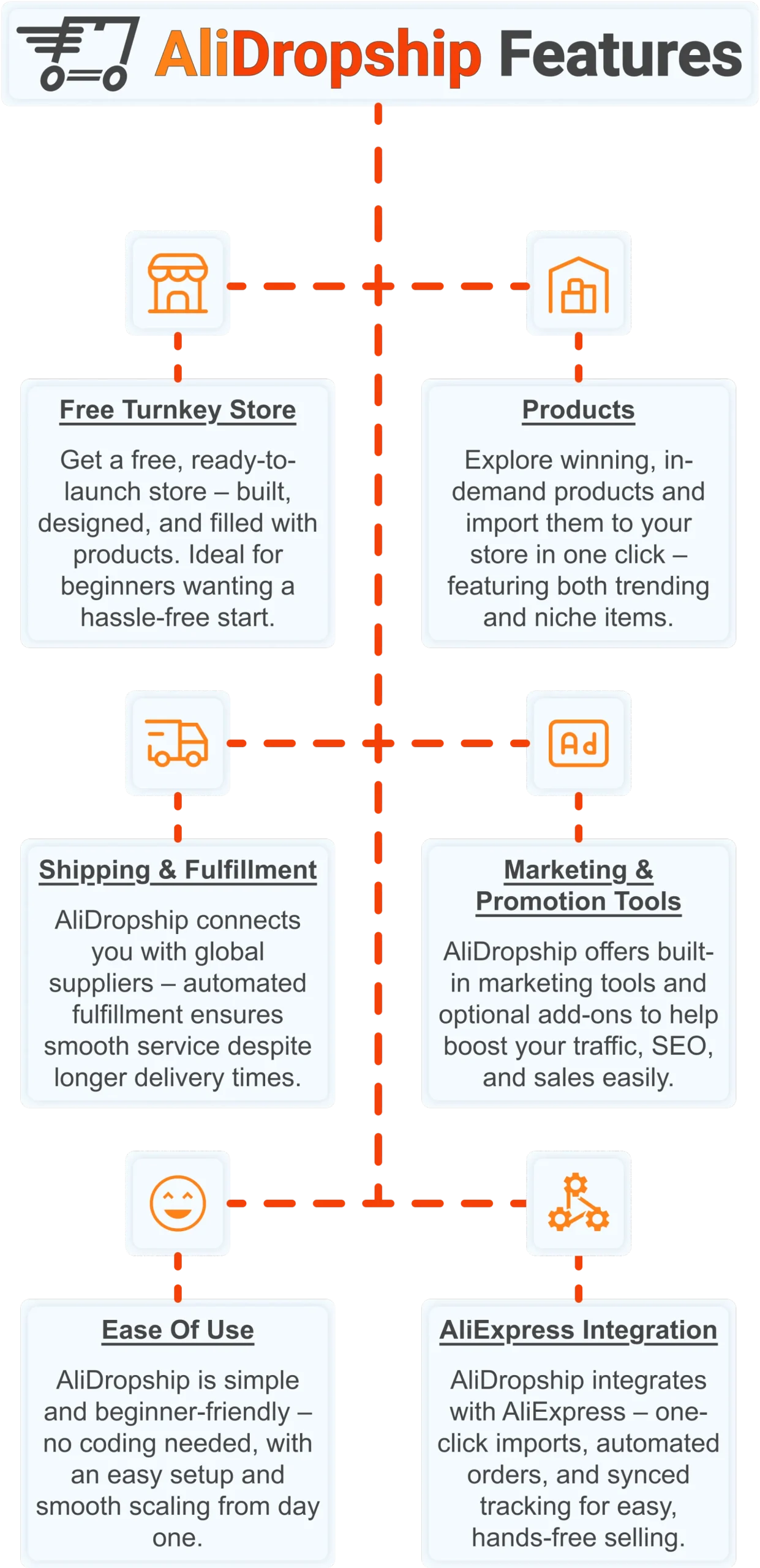
Free turnkey store ️
Get a free turnkey store – built, designed, and filled with products. Ideal for beginners wanting a hassle-free start, the store comes fully optimized to attract customers right away, saving you time on setup. Plus, it includes professional design elements to give your business a polished, trustworthy look from day one. This ready-made foundation makes it easy to move seamlessly into product selection.
Products
Once your store is set up, you can explore winning, in-demand products and import them in one click – featuring both trending and niche items. This wide selection lets you cater to diverse customer interests and test what works best. Regular updates ensure you always have fresh products, keeping your store competitive and relevant. With great products in place, smooth shipping becomes the next essential step.
Shipping & fulfillment
AliDropship connects you with global suppliers, and automated fulfillment ensures seamless order processing despite international delivery times. Customers receive real-time tracking updates, which builds confidence and trust in your store. Once shipping is handled reliably, you can focus on promoting your store and attracting traffic.
Marketing & promotion tools
To maximize sales, AliDropship offers built-in marketing tools and optional add-ons that help boost traffic, SEO, and conversions. From email campaigns and discounts to social media integration, these tools empower you to reach and retain customers without needing prior marketing experience. With promotion strategies in place, managing your business becomes simpler and more efficient.
Ease of use
AliDropship is beginner-friendly – no coding needed, with an intuitive dashboard that guides you through every step. Easy setup and smooth scaling let you expand your store without stress. As your business grows, adding new features, products, and marketing campaigns remains hassle-free, giving you more time to focus on sales.
AliExpress integration
Finally, AliDropship integrates seamlessly with AliExpress, enabling one-click imports, automated orders, and synced tracking. Your inventory stays up-to-date with the latest products and prices, while automated order processing frees you from manual tasks. Combined with the turnkey setup, reliable shipping, and built-in marketing tools, this integration ensures your dropshipping business is fully equipped for growth and success.
All the popular items to sell are out there waiting – what you need now is a store ready to move them. Get your free turnkey dropshipping store and start selling today.
Frequently asked questions
What are the most popular items to sell online in 2026?
The top categories include home decor, beauty and skincare, health and wellness gadgets, pet products, smart electronics, and eco-friendly goods. These niches combine high demand, strong margins, and real repeat purchase potential. The global dropshipping market is on track to surpass 500 billion dollars this year. Winning products typically ship without driving up costs and are difficult to find in local stores.
How much money can you make selling popular dropshipping items?
Beginners selling high-demand products with a properly set-up store can realistically earn 500 to 2,000 dollars per month within their first 60 to 90 days. Niche authority stores focused on categories like pet products or home decor can reach 2,000 to 15,000 dollars per month within 3 to 6 months. High-ticket dropshipping in electronics or furniture can generate 5,000 to 50,000 dollars or more per month, with margins often reaching 30 to 50 percent on products priced above 200 dollars. Experienced sellers who have identified winning products can reach 10,000 to 50,000 dollars or more per month.
What home decor products sell best for dropshipping?
Aesthetic room decor like LED strip lights, neon signs, and ambient lighting accessories consistently rank among the top sellers on AliExpress and TikTok Shopping. These items typically carry margins of 60 to 75 percent on products priced between 20 and 60 dollars. A focused home decor store can generate 800 to 6,000 dollars per month with 3 to 5 months of consistent traffic building and a catalog of 20 to 40 curated products. Functional home gadgets that solve a real household problem tend to have low return rates and strong repeat purchases.
How do you find winning dropshipping products before they saturate?
Use Google Trends alongside social signals to confirm whether interest in a product is rising or declining before committing to it. Mine AliExpress bestseller data for products with 1,000 or more orders and strong recent ratings. Track TikTok and Instagram trends, since over 60 percent of consumers discovered new products through short-form video in 2024. Validate with a small test budget of 10 to 20 dollars per day for 5 to 7 days before scaling ad spend on any single product.
What beauty and skincare products are trending for dropshipping in 2026?
At-home beauty devices like gua sha stones, LED face masks, and microneedling rollers carry average selling prices of 30 to 80 dollars and perform exceptionally well in video content. Natural and clean beauty products, including plant-extract serums and organic face oils, sell for 20 to 35 dollars with gross margins comfortably above 80 percent in many cases. The global beauty industry is valued at over 758 billion dollars, giving dropshippers a large addressable market. A focused beauty store can generate 1,500 to 8,000 dollars per month with 3 to 6 months of consistent traffic building.
 Previous post
