 ‧ Agnes Kazaryan ‧
March 21, 2026
‧ Agnes Kazaryan ‧
March 21, 2026  648 ‧
648 ‧
 0
0
So you are looking for ideas for online businesses – but you are tired of lists stuffed with vague “just start a blog!” advice that does not tell you what anything actually pays. Fair enough. In 2026, global ecommerce is projected to surpass $6.8 trillion, and real people are building real income from home-based digital ventures. The question is not whether online business works. It is which model fits where you are right now.
This guide gives you 17 legitimate online business models with honest earning ranges, effort levels, and enough context to make an informed decision – not just get excited and stall.
Quick Answer: The best ideas for online businesses in 2026 include dropshipping, freelancing, digital products, affiliate marketing, and content creation. Dropshipping is the strongest starting point for most beginners – no inventory, low startup cost, and realistic earnings of $500–$3,000/month within 60–90 days with consistent effort.
What is an online business and why does it matter in 2026?
An online business is any venture where the core operations – selling, delivering, communicating, and earning – happen over the internet. That covers everything from a one-person freelancing operation to a fully automated dropshipping store serving customers across multiple continents.
What makes 2026 different from even five years ago is the infrastructure. Payment processors, logistics networks, AI tools, and no-code platforms have matured to the point where you can launch a functioning online business in a single weekend. The barriers that once kept people out – technical skill, startup capital, physical location – have largely collapsed.
That said, “easy to start” does not mean “guaranteed to succeed.” Every model on this list requires real work and smart decisions. What separates people who build sustainable income from those who quit after 30 days is usually choosing the right model for their situation – then sticking with it long enough to see results.
Why this works in 2026: Consumer trust in online shopping and digital services has never been higher. Mobile commerce alone accounts for over 60% of global online transactions, creating a massive addressable market for new entrepreneurs starting from scratch.
How much can you realistically earn from an online business?
Income potential varies dramatically depending on the model, your time investment, and how quickly you learn from early mistakes. Here is an honest comparison of the most popular ideas for online businesses:
These figures reflect real ranges reported by entrepreneurs across Reddit, Trustpilot, and verified income reports – not headline-grabbing outliers. Most beginners land in the lower third of each range during the first 60–90 days, then grow from there with consistency and iteration.
One note on the upper figures: The higher end of each range represents full-time operators who have been running their business for 6–18 months. Reaching $5,000/month in dropshipping, for example, typically requires 3–6 months of active product testing, store optimization, and traffic building. The models that scale best – dropshipping, digital products, affiliate marketing – share one trait: once the system works, income can grow without proportionally increasing your hours.
Ecommerce and product-based online business ideas
1. Dropshipping
Dropshipping is one of the most beginner-accessible ideas for online businesses because you never hold inventory. You set up an online store, list products from a supplier, and when a customer buys, the supplier ships directly to them. Your profit is the difference between what you charge and what the supplier charges you.
The model works especially well in 2026 because tools like AliDropship have automated most of the friction – product importing, order processing, inventory syncing – that used to make dropshipping time-intensive. A well-chosen niche with consistent demand can generate $30–$80/day within the first 60–90 days of launch.
Earning potential: $500–$5,000+/month depending on niche, ad spend, and product selection.
2. Print-on-demand
Print-on-demand (POD) works like dropshipping but for custom-designed products – t-shirts, mugs, phone cases, wall art. You create or source designs, upload them to a platform like Printful or Printify, and they handle production and fulfillment when orders come in. No stock, no upfront investment.
The challenge with POD is that margins are thinner than standard dropshipping, and design quality matters a great deal. Stores focused on specific communities – pet owners, nurses, gamers, hobby niches – consistently outperform generic shops. Expect to earn $10–$40/day once you find designs that resonate with a real audience.
Earning potential: $200–$1,500/month for part-time operators; more with strong social traffic.
3. Selling handmade or vintage goods
If you make physical products – candles, jewelry, ceramics, clothing – or source vintage items, platforms like Etsy and Depop give you a built-in audience of buyers who actively search for unique goods. This model is more labor-intensive than digital options but carries strong margins and loyal repeat customers.
The key is treating it like a business from day one: professional photography, keyword-optimized listings, and consistent production output. Sellers who manage 20–50 active listings typically earn more than those with fewer, simply because of search visibility and surface area across the marketplace.
Earning potential: $300–$2,500/month depending on product type, pricing, and volume.
4. Amazon FBA
With Amazon FBA (Fulfillment by Amazon), you source products from wholesale suppliers or manufacturers, ship them to Amazon’s warehouses, and Amazon handles storage, packing, and delivery. You benefit from Amazon’s massive customer base and Prime shipping speeds.
The barrier is higher than dropshipping: you need startup capital ($1,000–$3,000 minimum) to purchase inventory, and competition on popular product categories is fierce. The upside is that FBA businesses are highly scalable and can be sold for significant multiples once they are established and generating consistent revenue.
Earning potential: $1,000–$8,000/month for experienced sellers; lower during the first 6 months while finding product-market fit.
Service-based online business ideas
5. Freelancing
Freelancing – offering skills like writing, design, development, video editing, or social media management to paying clients – is the fastest path to online income for most people. If you already have a marketable skill, you can be earning within days on platforms like Upwork, Fiverr, or Toptal.
How to get started with freelancing
Build a portfolio of 3–5 sample projects (even if unpaid initially), create a clean profile on two or three freelance platforms, and start with competitive pricing to earn your first reviews. Once you have 10–20 completed jobs and solid ratings, you can increase rates significantly. Many freelancers move from $15/hour to $60–$100/hour within 12–18 months by specializing in a high-value niche and building a reputation around it.
Earning potential: $800–$6,000/month for full-time freelancers, depending on skill and specialization.
6. Virtual assistant services
Virtual assistants (VAs) handle administrative, operational, and creative tasks for business owners remotely. Common services include email management, calendar scheduling, customer support, data entry, social media posting, and research. It is one of the most accessible ideas for online businesses because it requires general organizational skills rather than a specialized technical background.
Entry-level VAs typically charge $12–$20/hour; experienced VAs with specialized skills – bookkeeping, launch management, CRM setup – can charge $35–$65/hour. Most successful VAs work with 3–5 ongoing clients simultaneously, which creates stable monthly income without the feast-or-famine cycle that solo freelancers often experience.
Earning potential: $600–$3,500/month for part-time to full-time VA work.
7. Online tutoring and teaching
If you have expertise in an academic subject, a language, a musical instrument, or a professional skill, online tutoring is a direct path to consistent income. Platforms like Preply, Wyzant, and Cambly connect tutors with students globally, while tools like Zoom make one-on-one sessions seamless from anywhere in the world.
The earning curve is tied closely to your reviews and specialization. ESL (English as a Second Language) tutors are in extremely high demand and can book 20–30 hours per week within a few months on established platforms. Tutors in STEM subjects often charge $40–$80/hour once they have established strong profiles and positive ratings.
Earning potential: $400–$2,000/month for part-time; $2,000–$5,000/month for full-time specialists.
8. Consulting and coaching
If you have professional experience – in marketing, finance, HR, operations, fitness, nutrition, or any other field – you can package that knowledge as consulting or coaching and charge premium rates. Unlike freelancing, which typically means doing the work yourself, consulting means advising clients on strategy and implementation.
Business coaches and marketing consultants typically charge $150–$500/hour or structure their services as monthly retainers of $1,000–$3,000. The challenge is positioning: you need a clear niche, credible case studies, and a consistent lead generation channel – usually LinkedIn, content marketing, or referrals from satisfied clients.
Earning potential: $2,000–$10,000+/month for established consultants with a defined niche and a working lead pipeline.
Content and digital product online business ideas
9. Affiliate marketing
Affiliate marketing means earning commissions by promoting other companies’ products. When someone clicks your unique link and makes a purchase, you earn a percentage – usually 3–30% depending on the product category. Amazon Associates, ShareASale, and individual brand affiliate programs are the most common entry points.
The key to sustainable affiliate income is building an audience first – through a blog, YouTube channel, newsletter, or social media – and then recommending products that genuinely serve that audience. Thin “review” sites stuffed with keywords no longer rank well. Google’s algorithm in 2026 rewards real expertise and original content, so the days of easy affiliate income from low-quality pages are largely over.
Earning potential: $200–$3,000+/month; high-commission niches like software, finance, and travel can go significantly higher with the right content strategy.
10. Blogging and content publishing
Blogging as a business model combines several revenue streams: display advertising (via Mediavine or Raptive), affiliate marketing, sponsored content, and selling your own products or services. A well-established niche blog can generate passive income for years from a single well-ranking article.
The honest timeline: most blogs do not see meaningful traffic until month 6–12. After 12–18 months of consistent, quality content, blogs in focused niches typically earn $500–$3,000/month. Tightly focused niche sites often earn more with less traffic because they attract buyers rather than casual browsers who never convert.
Earning potential: $200–$5,000+/month after 12–24 months of consistent effort and content investment.
11. YouTube channel
YouTube combines the scale of content marketing with the trust of video. Channels monetize through AdSense (requires 1,000 subscribers and 4,000 watch hours), sponsorships, affiliate links, merchandise, and memberships. Educational, product review, and how-to channels perform especially well because they attract intent-driven viewers who are already looking for guidance.
Channel growth is gradual but compounding. Most creators do not earn meaningful revenue from AdSense alone until they reach 10,000–50,000 subscribers. Sponsorships and affiliate income, however, can begin much earlier if you are in a product-heavy niche. Finance, tech, fitness, and business channels tend to have the highest revenue per thousand views.
Earning potential: $100–$2,500+/month from AdSense alone; substantially more with diversified monetization including brand deals and digital products.
12. Selling digital products
Digital products – ebooks, templates, courses, Lightroom presets, Notion dashboards, stock photos, fonts – are among the highest-margin products you can sell online. You create them once and sell them indefinitely with no fulfillment cost per unit. Platforms like Gumroad, Etsy (for digital files), and Teachable handle the delivery automatically.
The challenge is discoverability. Without an existing audience or strong SEO, a digital product launch rarely succeeds. The most reliable approach is to build an audience first – even a small email list of 500–1,000 engaged subscribers – and launch to them before relying on organic search or marketplace traffic to carry the load.
Earning potential: $300–$4,000+/month once distribution is established; product bundles and upsells increase average order value significantly.
13. Online courses and memberships
If you can teach a skill or share specialized knowledge, online courses are one of the most scalable products available. A single course sold at $97–$297 to a warm audience of a few hundred people can generate $10,000–$50,000 in a launch week. Ongoing membership sites create predictable monthly recurring revenue.
The key distinction between a course that sells and one that does not is transformation – the clearer the before-and-after result you can demonstrate, the more persuasive your marketing becomes. Platforms like Kajabi and Teachable have made the technical side very manageable even for non-developers with no coding background.
Earning potential: $1,000–$10,000+/month for course creators with an established audience and a proven curriculum.
Tech and automation-based online business ideas
14. No-code apps and SaaS tools
No-code platforms like Bubble, Glide, and Webflow have made it possible to build functional web applications and software products without writing a single line of code. Entrepreneurs are using these tools to create niche SaaS products – project management tools for specific industries, booking systems, client portals – and charge monthly subscription fees for access.
This model has high upside but also high complexity. Finding a genuine pain point that people will pay to solve, then validating it before building, is the work most first-timers skip. The entrepreneurs who succeed here do heavy customer discovery before writing – or prompting AI to write – a single feature or screen.
Earning potential: $500–$10,000+/month for established SaaS products with a base of paying monthly subscribers.
15. AI-powered services
AI tools have created an entirely new category of online businesses in 2025–2026. Entrepreneurs are packaging AI capabilities into specialized services: AI-generated ad copy for specific industries, automated SEO audits, AI-assisted video editing, and chatbot development for small businesses. The business model is essentially AI combined with human judgment and good presentation – clients pay for the output, not the underlying tool.
Entry-level AI service providers earn $500–$2,000/month, while those who build proprietary workflows and target high-value clients – agencies, SaaS companies, ecommerce brands – can earn significantly more. The competitive window for undifferentiated AI services is narrowing fast, so specialization matters more than it did even 12 months ago.
Earning potential: $800–$5,000+/month depending on specialization and the quality of clients you are able to attract and retain.
16. Web design and development
Demand for web design and development has not slowed despite the rise of website builders. Businesses still want custom, fast-loading, conversion-optimized sites, and they are willing to pay $1,500–$8,000+ for a professional build. Developers who add strategy – not just code – command even higher project fees and ongoing retainers.
No-code tools like Webflow have lowered the skill floor, meaning designers without traditional coding skills can build high-quality sites. The most profitable freelance web businesses focus on a specific industry vertical – restaurants, therapists, ecommerce brands, real estate agents – rather than taking any job that walks through the door.
Earning potential: $2,000–$8,000/month for established web designers with a focused niche and a steady referral pipeline.
17. Social media management
Businesses of every size need consistent social media presence but often lack the time or expertise to manage it in-house. Social media managers handle content creation, scheduling, community management, and analytics for clients – typically on monthly retainers ranging from $500 to $2,500 per client.
Managing 4–6 clients simultaneously is realistic for a full-time social media manager, putting monthly income in the $3,000–$10,000 range. The highest earners tend to specialize in a single platform – TikTok, LinkedIn, Instagram – or a specific industry, rather than offering a generic “we do everything” service that is hard to price and harder to deliver at quality.
Earning potential: $1,500–$6,000/month for full-time social media managers with 4–6 solid retainer clients.
Legal and ethical considerations for online businesses
Starting an online business does not exempt you from legal obligations or ethical standards. In fact, the low barriers to entry in digital entrepreneurship mean that cutting corners is tempting – and more visible than ever to customers, regulators, and the platforms you depend on.
Here are the most important areas to get right from the start.
Business registration: Depending on your country and structure, you may need to register as a sole trader, LLC, or limited company. In the US, most online entrepreneurs start as sole proprietors and upgrade to an LLC once they are earning consistently. Check your local requirements before making your first sale.
Tax obligations: Online income is taxable income. Keep records of every transaction from day one. In the US, the self-employment tax rate is 15.3% on net earnings, plus income tax. Many countries require quarterly estimated payments once you exceed a specific income threshold – do not wait until year-end to figure this out.
Platform terms of service: Whether you are on Etsy, Upwork, Amazon, or Google, violating platform TOS can result in account bans that are extremely difficult to recover from. Read the rules carefully – especially around review solicitation, prohibited content, and advertising policies.
Consumer protection: If you sell products or services, you are subject to consumer protection laws in the countries you sell to. State your refund policies, delivery timelines, and contact information clearly on your store or website from day one.
Key principle: Build your online business the same way you would want a business to treat you as a customer – transparently, reliably, and with clear communication at every step.
Important: Fake reviews, review manipulation, and misleading income claims are not just unethical – they violate platform policies, FTC guidelines, and consumer protection laws in most jurisdictions.
How to choose the right online business idea for you
With 17 options in front of you, the real risk is paralysis. Here is how to cut through it by matching models to where you actually are right now.
Complete beginners
If you have no prior business experience, limited capital, and are still learning the basics, start with either dropshipping or freelancing. Dropshipping gives you a business model that does not require you to sell your time, while freelancing lets you earn quickly using skills you already have. Both have substantial learning resources, active communities, and low financial risk. A platform like AliDropship can get a complete beginner running a dropshipping store in a single weekend with their turnkey store option.
Intermediate / part-time operators
If you already have some online income or business experience and want to build something more scalable, look at affiliate marketing, digital products, or expanding a dropshipping store into a real brand. These models reward the content and SEO skills you have likely developed, and they can run alongside existing income streams during the growth phase.
Advanced / full-time goal
If you are serious about replacing a full-time salary within 12–18 months, the highest-ceiling models are consulting, online courses, SaaS, and a well-branded ecommerce store. Each requires significant upfront investment of time and – in some cases – capital, but all have documented six-figure annual income potential for operators who commit fully and treat it like a real business from the start.
Whatever your starting point, the most important thing is choosing one model, committing to it for at least 90 days, and measuring results honestly before deciding to pivot or double down. The biggest mistake new online entrepreneurs make is jumping between ideas before any single one has had time to gain traction.
AliDropship: Your complete all-in-one solution for starting dropshipping in 2026
If you want the simplest possible way to start dropshipping – especially if you’re brand new – AliDropship remains one of the most beginner-friendly tools available in 2026. It brings together store creation, product imports, automation, and marketing into a single streamlined system designed to help you launch quickly and grow confidently.
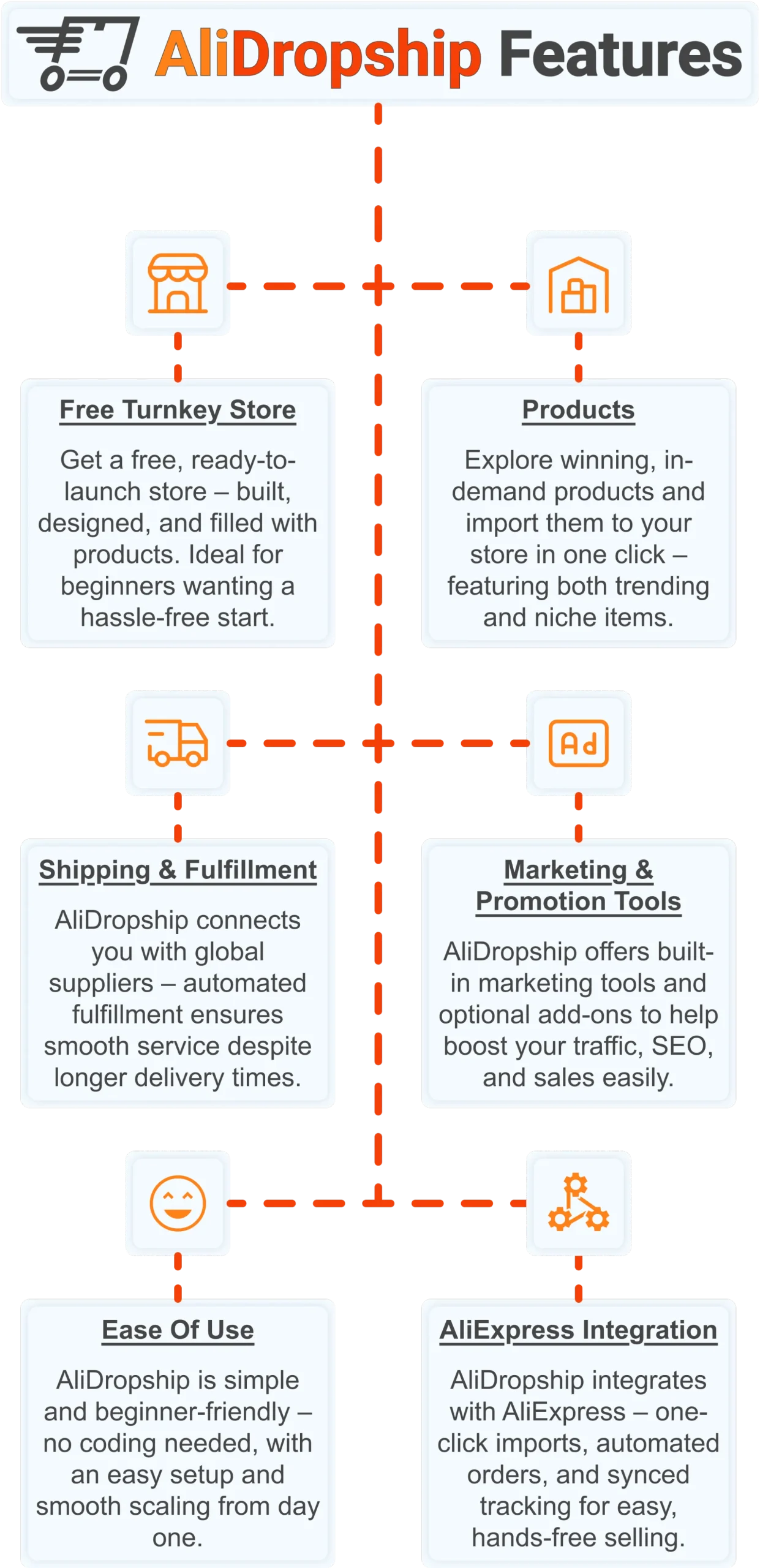
Free turnkey store ️
Get a free turnkey store – built, designed, and filled with products. Ideal for beginners wanting a hassle-free start, the store comes fully optimized to attract customers right away, saving you time on setup. Plus, it includes professional design elements to give your business a polished, trustworthy look from day one. This ready-made foundation makes it easy to move seamlessly into product selection.
Products
Once your store is set up, you can explore winning, in-demand products and import them in one click – featuring both trending and niche items. This wide selection lets you cater to diverse customer interests and test what works best. Regular updates ensure you always have fresh products, keeping your store competitive and relevant. With great products in place, smooth shipping becomes the next essential step.
Shipping & fulfillment
AliDropship connects you with global suppliers, and automated fulfillment ensures seamless order processing despite international delivery times. Customers receive real-time tracking updates, which builds confidence and trust in your store. Once shipping is handled reliably, you can focus on promoting your store and attracting traffic.
Marketing & promotion tools
To maximize sales, AliDropship offers built-in marketing tools and optional add-ons that help boost traffic, SEO, and conversions. From email campaigns and discounts to social media integration, these tools empower you to reach and retain customers without needing prior marketing experience. With promotion strategies in place, managing your business becomes simpler and more efficient.
Ease of use
AliDropship is beginner-friendly – no coding needed, with an intuitive dashboard that guides you through every step. Easy setup and smooth scaling let you expand your store without stress. As your business grows, adding new features, products, and marketing campaigns remains hassle-free, giving you more time to focus on sales.
AliExpress integration
Finally, AliDropship integrates seamlessly with AliExpress, enabling one-click imports, automated orders, and synced tracking. Your inventory stays up-to-date with the latest products and prices, while automated order processing frees you from manual tasks. Combined with the turnkey setup, reliable shipping, and built-in marketing tools, this integration ensures your dropshipping business is fully equipped for growth and success.
Of all the ideas for online businesses covered in this guide, dropshipping with AliDropship stands out for its combination of low startup cost, automation, and real earning potential from day one. Get your free turnkey store today and start building income on your own terms.
Frequently asked questions
What are the best ideas for online businesses in 2026?
The best ideas for online businesses in 2026 include dropshipping, freelancing, digital products, affiliate marketing, and content creation. Dropshipping is the strongest starting point for most beginners, requiring no inventory and low startup cost with realistic earnings of 500 to 3000 dollars per month within 60 to 90 days. Global ecommerce is projected to surpass 6.8 trillion dollars in 2026, supporting a large addressable market for new entrepreneurs. Mobile commerce alone accounts for over 60 percent of global online transactions.
How much can you realistically earn from an online business in 2026?
Dropshipping offers monthly earning potential of 500 to 5000 dollars or more, while freelancing ranges from 800 to 6000 dollars depending on skill and specialization. Affiliate marketing typically earns 200 to 3000 dollars or more per month, and digital products can reach 300 to 4000 dollars or more once distribution is established. SaaS and no code apps carry the highest ceiling at 500 to 10000 dollars or more per month, though they require very high effort to build. Most beginners land in the lower third of each range during the first 60 to 90 days before growing with consistency.
How does dropshipping compare to Amazon FBA as an online business idea?
Dropshipping requires no inventory investment, since a supplier ships directly to the customer after an order is placed, with earning potential of 500 to 5000 dollars or more per month. Amazon FBA requires 1000 to 3000 dollars minimum in startup capital to purchase inventory that gets shipped to Amazon warehouses. FBA businesses can earn 1000 to 8000 dollars per month for experienced sellers, though earnings are typically lower during the first 6 months while finding product market fit. Dropshipping has a lower barrier to entry, while FBA benefits from Amazon massive customer base and Prime shipping speeds.
Which service based online business ideas pay the most?
Consulting and coaching carries the highest ceiling among service based ideas, with business coaches and marketing consultants charging 150 to 500 dollars per hour or structuring services as monthly retainers of 1000 to 3000 dollars. Freelancing offers 800 to 6000 dollars per month for full time freelancers, with many moving from 15 dollars per hour to 60 to 100 dollars per hour within 12 to 18 months through specialization. Web design and development can earn 2000 to 8000 dollars per month for established designers with a focused niche and steady referral pipeline. Online tutoring earns 400 to 2000 dollars per month part time, rising to 2000 to 5000 dollars per month for full time specialists.
What legal and tax obligations apply to running an online business?
Online income is taxable income, and in the US the self employment tax rate is 15.3 percent on net earnings, plus regular income tax. Many countries require quarterly estimated payments once income exceeds a specific threshold, so records should be kept from day one rather than waiting until year end. Violating platform terms of service on sites like Etsy, Upwork, or Amazon can result in account bans that are extremely difficult to recover from. Fake reviews, review manipulation, and misleading income claims violate platform policies, FTC guidelines, and consumer protection laws in most jurisdictions.
 Previous post
