 ‧ Agnes Kazaryan ‧
March 13, 2026
‧ Agnes Kazaryan ‧
March 13, 2026  1097 ‧
 0
0
If you are trying to pick between Shopify and Squarespace for your online store, you are not alone. These two platforms come up in almost every beginner comparison – and for good reason. Both are polished, both are beginner-friendly, and both promise to get you selling without hiring a developer.
But they were built for very different goals, and picking the wrong one can cost you months of momentum and hundreds of dollars in fees before you realize your mistake.
Quick Answer: Shopify is the stronger choice for dedicated ecommerce businesses focused on scaling sales and managing a large product catalog. Squarespace is the better fit for creative professionals, service providers, or small shops where selling is a secondary feature of a broader website.
This guide walks through both platforms honestly – pricing, features, ecommerce tools, and real limitations – so you can make a confident decision based on what you are actually trying to build.
Before we get into the detail, it helps to understand the origin of each platform, because that foundation shapes every comparison that follows. Shopify was purpose-built for ecommerce from day one. Squarespace started as a website builder and added commerce later. That single difference matters more than any feature list.
What is the Shopify vs Squarespace debate really about?
At its core, this comparison comes down to one question: are you building a brand website that also sells products, or are you building an ecommerce store that also needs to look good? Your honest answer to that question will point you clearly in one direction.
Shopify launched in 2006 after its founder wanted to sell snowboards online and could not find a platform adequate for the job. That origin story matters – the entire platform has always been optimized around the seller experience.
As of 2026, Shopify powers over 4.6 million live stores across 175 countries and processes hundreds of billions of dollars in annual sales volume. It is not a website builder that added a cart. It is an ecommerce engine that added a website.
Squarespace launched in 2004 as a drag-and-drop builder focused on design quality. Its ecommerce functionality – available through the Commerce plans – is genuinely capable for smaller operations. But it is layered on top of a platform that was originally designed for portfolios, blogs, and service businesses. For many sellers, that distinction starts to matter a lot once you try to scale.
Important note: Neither platform offers a free plan for ecommerce. Both require a paid subscription before you can accept a single payment from a customer – which factors directly into your cost-per-order calculation from the very first month.
What does each platform actually cost in 2026?
Pricing is usually the first comparison people make – and it is more nuanced than a simple monthly fee suggests. Both platforms charge differently based on your plan tier, your payment method, and whether you use their native payment processor or a third-party gateway. Here is a side-by-side breakdown of current plans and fees:
On the surface Squarespace looks cheaper – but the Business plan’s 3% transaction fee adds up fast at any meaningful sales volume. Shopify’s transaction fees only apply if you do not use Shopify Payments, which is available in the US, UK, Canada, Australia, and most of Europe. At scale, Shopify’s higher monthly base fee frequently works out cheaper per order than Squarespace’s lower headline price.
One note on true cost: App subscriptions are a real variable on Shopify. Many features that come built into Squarespace – like abandoned cart recovery – require paid Shopify apps. Budget an extra $20–$100/month for essential apps depending on your store setup, and factor that into your total platform cost before committing to either option.
Shopify – where it leads and where it falls short
Shopify is one of the most complete ecommerce platforms available today. If your primary goal is building and scaling an online store, it has very few weaknesses at the operational level. But it is not the right choice for every situation, and understanding its limitations is just as important as knowing what it does well.
Where Shopify leads
Ecommerce-first infrastructure
Shopify was built to sell. Its dashboard, inventory management, order processing, and checkout flow are all designed with high-volume selling in mind. You can manage thousands of SKUs, set up product variants, run discount campaigns, and handle returns without needing a single third-party plugin.
The checkout is widely considered the highest-converting in the industry – Shopify has invested heavily in checkout optimization because it directly impacts their own revenue model.
For dropshippers specifically, Shopify integrates natively with DSers (the official AliExpress dropshipping partner), as well as Zendrop, AutoDS, and dozens of other fulfillment tools. Setup time from store creation to first live product is typically under 24 hours for a basic storefront.
Why this works in 2026: Shopify’s checkout conversion improvements have been documented at scale – stores migrating to Shopify’s native checkout report meaningful lifts in completed purchases, which compounds significantly as traffic grows.
The app ecosystem
The Shopify App Store contains over 8,000 apps covering virtually every ecommerce use case – email marketing, upsells, loyalty programs, reviews, subscriptions, shipping calculators, SEO tools, and more. This modularity is one of the biggest selling points. You can start lean and add capabilities as your store grows without switching platforms or rebuilding from scratch.
The downside: relying on multiple apps inflates your monthly costs fast. It is not unusual for a moderately equipped Shopify store to carry $80–$150/month in app subscriptions on top of the base plan fee. Always model the full cost before committing.
Payment processing and checkout flexibility
Shopify Payments eliminates transaction fees entirely and provides a seamless native checkout experience. It accepts all major credit cards, Apple Pay, Google Pay, and Shop Pay – the platform’s own accelerated checkout.
For stores using third-party gateways like PayPal or Stripe, Shopify adds a 0.5%–2% transaction fee depending on your plan tier. Factor this into your margin calculations before launch, especially on higher-volume product categories.
Where Shopify falls short
Design flexibility has traditionally been a weak point relative to Squarespace. While the 2.0 theme architecture has improved significantly, creating a highly customized storefront still often requires a developer or a premium theme purchase. Free themes are functional but generic – standing out visually takes effort and usually extra money on top of your subscription.
Content marketing is another gap. The built-in blogging tool is basic compared to a dedicated CMS. If organic traffic from long-form content is central to your growth strategy, you will likely need workarounds or supplementary tools – none of which are free.
Squarespace – where it shines and where it struggles
Squarespace occupies a distinct space in this comparison. Its design quality is genuinely best-in-class for a DIY platform, and its all-in-one structure means fewer external tools to manage day to day. But its ecommerce capabilities have specific ceilings that matter once you start selling at any real volume.
Where Squarespace excels
Templates and visual design
Squarespace templates are consistently rated among the most polished in the website builder category. Every template is mobile-responsive, professionally designed, and deeply customizable through the visual editor. For photographers, designers, consultants, restaurants, and similar businesses, a Squarespace site can look genuinely premium without a single line of custom code.
The drag-and-drop editor is intuitive and forgiving. Rearranging sections, swapping fonts, adjusting spacing – all of this happens in real time with a clean visual interface. Design confidence is higher on Squarespace than on most competing platforms at the same price point, and the results consistently reflect that.
All-in-one tools included by default
Squarespace bundles email marketing, analytics, SEO tools, scheduling, and membership features into its plans at no extra cost. For a small business that wants a single dashboard managing the website, email list, and booking calendar simultaneously, Squarespace offers more out-of-the-box value than Shopify at an equivalent price tier.
The Commerce plans add abandoned cart recovery, product reviews, advanced shipping rules, and subscription selling without additional apps. For a simpler store setup with a limited product range, this can work out more cost-effective than assembling the same feature set on Shopify through individual app subscriptions.
Where Squarespace falls short for ecommerce
The biggest limitation is scalability. Squarespace works well for stores managing up to a few hundred SKUs. Once you start handling a large catalog, complex variants, or multiple supplier integrations, its inventory tools begin to show clear limitations compared to Shopify. There is no equivalent of the Shopify App Store – the Squarespace extension library is far smaller and far less specialized.
Dropshipping support on Squarespace is limited. While tools like Printful and Printify integrate with the platform, dedicated AliExpress dropshipping workflows – automated order routing, tracking sync, bulk product imports – are not well supported. If dropshipping is your primary business model, Shopify is clearly the more practical choice.
Important: Squarespace does not support selling in multiple currencies natively on its lower-tier plans. For stores targeting customers across several international markets, this is a significant operational constraint that can limit your growth ceiling early.
Shopify vs Squarespace – head-to-head feature comparison
Here is a direct side-by-side breakdown of the factors that matter most to online sellers in 2026:
The table makes the core trade-off clear: Shopify wins on ecommerce depth and scalability, while Squarespace wins on design quality and bundled tools. Neither wins outright on total cost – once you factor in apps, transaction fees, and plan upgrades, the real monthly number shifts significantly on both sides.
Things to watch out for on both platforms
Neither Shopify nor Squarespace is completely transparent about the full cost of running a live store, and both have practices worth knowing before you sign up.
On Shopify, the App Store model means you can end up paying $20–$50/month for individual features that competing platforms include by default – things like customer reviews, advanced upsells, or subscription management. These costs are not highlighted during sign-up, and they compound quickly as your store grows. Always audit your app subscriptions quarterly.
On Squarespace, the 3% transaction fee on the Business plan is one of the highest in the website builder category. At $10,000/month in sales – which is a realistic target for a growing store within 6–12 months of consistent effort – that fee alone adds up to $300/month on top of your platform subscription. Upgrading to Commerce Basic removes the fee but adds to the base cost.
Key principle: Always model the total monthly cost across platform fee, apps, transaction fees, and payment gateway charges before committing to either platform. The headline price is rarely the real price.
Both platforms also lock you into their ecosystems to varying degrees. Migrating a Shopify store to another platform requires exporting product data, customer records, and order history manually – a process that is possible but time-consuming at scale. Squarespace migrations are similarly involved. Switching platforms mid-growth is disruptive, so choosing correctly at the start saves significant time and money later.
Which platform is right for you?
The honest answer is that neither platform is universally better – the right choice depends on what you are actually trying to build. Here is a practical breakdown by reader type.
Complete beginner: If you are new to ecommerce and want to test the waters without committing to $300–$900 in annual platform fees upfront, both Shopify and Squarespace are more overhead than you need at day one.
A free turnkey store – already built, stocked, and optimized – removes the platform cost entirely and lets you focus on learning the business rather than paying to access it. That option is worth considering before you commit to either paid platform.
Intermediate / part-time: If you have validated a product idea and are ready to scale, Shopify is the stronger investment. Budget $29–$79/month for the base plan, plus $20–$60/month for essential apps, and expect to reach consistent daily sales within 60–90 days of focused traffic and product testing. Use Shopify Payments from the start to eliminate transaction fees.
Advanced / full-time goal: If you are building a full-scale ecommerce operation – multi-supplier, high-volume, international – Shopify is the clear choice. Squarespace hits operational ceilings at scale that Shopify was designed to push through. The higher monthly cost at the mid-tier and above is justified by the checkout performance, inventory depth, and integration ecosystem.
If you are a creative professional, service provider, or local business that wants to sell a handful of products alongside a portfolio or booking site, Squarespace is the smarter and more cost-effective option. The design quality is higher out of the box, the all-in-one tools reduce your software stack, and stores with under 50 products and no dropshipping requirements are genuinely well-served here.
AliDropship: Your complete all-in-one solution for starting dropshipping in 2026
If you want the simplest possible way to start dropshipping – especially if you’re brand new – AliDropship remains one of the most beginner-friendly tools available in 2026. It brings together store creation, product imports, automation, and marketing into a single streamlined system designed to help you launch quickly and grow confidently.
Free turnkey store ️
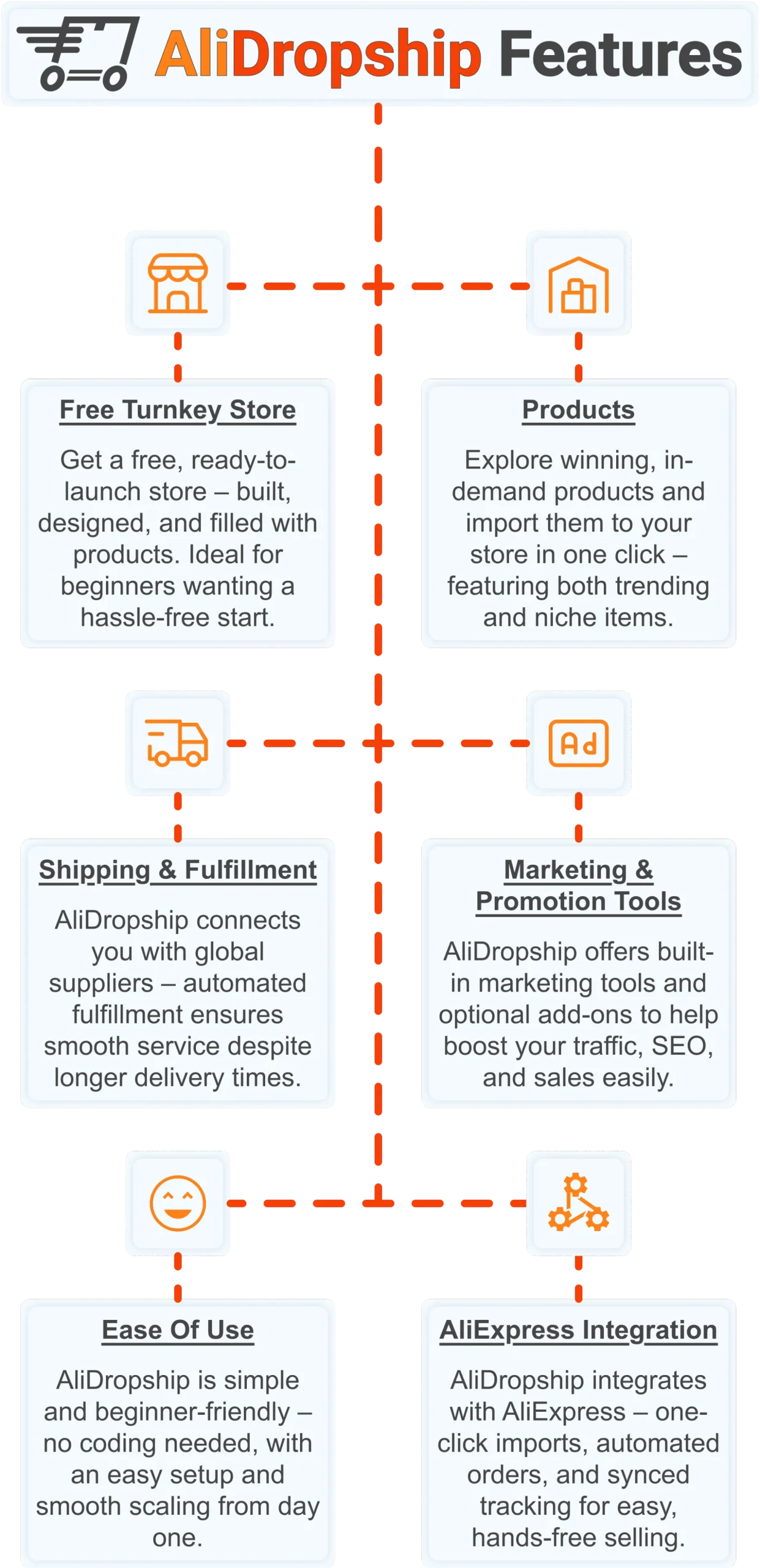
Get a free turnkey store – built, designed, and filled with products. Ideal for beginners wanting a hassle-free start, the store comes fully optimized to attract customers right away, saving you time on setup. Plus, it includes professional design elements to give your business a polished, trustworthy look from day one. This ready-made foundation makes it easy to move seamlessly into product selection.
Products
Once your store is set up, you can explore winning, in-demand products and import them in one click – featuring both trending and niche items. This wide selection lets you cater to diverse customer interests and test what works best. Regular updates ensure you always have fresh products, keeping your store competitive and relevant. With great products in place, smooth shipping becomes the next essential step.
Shipping & fulfillment
AliDropship connects you with global suppliers, and automated fulfillment ensures seamless order processing despite international delivery times. Customers receive real-time tracking updates, which builds confidence and trust in your store. Once shipping is handled reliably, you can focus on promoting your store and attracting traffic.
Marketing & promotion tools
To maximize sales, AliDropship offers built-in marketing tools and optional add-ons that help boost traffic, SEO, and conversions. From email campaigns and discounts to social media integration, these tools empower you to reach and retain customers without needing prior marketing experience. With promotion strategies in place, managing your business becomes simpler and more efficient.
Ease of use
AliDropship is beginner-friendly – no coding needed, with an intuitive dashboard that guides you through every step. Easy setup and smooth scaling let you expand your store without stress. As your business grows, adding new features, products, and marketing campaigns remains hassle-free, giving you more time to focus on sales.
AliExpress integration
Finally, AliDropship integrates seamlessly with AliExpress, enabling one-click imports, automated orders, and synced tracking. Your inventory stays up-to-date with the latest products and prices, while automated order processing frees you from manual tasks. Combined with the turnkey setup, reliable shipping, and built-in marketing tools, this integration ensures your dropshipping business is fully equipped for growth and success.
Frequently Asked Questions
What is the main difference between Shopify and Squarespace for ecommerce?
Shopify was purpose-built for ecommerce from day one, while Squarespace started as a website builder and added commerce later. As of 2026, Shopify powers over 4.6 million live stores across 175 countries, showing its scale as a dedicated selling platform. Squarespace remains genuinely capable for smaller operations but was originally designed for portfolios, blogs, and service businesses. This foundational difference shapes almost every other comparison between the two platforms.
How much does Shopify cost compared to Squarespace in 2026?
Shopify Basic costs 29 dollars per month with annual billing and a 2 percent transaction fee that is waived when using Shopify Payments. Squarespace Business costs 23 dollars per month but carries a 3 percent transaction fee on every sale, which adds up quickly at higher volume. At 10000 dollars per month in sales, that Squarespace fee alone equals 300 dollars on top of the platform subscription. Shopify also requires app subscriptions, often adding 20 to 100 dollars per month depending on store setup.
Is Shopify or Squarespace better for dropshipping?
Shopify integrates natively with DSers, the official AliExpress dropshipping partner, along with Zendrop, AutoDS, and dozens of other fulfillment tools. Setup time from store creation to a live first product is typically under 24 hours on Shopify. Squarespace dropshipping support is limited, since automated order routing, tracking sync, and bulk product imports are not well supported. For sellers whose primary business model is dropshipping, Shopify is clearly the more practical platform.
What are the biggest limitations of using Squarespace for ecommerce?
Squarespace works well for stores managing up to a few hundred SKUs, but its inventory tools show clear limitations once a catalog grows larger or requires multiple supplier integrations. There is no equivalent of the Shopify App Store, since the Squarespace extension library is far smaller and less specialized. Squarespace also does not support selling in multiple currencies natively on its lower-tier plans, which limits growth for international sellers. These constraints make it a better fit for stores with under 50 products rather than large-scale operations.
How many apps does the Shopify App Store offer compared to Squarespace?
The Shopify App Store contains over 8000 apps covering use cases like email marketing, upsells, loyalty programs, reviews, subscriptions, and SEO tools. This modularity lets sellers start lean and add capabilities as their store grows without rebuilding from scratch. However, a moderately equipped Shopify store can carry 80 to 150 dollars per month in app subscriptions on top of the base plan fee. Squarespace, by comparison, bundles many of these tools directly into its plans at no extra cost, but its extension library remains far more limited.
While Shopify and Squarespace both charge monthly fees before you earn your first dollar, AliDropship lets you launch a fully stocked ecommerce store for free – with a $100 voucher included to jumpstart your growth. Claim your free turnkey store today and start building income without the platform overhead.
 Previous post
